Applying The Scientific Method to Genealogical Research (Part 2)

I started off this series with a description of The Scientific Method and posed two questions .  When should a genealogist apply The Scientific Method to a genealogical research problem?  How does one go about doing so?  What follows is a description of how my cousin and I used the scientific method to answer a question about our own family:  Where is our Aunt Bertha Danko buried?

  1. Define the question:  Where is Bertha Danko buried?
  2. Gather information and resources:  Family members related that Bertha Danko is buried in an unmarked grave in Hope Cemetery, Worcester, Massachusetts .  She died as an infant in Worcester, Massachusetts probably sometime between 1910-1915.
  3. Form hypothesis:  Bertha Danko is buried in an unmarked grave in Hope Cemetery, Worcester, Massachusetts.
  4. Perform experiment and collect data:  Joseph Danko went to Hope Cemetery and asked for burial information and grave location for Bertha Danko.
  5. Analyze data:  Records for Hope Cemetery include no information on anyone with the surname Danko.
  6. Interpret data and draw conclusions:  Either Bertha Danko is not buried in Hope Cemetery, there is an error or omission in the cemetery records, or the clerk at the cemetery did not conduct an accurate and thorough search.
  7. Publish results:  Information was communicated to other family members.
  8. Retest (frequently done by others):  Several years after Joseph Danko went to Hope Cemetery, Stephen Danko visited the same cemetery and inquired about the burial information and grave location for Bertha Danko .  The results, interpretation, and conclusions were the same as reported by Joseph Danko.

It’s not difficult to define the question .  Genealogists generally have an infinite supply of questions they want answered:  When was John Smith born?  Who are his parents?  When did he come to this country?  What was his occupation?

But, when can a researcher apply The Scientific Method to help answer a genealogical question?  The answer is simple .  The Scientific Method can be applied to any genealogical research problem for which the researcher can develop a testable hypothesis .  First, one needs to have some information and resources from which to form the hypothesis .  This information may be in the form of some anecdotal evidence, in the form of primary information obtained from an original source, or in the form of any one of many other sources .  The hypothesis should be expressed as a statement of fact, so that one may later determine whether or not the results support or refute the statement.

When one performs the experiment and collects the data in a genealogical study, one doesn’t generally go into a laboratory and conduct an experiment on the laboratory bench top .  The experiment in a genealogical sense is usually a search of the relevant records, although other methods such as interviews or mathematical calculations may also be appropriate .  The genealogist then analyzes the information obtained, interprets the information, and draws conclusions from the information.

The results should be published, even if only to other family members, so that others can determine whether the information obtained justify the conclusions .  Other genealogists may wish to retest the hypothesis using the same or different approaches.

Well, in the example above, the result was negative .  We did not answer the initial question and it appears that the hypothesis may be false .  Part 3 of this series will examine the formation of a new hypothesis and beginning a new iteration of The Scientific Method.

For other posts in this series, please see:

Copyright © 2010 by Stephen J. Danko
Posted in Dańko, Dziurzyński | Tagged | Comments Off on Applying The Scientific Method to Genealogical Research (Part 2)

Applying The Scientific Method to Genealogical Research (Part 1)

Kimberly Powell described genealogy as “North America’s Fastest Growing Hobby.”  While that is probably true, I personally consider genealogy to be more than just a hobby .  When considered as an academic discipline, genealogy is generally classified with the humanities (studies of the human condition) .  Academic studies in the humanities often rely on observation, analysis, and speculation to achieve their goals and, indeed, genealogy appears to fall into that category.

Still, from time to time there arises the question of whether some aspects of genealogy could also be considered to be a scientific discipline, where research relies on empirical evidence such as that derived from experimentation .  If so, when would a genealogist devise an experiment to solve a genealogical problem, and how would the genealogist construct the experiment?

I don’t think that genealogy qualifies to be called a scientific discipline .  There are, however, aspects of genealogical research that seem to be amenable to experimentation and The Scientific Method.

As a PhD scientist with many years of experience conducting bench-level experimentation, I use The Scientific Method in my daily work (and here I have capitalized The Scientific Method to make clear the fact that I’m referring to the set of steps commonly known by that name and not just a methodology that is scientific in nature) .  The Scientific Method is most easily understood in the context of the pure sciences where one conducts laboratory experiments to test hypotheses .  However, there is nothing in The Scientific Method that precludes its use in other disciplines.

The Scientific Method has been outlined and described in many different ways .  One of those that I find particularly useful reads as follows:

  1. Define the question
  2. Gather information and resources (observe)
  3. Form hypothesis
  4. Perform experiment and collect data
  5. Analyze data
  6. Interpret data and draw conclusions (that may serve as a starting point for new hypothesis)
  7. Publish results
  8. Retest (frequently done by others)

When, by step 6, the researcher determines that the conclusions are unable to answer the question defined in step 1, the method loops back to step 2 to gather more information and resources or to step 3 with a new hypothesis.

So when should a genealogist apply The Scientific Method to a genealogical research problem and how does one go about doing so?

Part 2 of this series will begin a look at an example from my own research that I think demonstrates the use of The Scientific Method very well.

For other posts in this series, please see:

Copyright © 2010 by Stephen J. Danko
Posted in Dańko, Dziurzyński | Tagged | 1 Comment

In Trouble with the Law (Part 18 of 18)

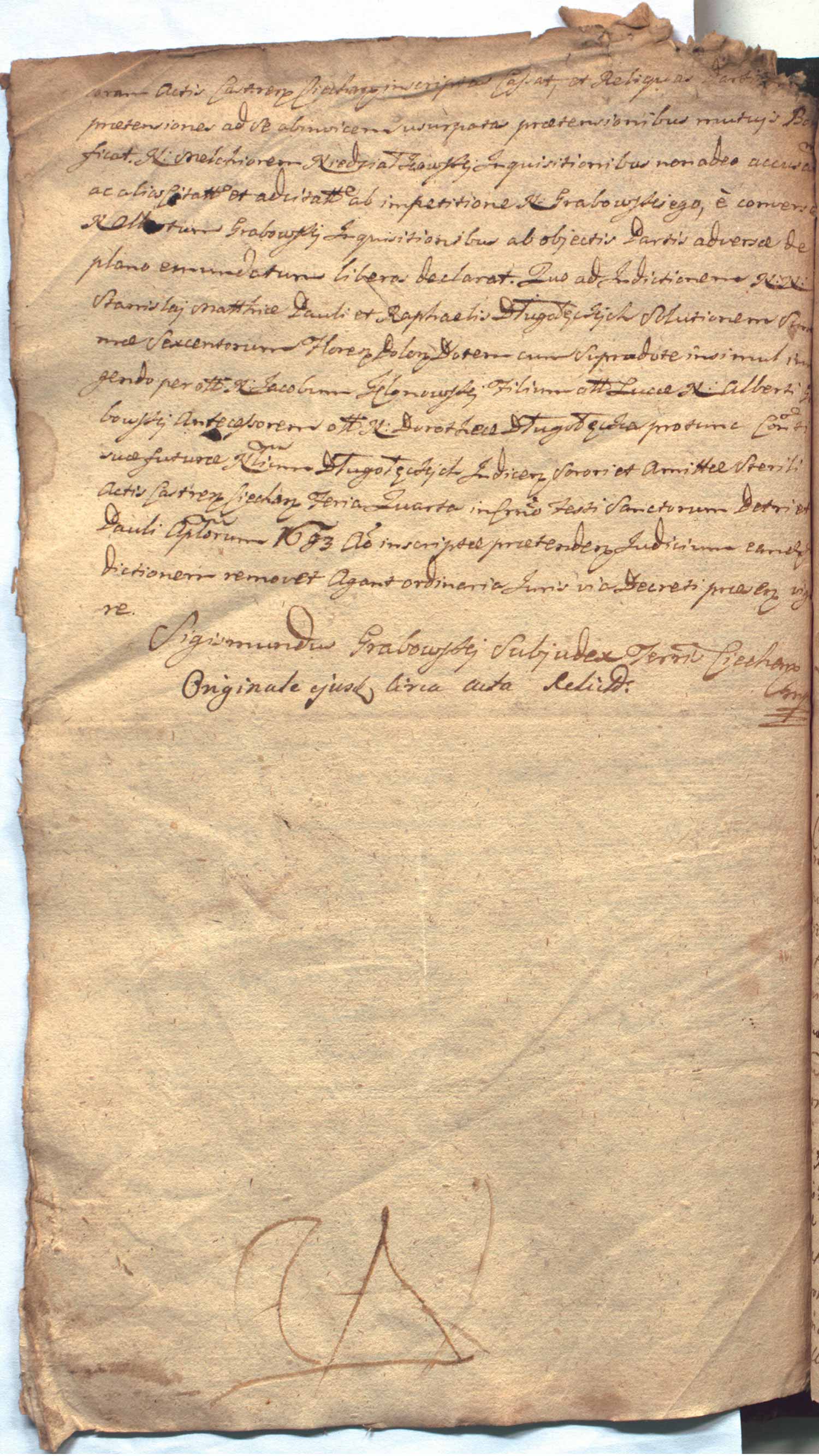
Continuing with the court record of the case of Grabowski v. Niedziałkowski, let’s examine the eighteenth and final page of the record: “Ciechanowskie Grodzkie Wieczyste”, sygn.107, k.59v.

“Ciechanowskie Grodzkie Wieczyste”, sygn.107, k.59v

“Ciechanowskie Grodzkie Wieczyste”, sygn.107, k.59v

SOURCE: Klonowo, Polish-Lithuanian Commonwealth, “Ciechanowskie Grodzkie Wieczyste,” sygn.107, k.59v, Grabowski v. Niedziałkowski, 1756; Archiwum Główne Akt Dawnych w Warszawie, Warsaw, Poland.

Translated from Latin to Polish, and then from Polish to English, the record states:

… Now, all parties apologize and promise in the records before the Ciechanów district court, to erase their grievances and usurpation. Melchior Niedziałkowski withdraws his claims against Grabowski and Grabowski withdraws his claims against everyone around him. There remains, for further investigation thorough an ordinary court, the matter of repaying Stanisław, Maciej, Paweł, and Rafał Długołęcki the sum of 600 florins owed them for the dowry recorded by Jakub Klonowski, son of the deceased Lukasz and the ancestor of Wojciech Grabowski, for the deceased Dorota Dlugołęcka, at that time his future wife and the childless sister and aunt of those same Długołęckis, recorded in the municipal records of Ciechanów on Wednesday, the day after the Feast of the Apostles Peter and Paul in the year 1683.

For other parts of this record, see:

Copyright © 2010 by Stephen J. Danko
Posted in Długołęcki, Grabowski, Klonowski, Milewski, Niedziałkowski, Sosnowski, Żaboklicki | Tagged | 1 Comment

In Trouble with the Law (Part 17 of 18)

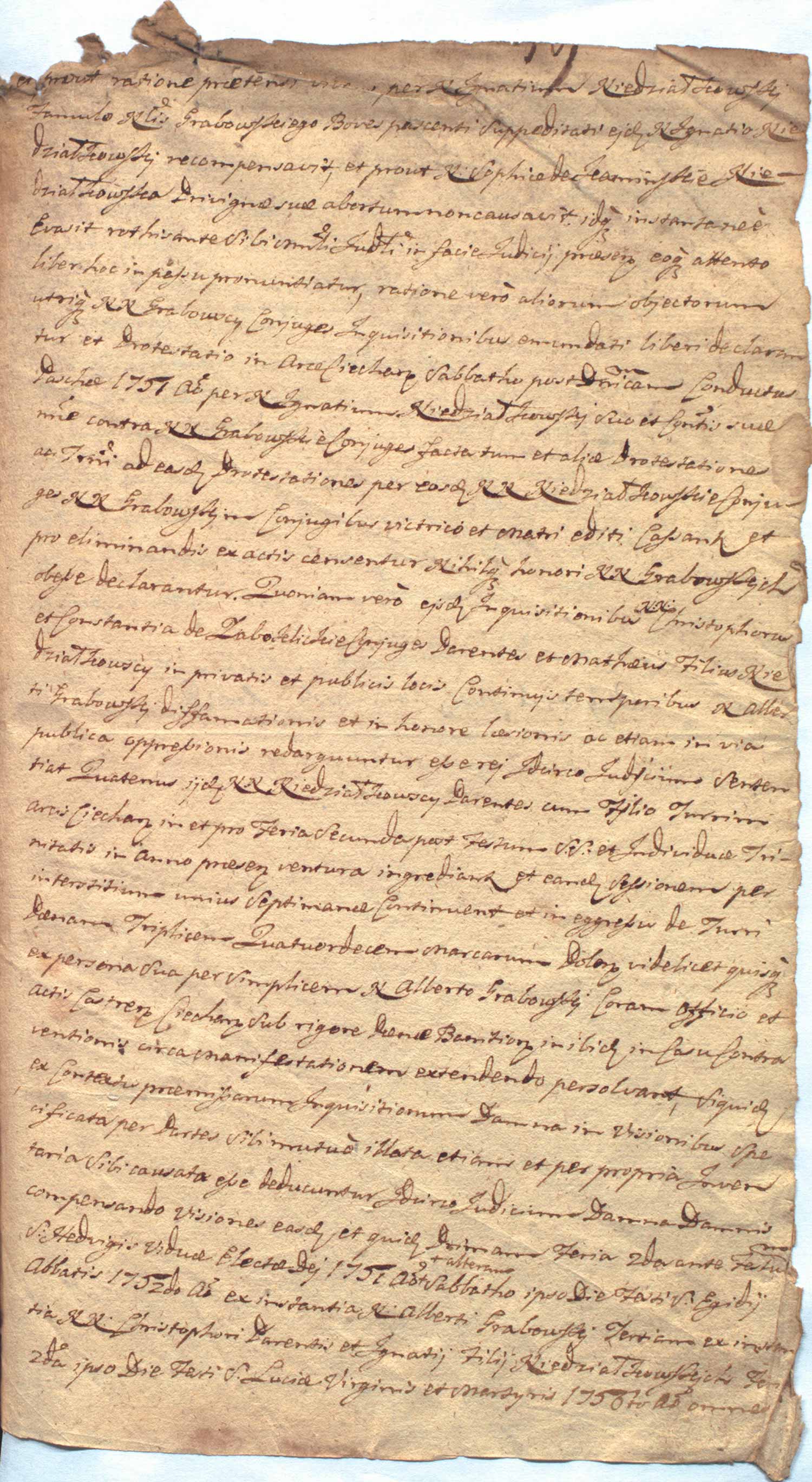
Continuing with the court record of the case of Grabowski v. Niedziałkowski, let’s examine the seventeenth page of the record: “Ciechanowskie Grodzkie Wieczyste”, sygn.107, k.59r. No one should have this much trouble with their relatives.

“Ciechanowskie Grodzkie Wieczyste”, sygn.107, k.59r

“Ciechanowskie Grodzkie Wieczyste”, sygn.107, k.59r

SOURCE: Klonowo, Polish-Lithuanian Commonwealth, “Ciechanowskie Grodzkie Wieczyste,” sygn.107, k.59r, Grabowski v. Niedziałkowski, 1756; Archiwum Główne Akt Dawnych w Warszawie, Warsaw, Poland.

Translated from Latin to Polish, and then from Polish to English, the record states:

…which unfairly rewards Niedziałkowski, freeing that same Grabowski from the protest lodged with the Ciechanów court on Saturday Transitions Sunday in the year 1751 by Ignacy Niedziałkowski in his own name and that of his wife against the married couple, the Grabowskis, their stepfather and mother.
Further investigation showed that the married couple Krzyszstof and Konstancja née Zaboklicka, the parents, Maciej, their son, all Niedziałkowskis, defamed and swore upon the honor of this same Wojciech Grabowski, and also attacked him on a public road. As a result, the parents and son Niedziałkowski were sentenced for punishment to a tower in the Ciechanów castle from the Monday after the Feast of the Holy Trinity next year for one week without interruption, convertible into triple penalty fines of 14 Polish grzywnas to be paid into the hands of Wojciech Grabowski hands under penalty of banishment.
In the face of further damage made by the parties themselves, an inspection took place on these same estates on the Monday after the Feast of St. Hedwig the Widow in the year 1751, on the Saturday on the Feast of St. Idzi the Abbot in the year 1752, both at the request of Wojciech Grabowski. A third inspection was made at the request of Krzysztof, the father, and Ignacy, the son Niedziałkowski, on Monday on the Feast of St. Lucia, Virgin and Martyr, in the year 1756. …

To be continued…

For other parts of this record, see:

Copyright © 2010 by Stephen J. Danko
Posted in Długołęcki, Grabowski, Klonowski, Milewski, Niedziałkowski, Sosnowski, Żaboklicki | Tagged | Comments Off on In Trouble with the Law (Part 17 of 18)

In Trouble with the Law (Part 16 of 18)

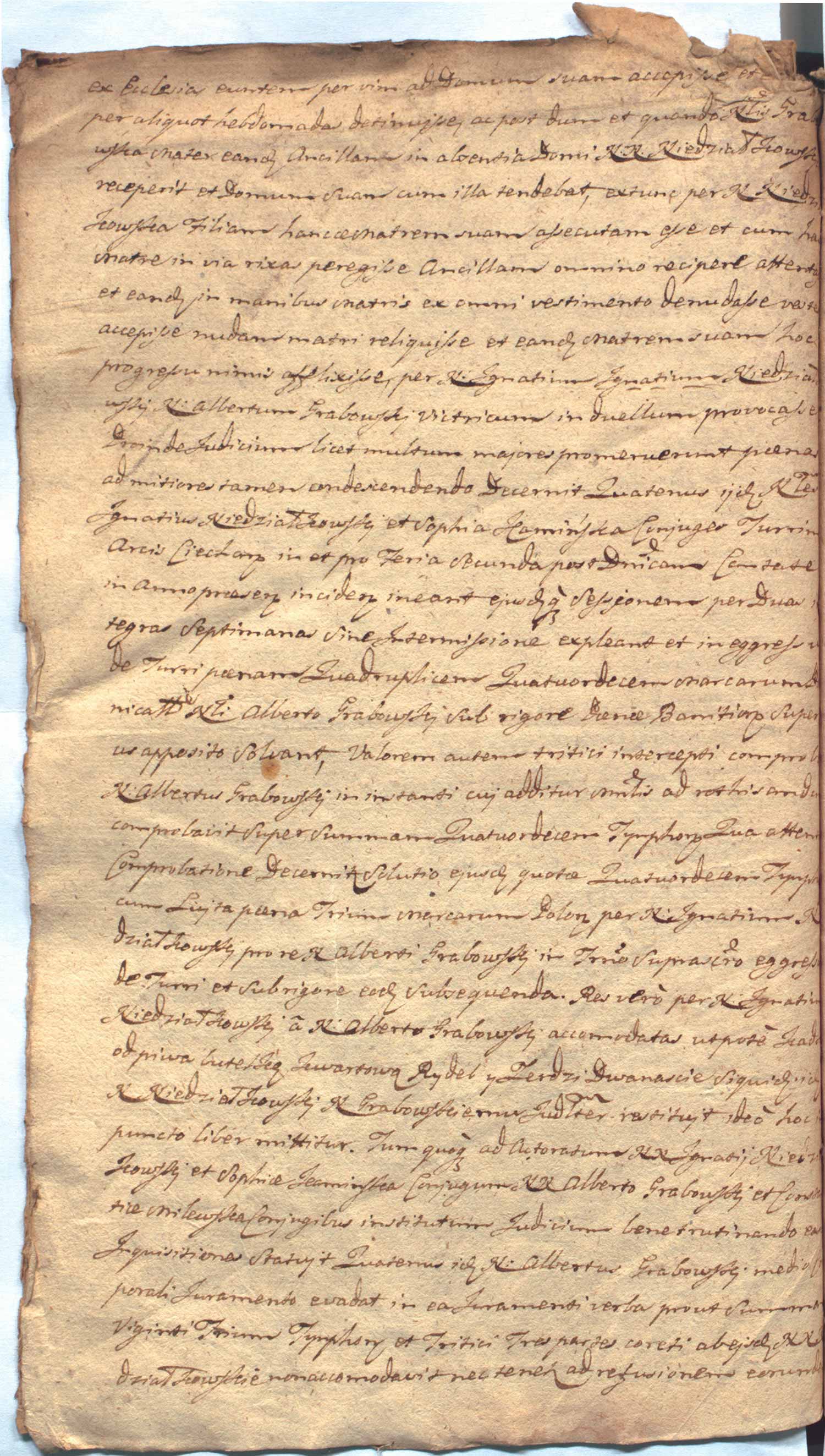
Continuing with the court record of the case of Grabowski v. Niedziałkowski, let’s examine the sixteenth page of the record: “Ciechanowskie Grodzkie Wieczyste”, sygn.107, k.58v. The soap opera continues.

“Ciechanowskie Grodzkie Wieczyste”, sygn.107, k.58v

“Ciechanowskie Grodzkie Wieczyste”, sygn.107, k.58v

SOURCE: Klonowo, Polish-Lithuanian Commonwealth, “Ciechanowskie Grodzkie Wieczyste,” sygn.107, k.58v, Grabowski v. Niedziałkowski, 1756; Archiwum Główne Akt Dawnych w Warszawie, Warsaw, Poland.

Translated from Latin to Polish, and then from Polish to English, the record states:

…in the church and held her for several weeks in her house, and her mother recovered her, taking advantage of the absence of the Grabowskis, for which the daughter later had a quarrel with her, while Ignacy Niedziałkowski challenged his stepfather, Wojciech Grabowski, to a duel.
For all this, Ignacy Niedziałkowski and his wife Zofia Kamińska were sentenced by a local court to imprisonment on Monday after the fourth Sunday after Easter this year in the Ciechanów castle tower for two weeks without interruption, convertible into a quadruple penalty fine of 14 grzywnas to be paid into the hands of Wojciech Grabowski, under penalty of banishment. For taking the wheat, Wojciech Grabowski requested the sum of 14 tynfs from Ignacy Niedziałkowski, which sum was awarded to him together with a fine of 3 grzywnas. Moreover, Ignacy Niedziałkowski was ordered to return things borrowed from Wojciech Grabowski, that is, a vat of beer, a quart bottle, a spade, and 12 poles.  As for Niedziałkowski’s accusations against Grabowski, the sum of 23 tynfs and 3 bushels of wheat, the court did not consent, because the servant of that same Niedziałkowski took Grabowski’s grazing cattle, …

To be continued…

For other parts of this record, see:

Copyright © 2010 by Stephen J. Danko
Posted in Długołęcki, Grabowski, Klonowski, Milewski, Niedziałkowski, Sosnowski, Żaboklicki | Tagged | Comments Off on In Trouble with the Law (Part 16 of 18)

In Trouble with the Law (Part 15 of 18)

Continuing with the court record of the case of Grabowski v. Niedziałkowski, let’s examine the fifteenth page of the record: “Ciechanowskie Grodzkie Wieczyste”, sygn.107, k.58r .  This is where the record really starts to get interesting! At this point in the record, it becomes clear that Wojciech Grabowski is the stepfather of my 5th great grandmother, Zofia née Kamińska Niedziałkowska, and that this lawsuit was filed by Grabowski against his stepdaughter and her husband.

“Ciechanowskie Grodzkie Wieczyste”, sygn.107, k.58r

“Ciechanowskie Grodzkie Wieczyste”, sygn.107, k.58r

SOURCE: Klonowo, Polish-Lithuanian Commonwealth, “Ciechanowskie Grodzkie Wieczyste,” sygn.107, k.58r, Grabowski v. Niedziałkowski, 1756; Archiwum Główne Akt Dawnych w Warszawie, Warsaw, Poland.

Translated from Latin to Polish, and then from Polish to English, the record states:

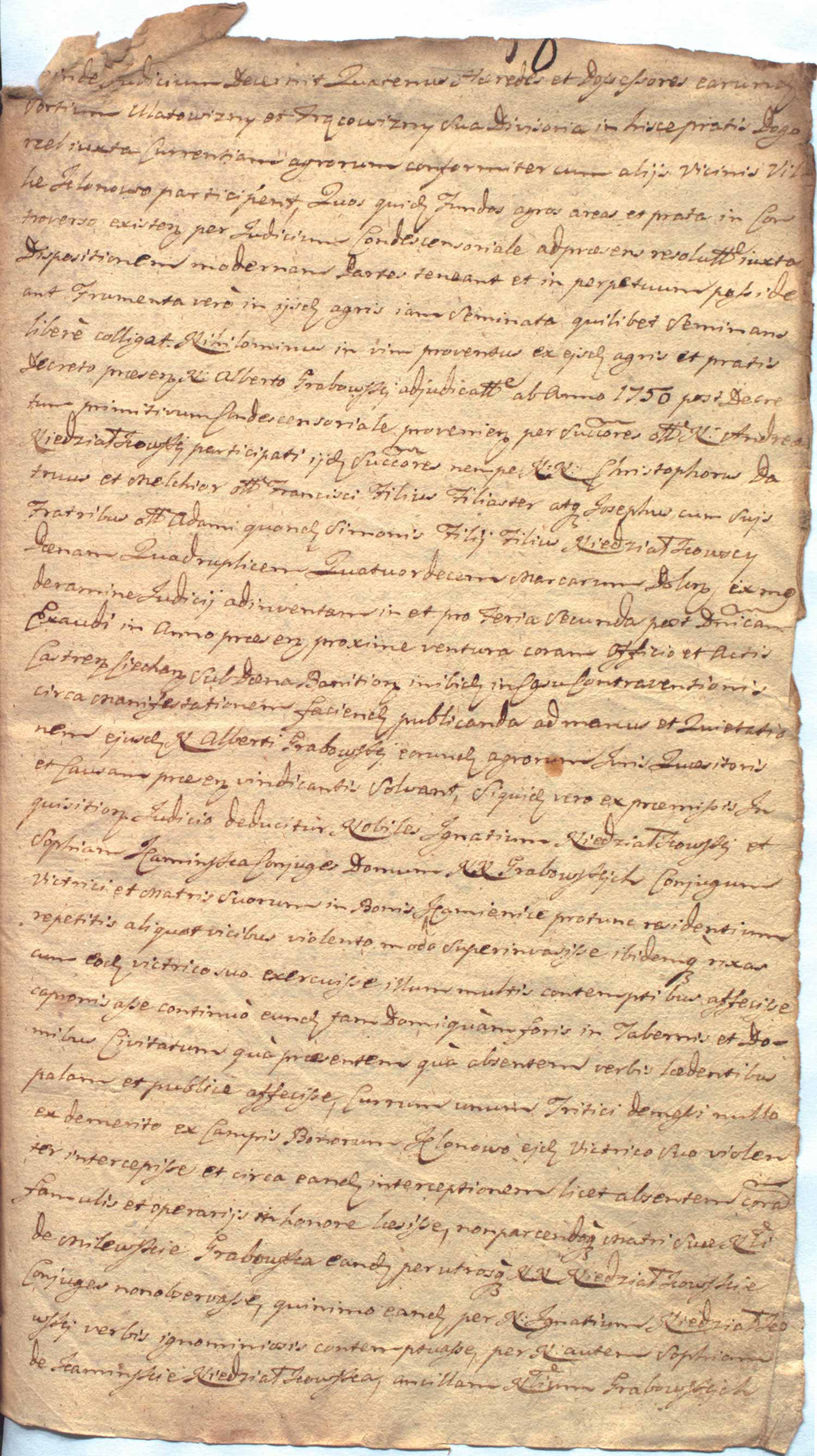
…Moreover, the same decree in the year 1750 sentenced the heirs of the deceased Andrzej Niedziałkowski, namely Krzysztof the uncle, his nephew Melchior son of the deceased Franciszek, also Józef and his brothers sons of the deceased Adam, who was the son of the deceased Szymon, all Niedziałkowskis, quadruple penalties of 14 Polish grzywnas [an old form of currency based on the weight of gold or silver], to be paid in the local court on the Monday after the sixth Sunday after Easter next year into the hands of Wojciech Grabowski under penalty of banishment.
After all this, Ignacy Niedziałkowski and his wife Zofia Kamińska violently attacked the home of the married couple, the Grabowskis, his stepfather and mother, in the Kamieniec estate where they resided at that time, carried on arguments with his stepfather, swore at him in various locations in the taverns and town houses, forcibly seized a wheat wagon from a field in Klonowo, and on occasion swore on the honor of the servants of his stepfather. Both spouses swore at his mother née Milewska Grabowska. Also Zofia née Kamińska Niedziałkowska kidnapped a female servant of Grabowski…

To be continued…

For other parts of this record, see:

Copyright © 2010 by Stephen J. Danko
Posted in Długołęcki, Grabowski, Kamiński, Milewski, Niedziałkowski, Sosnowski, Żaboklicki | Tagged | 1 Comment

In Trouble with the Law (Part 14 of 18)

Continuing with the court record of the case of Grabowski v. Niedziałkowski, let’s examine the fourteenth page of the record: ”Ciechanowskie Grodzkie Wieczyste”, sygn.107, k.57v.

“Ciechanowskie Grodzkie Wieczyste”, sygn.107, k.57v

“Ciechanowskie Grodzkie Wieczyste”, sygn.107, k.57v

SOURCE: Klonowo, Polish-Lithuanian Commonwealth, “Ciechanowskie Grodzkie Wieczyste,” sygn.107, k.57v, Grabowski v. Niedziałkowski, 1756; Archiwum Główne Akt Dawnych w Warszawie, Warsaw, Poland.

Translated from Latin to Polish, and then from Polish to English, the record states:

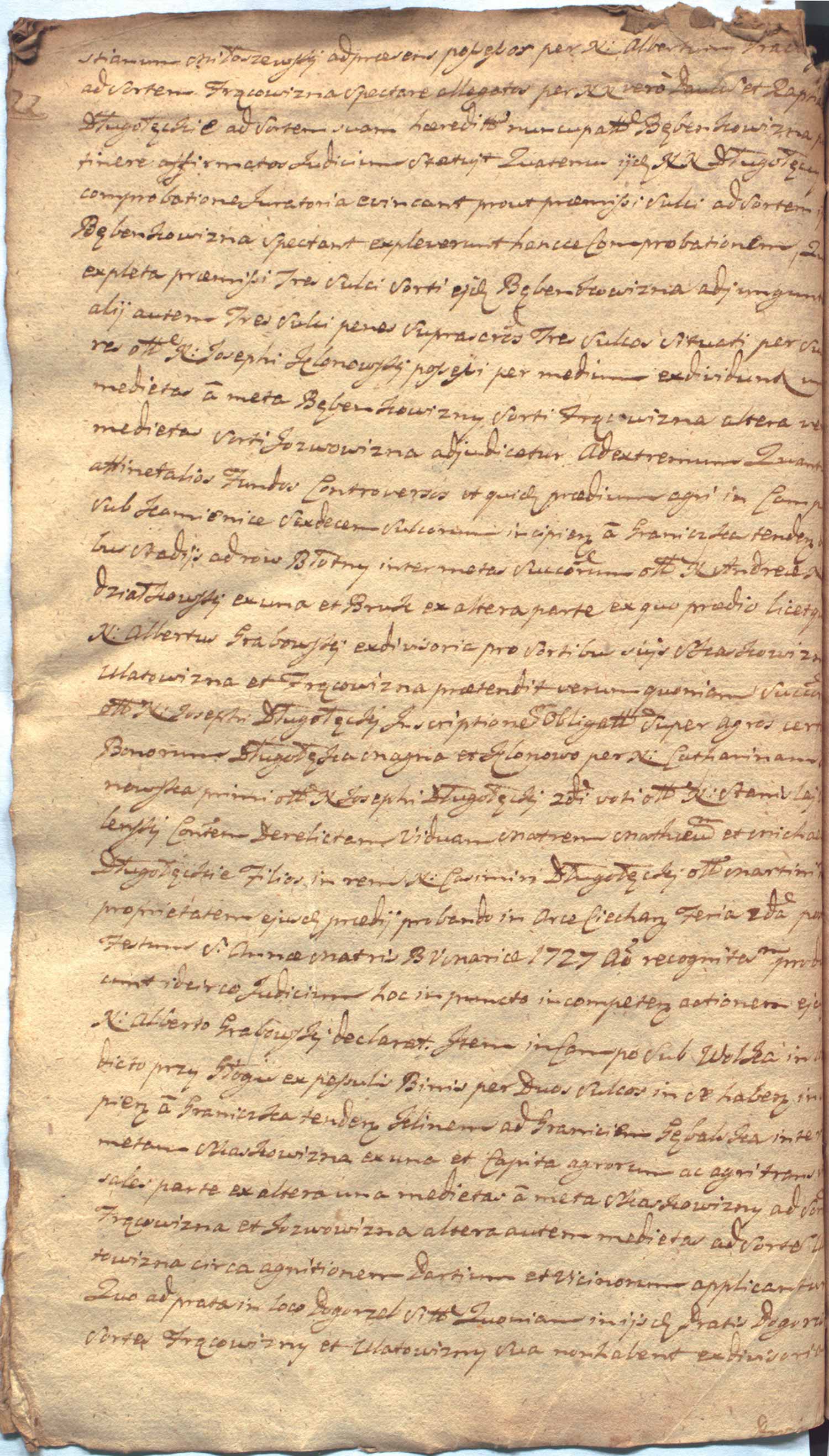
…Sebastian Miłoszewski and claimed by Wojciech Grabowski to be part of Frącowizna, and claimed by Paweł and Rafał Długołęcki to be part of their inheritance called Bębenkowizna, was granted to that Bębenkowizna. Also, three plots near the above three plots, being in possession of the heirs of the deceased Józef Klonowski, will be divided in half, the half on the Bębenkowizna to Frącowizna and the other half to Józwowizna.
In the field below Kamieniec 16 plots from Graniczka through two stops to Rowa Błotny between the boundary line of the heirs of the deceased Andrzej Klonowski and Bruki, which lands Wojciech Grabowski claimed were part of Skaskowizna, Ulatowizna, and Frącowizna, and on which the heirs of the deceased Józef Klonowski have a lien covering parts of Długołęka Wielka and Klonowo, and made by Katarzyna Klonowska, widow of the deceased Józef Długołęcki and the deceased Stanisław Smoleński, as well as her sons Maciej and Michał Długołęcki for things of Kazimierz Długołęcki, the son of the deceased Marcin, in the local records on the Monday after the Feast of St. Anne, Mother of the Blessed Virgin Mary in the year 1727, has been awarded to Wojciech Grabowski.
Also in the field below Wólka in the place called Przy Głog, in the second flat after two plots from Graniczka through Klin to the Gębalski border between Skaskowizna and Głowa Przeczy, one half from the Skaskowizna side was allocated to Frącowizna, and the other to Józwowizna.
As for the meadow called Pogrzel, this does not belong to either Frącowizna or Ulatowizna. …

To be continued…

For other parts of this record, see:

Copyright © 2010 by Stephen J. Danko

Posted in Długołęcki, Grabowski, Klonowski, Milewski, Niedziałkowski, Sosnowski, Żaboklicki | Tagged | 1 Comment

In Trouble with the Law (Part 13 of 18)

Continuing with the court record of the case of Grabowski v. Niedziałkowski, let’s examine the thirteenth page of the record: ”Ciechanowskie Grodzkie Wieczyste”, sygn.107, k.57r.

“Ciechanowskie Grodzkie Wieczyste”, sygn.107, k.57r

“Ciechanowskie Grodzkie Wieczyste”, sygn.107, k.57r

SOURCE: Klonowo, Polish-Lithuanian Commonwealth, “Ciechanowskie Grodzkie Wieczyste,” sygn.107, k.57r, Grabowski v. Niedziałkowski, 1756; Archiwum Główne Akt Dawnych w Warszawie, Warsaw, Poland.

Translated from Latin to Polish, and then from Polish to English, the record states:

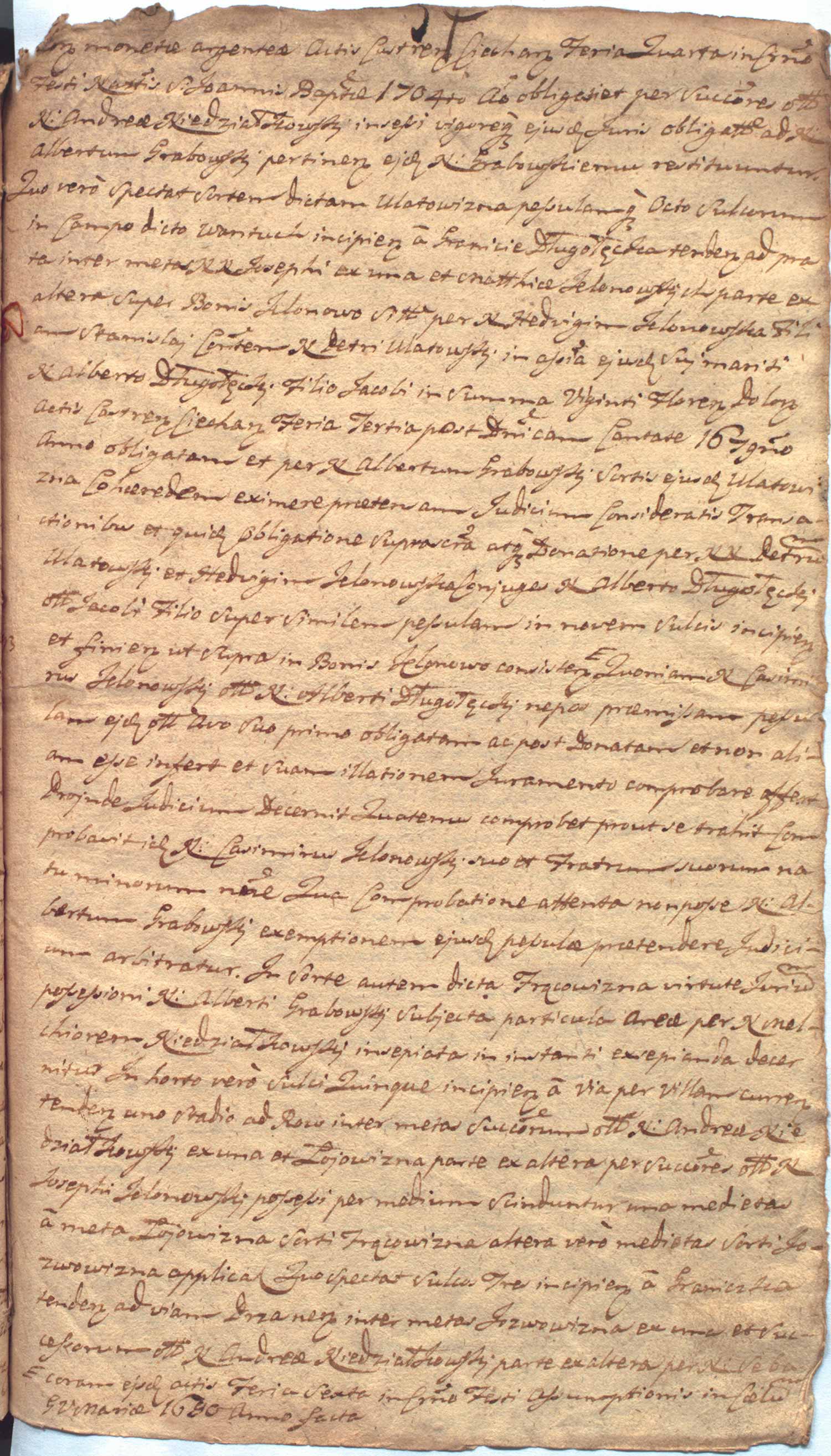
…in the local records on Wednesday, the day after the Feast of St. John the Baptist in the year 1704, and occupied by the heirs of Andrzej Klonowski, have been restored to Wojciech Grabowski.
On the section called Ulatowizna flats, about eight plots in the field called Wantuch from the Długołęcka border to the meadow between the boundary line of Józef and Maciej Klonowski in the Klonowo estates, mortgaged by Jadwiga Klonowska, daughter of Stanisław and wife of Piotr Ulatowski, in the assistance of the same husband, to Wojciech Długołęcki, son of Jakub, for 20 florins in the local records, on the Tuesday after the Fourth Sunday after Easter in the year 1679, and acquired by Wojciech Grabowski, coheir that Ulatowizna section, and mortgaged by the married couple Piotr Ulatowski and Jadwiga Klonowska to Wojciech Długołęcki, son of the deceased Jakub, similar to the flats of about nine plots in an identical location in the Klonowo estate in the local acts on Friday, the day after the Assumption of the Blessed Virgin Mary in the year 1680, and resold by Kazimierz Klonowski, grandson of the same deceased Wojciech Długołęcki, acting on his own behalf and that of his juvenile brother, to Wojciech Grabowski. These flats were granted to Grabowski.
On the section called Frącowizna, being in legal possession of Wojciech Grabowski, part of a field by Melchior Niedziałkowski [I have no idea what’s going on!] .  In the garden, five plots from the rural road through one stop to Rowa between the boundary line of the heirs of the deceased Andrzej Niedziałkowski and Łojowizna, and being in possession of the heirs of the deceased Józef Klonowski, will be cut by half, where one half from the Łojowizna side will be granted to Frącowizna, and the second to Józwowizna .  Next, three plots from Graniczka to the Przasnysz road between Józwowizna and the boundary line of the heirs of the deceased Andrzej Nniedziałkowski, owned by…

To be continued…

For other parts of this record, see:

Copyright © 2010 by Stephen J. Danko

Posted in Długołęcki, Grabowski, Klonowski, Milewski, Niedziałkowski, Sosnowski, Żaboklicki | Tagged | Comments Off on In Trouble with the Law (Part 13 of 18)

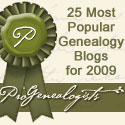
In Trouble with the Law (Part 12 of 18)

Continuing with the court record of the case of Grabowski v. Niedziałkowski, let’s examine the twelfth page of the record: ”Ciechanowskie Grodzkie Wieczyste”, sygn.107, k.56v.

“Ciechanowskie Grodzkie Wieczyste”, sygn.107, k.56v

“Ciechanowskie Grodzkie Wieczyste”, sygn.107, k.56v

SOURCE: Klonowo, Polish-Lithuanian Commonwealth, “Ciechanowskie Grodzkie Wieczyste,” sygn.107, k.56v, Grabowski v. Niedziałkowski, 1756; Archiwum Główne Akt Dawnych w Warszawie, Warsaw, Poland.

Translated from Latin to Polish, and then from Polish to English, the record states:

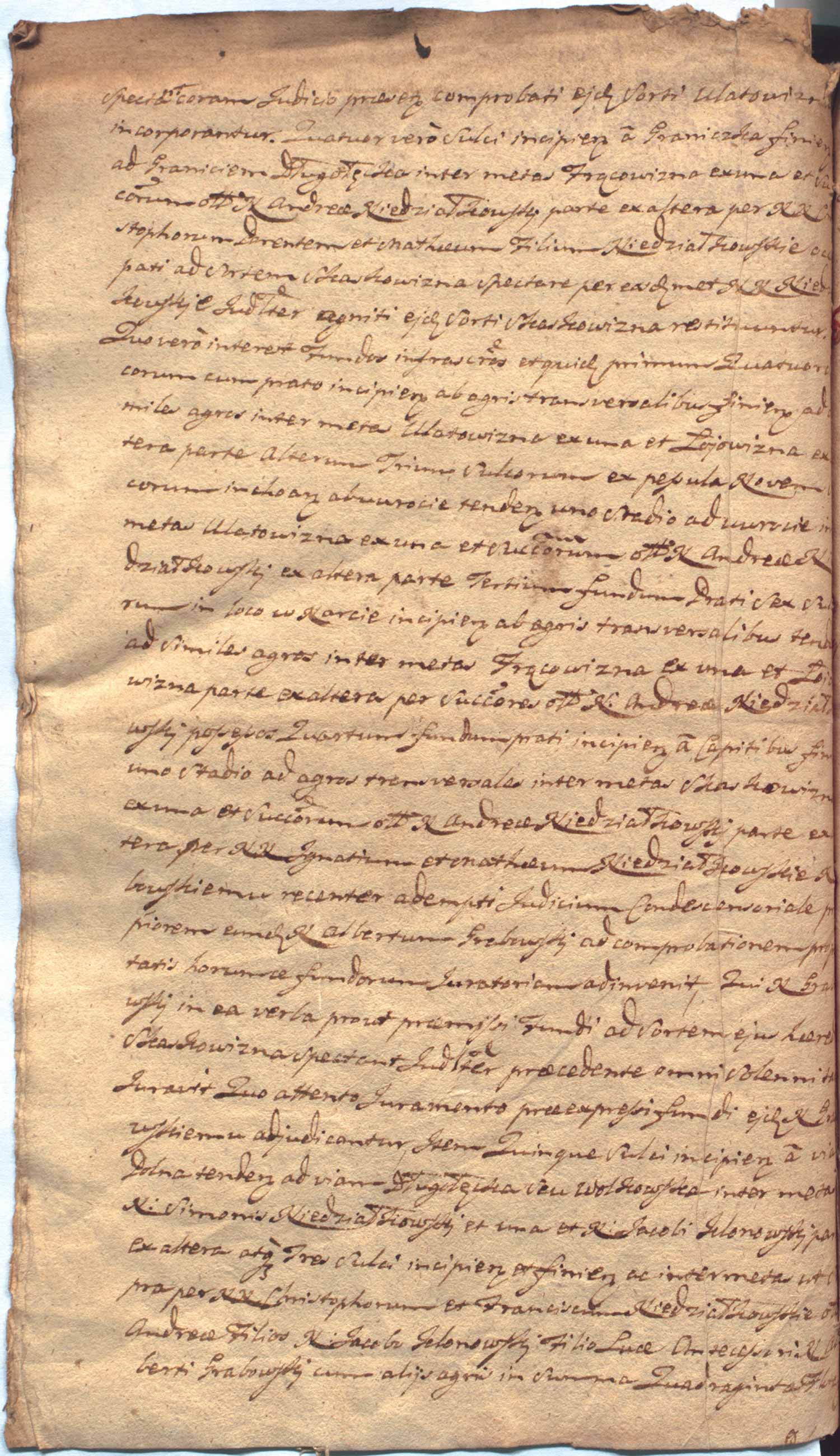
…and to this section it was presently attached.
Also, four plots from Graniczki to the Długołęcki border between Frącowizna and the boundary line of the heirs of the deceased Andrzej Niedziałkowski, occupied by Krzysztof, the father, and Mateusz, his son, both Niedziałkowskis, claiming it is part of Skasowizna, and it was restored to that section.
Also, four lands, that is, first – four plots in the meadow from Przeczy to another Przeczy between Ulatowizna and Łojowizna, the second – three plots in [Płoski?] about nine plots from Uwrocia through one stop to Uwrocia between Ulatowizna and the boundary line of the heirs of the deceased Andrzej Niedziałkowski, the third – a meadow about six plots in Narec from Przeczy to another Przeczy between Frącowizna and Łojowizna, owned by the heirs of the deceased Andrzej Niedziałkowski, the fourth – a meadow from Głów through one stop to Przeczy between Skasowizna and the boundary lines of the heirs of the deceased Andrzej Niedziałkowski, recently granted by the previous congressional court to Ignacy and Mateusz Niedziałkowski, now restored to Grabowski.
Also, five plots from the dirt road to the Długołęcka road, in other words, Wolkowski between the boundary line of Szymon Niedziałkowski and Jakub Klonowski, also three plots similarly located by Krzysztof and Franciszek Niedziałkowski, sons of the deceased Andrzej, Jakub Klonowski, son of Łukasz, ancestor of Wojciech Grabowski, mortgaged for 40 florins…

To be continued…

For other parts of this record, see:

Copyright © 2010 by Stephen J. Danko
Posted in Długołęcki, Grabowski, Klonowski, Milewski, Niedziałkowski, Sosnowski, Żaboklicki | Tagged | Comments Off on In Trouble with the Law (Part 12 of 18)

In Trouble with the Law (Part 11 of 18)

Continuing with the court record of the case of Grabowski v. Niedziałkowski, let’s examine the eleventh page of the record: ”Ciechanowskie Grodzkie Wieczyste”, sygn.107, k.56r.

“Ciechanowskie Grodzkie Wieczyste”, sygn.107, k.56r

“Ciechanowskie Grodzkie Wieczyste”, sygn.107, k.56r

SOURCE: Klonowo, Polish-Lithuanian Commonwealth, “Ciechanowskie Grodzkie Wieczyste,” sygn.107, k.56r, Grabowski v. Niedziałkowski, 1756; Archiwum Główne Akt Dawnych w Warszawie, Warsaw, Poland.

Translated from Latin to Polish, and then from Polish to English, the record states:

…was deemed inappropriate.
Also, in another field toward the Wólkowski forest, 9 plots from the moat to Błoty between Frącowizna and Łojowizna, being in the possession of the heirs of the deceased Andrzej Niedziałkowski and having been usurped by Wojciech Grabowski to the Skasowizna section, the previous court awarded to Krzysztof, Melchior and Józef Niedziałkowski, whereas the present court awards to Grabowski.
Also 6 plots in [Płoski?] against 18 plots mortgaged by Szymon Niedziałkowski, son of the deceased Andrzej, Jakub Klonowski, son of Łukasz and an ancestor of Wojciech Grabowski, for 100 florins in the local records on Thursday, the day after the Feast of St. Idzi, Abbot in the year 1700, starting at the Klonowski border to the Błotny Meadow between the boundary line of Adam Klonowski and the same Szymon Niedziałkowski, taken by Krzysztof and Melchior Niedziałkowski, was awarded to Wojciech Grabowski .  In this field is a meadow with old established fields.
Also in the third field below Wólka, four plots from Przeczy to another Przeczy between Rowa and the boundary line of the heirs of the deceased Andrzej Niedziałkowski, plowed by the heirs of the deceased Adam Niedziałkowski, son of the deceased Szymon, likewise [Płoska?] for one stop long about two plots, transformed in [Płoskę?] about four plots, a field together with meadows about four plots, from Rowa to the border between Frącowzina and Ulatowizna seized by the heirs of Andrzej Niedziałkowski, and belonging to the Skasowizna section, was awarded to Wojciech Grabowski.
Also, four plots of the field from the dirt road to Graniczka between Skasowizna and the boundary line of the heirs of the deceased Andrzej Niedziałkowski, used 50-50 by Wojciech Grabowski and Jakub Długołęcki, claimed to be part of Ulatowizna,…

To be continued…

For other parts of this record, see:

Copyright © 2010 by Stephen J. Danko

Posted in Długołęcki, Grabowski, Klonowski, Milewski, Niedziałkowski, Sosnowski, Żaboklicki | Tagged | Comments Off on In Trouble with the Law (Part 11 of 18)