
Katarzyna née Zakrzewska Pszczółkowska was born in about 1738 in the Polish-Lithuanian Commonwealth, married Antoni Pszczółkowski in 1766, and died on 16 April 1768 in Pszczółki-Czubaki, Ciechanów Ziemia, Masovian Voivodeship, Province of Greater Poland, Polish-Lithuanian Commonwealth. Her death and burial was recorded in the metrical records for Grudusk parish.
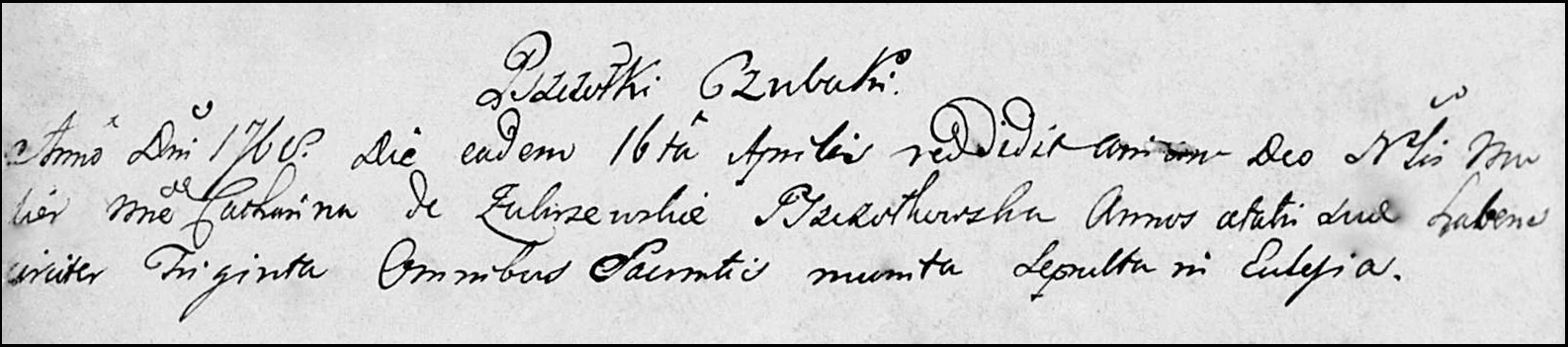
Death and Burial of Katarzyna Pszczółkowska – 1768
SOURCE: Parafia Świętych Apostołów Piotra i Pawła (Grudusk, Ciechanów Ziemia, Masovian Voivodeship, Province of Greater Poland, Polish-Lithuanian Commonwealth), Roman Catholic parish register of births, marriages, banns, and deaths for Grudusk (manuscripts in the Płock Diocesan Archives),” folio 3 verso (5th record from the top of the page), Katarzyna Pszczółkowska, 16 Apr 1768; filmed as Księgi metrykalne, 1744-1825; FHL microfilm 1496798.
A transcription of this record in Latin reads as follows:
Pszczółki-Czubaki
Anno Domini 1768 die 16ta Aprilis reddidit animam Deo Nobilis mulier nomine Catharina de Zakrzewskae Pszczółkowska annos statis suae habens circiter triginta Omnibus Sacramentis munita Sepulta in Ecclesia.
Translated from the Latin, the record states:
Pszczółki-Czubaki
In the year of our Lord 1768, on the 16th day of April, a noble woman named Catherine née Zakrzewska Pszczółkowska, having attained the age of about thirty, gave up her life to God, having been blessed with all the Sacraments. She was buried in the Church.
This record includes some interesting phrases that I don’t see often:
reddidit animam Deo “gave up her life to God” (instead of “died”);
annos statis suae habens circiter triginta “having attained the age of about thirty” (instead of “about thirty years old”).
As with other records written at this time, several words are abbreviated. Abbreviated words in old Latin records are usually highlighted with a curlicue above the word:
Dni (Domini) = of the Lord
Nlis (Nobilis) = Noble
nne (nomine) = named
This is the first time I’ve seen a Latin record in Poland that used the word “mulier” instead of “femina” to refer to a woman.
Finally, a note about the way dates are expressed in many Latin records in Poland. The dates are often written using ordinal numbers rather than cardinal numbers; e.g. 16ta Aprilis = the 16th of April (instead of just April 16). Sometimes, the numbers are difficult to read, but can be deciphered if you look at the letters that follow the number:
-mus, -ma, -mum – the number must be either 1 or 7
-dus, -da, -dum – the number must be 2
-tius, -tia, -tium – the number must be 3
-tus, -ta, -tum – the number must be either 4, 5, or 6
-vus, -va, -vum – the number must be 8
-us, -a, -um – the number must be 9
Copyright © 2026 by Stephen J. Danko