Cadastral Map of the Polish Village of Nienadowa – 1852

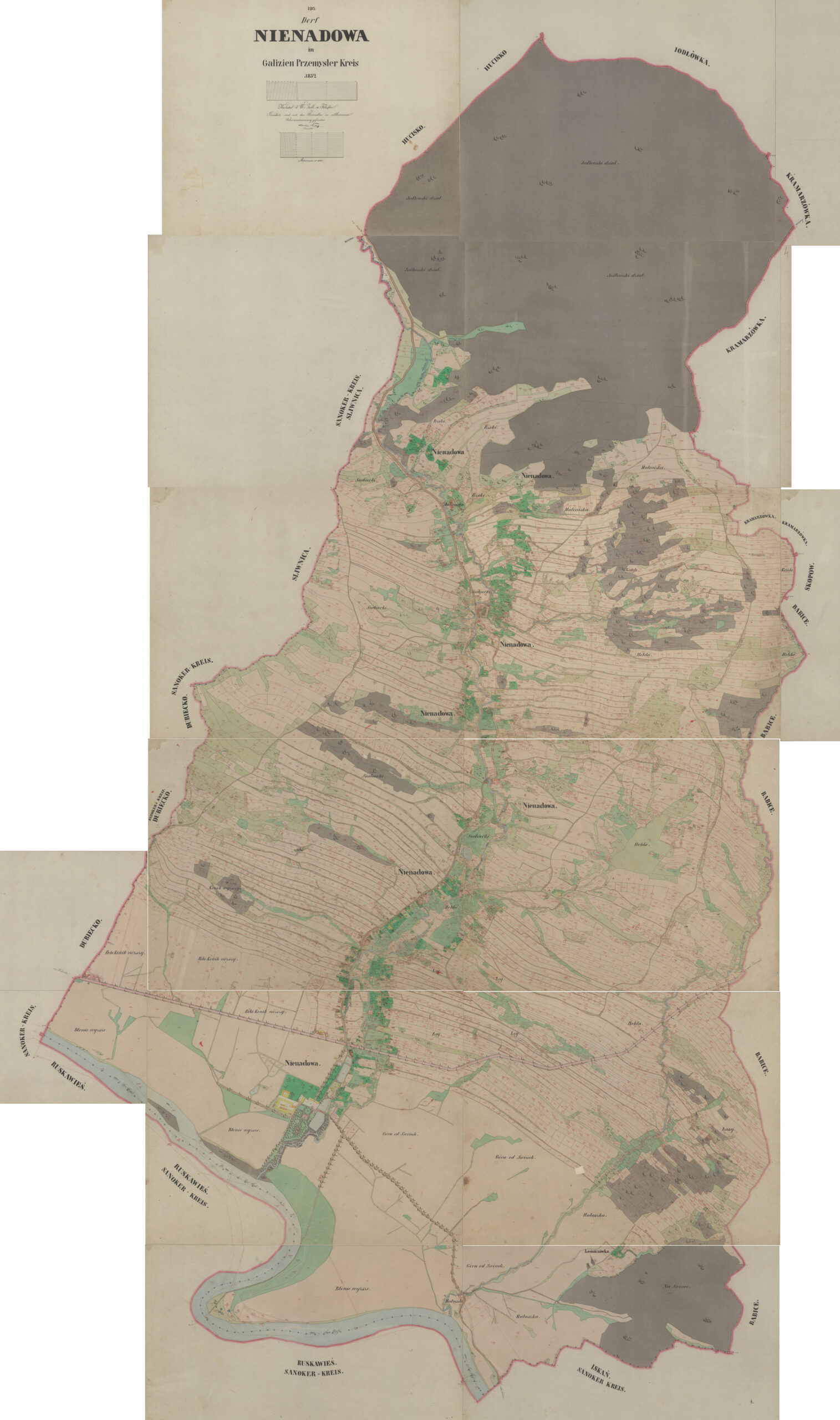
The cadastral map of the Polish village of Nienadowa, created by officials of the Austrian Empire in 1852 is available on the website of the Polish State Archives at Szukaj w Archiwach. The files at Szukaj w Archiwach include fifteen images that, together, form the complete map.

The Gesher Galicia Map Room includes a high-resolution version of the cadastral map of Nienadowa with the individual images stitched together. One of the great features of the maps in the Gesher Galicia Map Room is that the user can zoom in and out of the maps to view either an overview of the map or concentrate on the smallest details.

Nienadowa Cadastral Map – 1852
Dorf Nienadowa in Galizien Przemysler Kreis 1852 (State Archives in Poland); digital images, Szukaj w Archiwach
(https://www.szukajwarchiwach.gov.pl/en/jednostka/-/jednostka/18051011: accessed 02 December 2025)

Copyright © 2025 by Stephen J. Danko

Posted in Daily Journal | Comments Off on Cadastral Map of the Polish Village of Nienadowa – 1852

The Dictionary of Polish Place Names – Nienadowa (Dubiecko Parish)

The Dictionary of Polish Place Names (Nazwy Miejscowe Polski) explains the origin of place names in Poland and details how the place name changed over time.

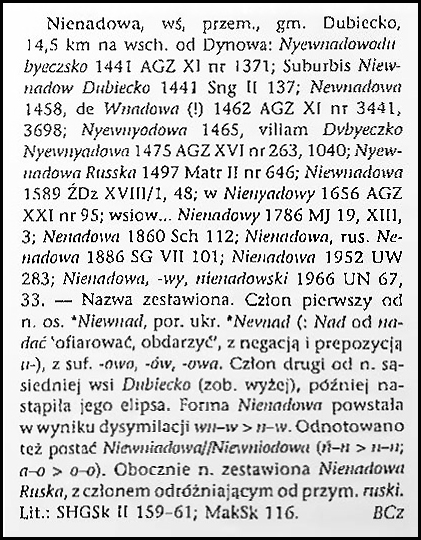
The present-day village of Nienadowa is located in Podkarpackie Voivodeship, about 3 kilometers east of Dubiecko. According to Polish Place Names, the village was referred to as Nyewnadowodu byeczsko and Suburbis Niewnadow Dubiecko in 1441, Newnadowa in 1458, de Wnadowa (!) in 1462, Nyewnyodowa 1465, villam Dvbyeczko Nyewnyadowa and Nyewnadowa Russka in 1497, Niewnadowa 1589, in Nienyadowy 1656, wsiow… Nienadowy in 1786, Nenadowa in 1860, Nienadowa and Ruthenian Nenadowa in 1886, Nienadowa in 1952 and in 1966.

Nazwy Miejscowe Polski states that early name of the village was a compiled name. The first part is the singular personal name Niewnad (Ukrainian Nevnad) from the word nadać meaning “to offer, to bestow” with the suffix -owo, -ów, -owa, and the second element is from the neighboring village of Dubiecko. Alternatively, the name of the village was combined with Nienadowa Ruska and the second element “Dubiecko” added to distinguish it from the adjective “Ruski”. Eventually, the second element of the name was deleted.

Source: Rymut, Kazimierz, ed., Nazwy Miejscowe Polski (Place Names of Poland) – Krakow 2007, Volume VII, page 421.

Click the link for a PDF copy of the Nazwy Miejscowe Polski entry for Nienadowa. Translated from the Polish, the entry reads:

Nienadowa, village, Przemyśl, Dubiecko gmina, 14.5 km east of Dynów: Nyewnadowodu byeczsko 1441 AGZ XI No. 1371; Suburbis Niewnadow Dubiecko 1441 Sng II 137; Newnadowa 1458, de Wnadowa (!) 1462 AGZ XI No. 3441, 3698; Nyewnyodowa 1465, villam Dvbyeczko Nyewnyadowa 1475 AGZ XVI No. 263, 1040; Nyewnadowa Russka 1497 Matr II No. 646; Niewnadowa 1589 ŹDz XVIII/I, 48; in Nienyadowy 1656 AGZ XXI No. 95; wsiow… Nienadowy 1786 MJ 19, XIII, 3; Nenadowa 1860 Sch 112; Nienadowa, Ruthenian Nenadowa 1886 SG VII 101; Nienadowa 1952 UW 283; Nienadowa, –wy, nienadowski 1966 UN 67, 33. — Compiled name. First element from the singular personal name *Niewnad, compare Ukrainian *Nevnad (: From nadać ‘to offer, to bestow’, with negation and the preposition u-), with the suffix –owo, –ów, –owa. Second element from the singular of the neighboring village Dubiecko (see above), later its ellipsis took place. The form Nienadowa arose as a result of dissimilation wn-w > n-w. The form Niewniadowa//Niewniodowa (ń-n > n-n; n-o > o-o) was also noted. Alternatively, the name was combined with Nienadowa Ruska, with a member distinguishing it from the adjective Ruski. Lit.: SHGSk lI 159-61; MakSk 116.
Barbara Czopek-Kopciuch

Copyright © 2025 by Stephen J. Danko

Posted in Daily Journal | Comments Off on The Dictionary of Polish Place Names – Nienadowa (Dubiecko Parish)

The Polish Village of Nienadowa (Dubiecko Parish)

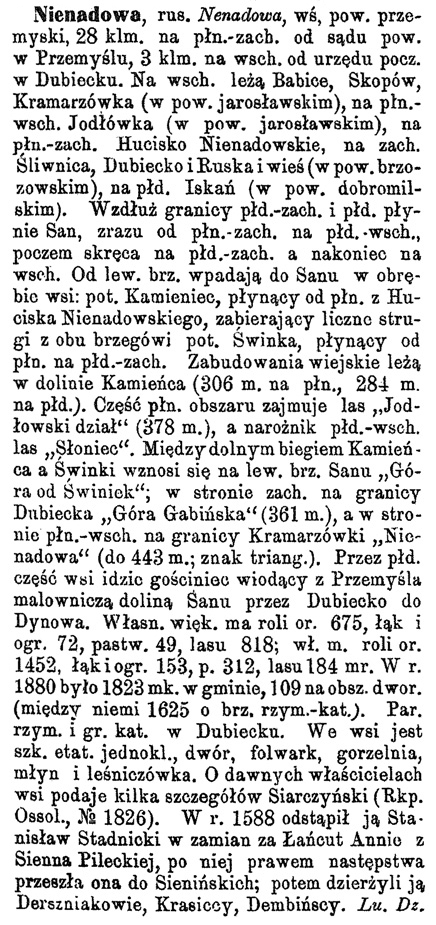
The Słownik Geograficzny Królestwa Polskiego i Innych Krajów Słowiańskich (Geographical Dictionary of the Kingdom of Poland and other Slavonic Countries) includes an entry for the village of Nienadowa in Dubiecko Parish.

1855 Map of Dubiecko and Environs

Ritter, Karl. 1855. “Administrativ-Karte von Den Königreichen Galizien und Lodomerien.” Wien: Verlag und Eigenthum von Artaria & Co.; digital images, Polona (https://polona.pl/item-view/9341ec1b-5a4b-44a5-9f6b-a22c716faf46?page=36: accessed 30 November 2025)

Source:  Sulimierski, Filip, Bronisław Chlebowski, and Władysław Walewski, eds., Słownik Geograficzny Królestwa Polskiego i Innych Krajów Słowiańskich (Geographical Dictionary of the Kingdom of Poland and other Slavonic Countries) – Warsaw 1882, Volume III, page 202.

Click on the link for a PDF copy of the first Słownik Geograficzny entry for Nienadowa (Dubiecko Parish). Translated from the Polish, the entry reads:

Nienadowa, Nenadowa in Ruthenian; a village in Przemyśł Powiat, 28 kilometers to the north-west of the powiat court in Przemyśl, 3 kilometers east of the post office in Dubiecko. To the east are located Babice, Skopów, Kramarzówka (in Jarosław Powiat), to the north-west Hucisko Nienadowskie, to the west Śliwnica, Dubiecko and Ruska wieś (in Brzozów Powiat), to the south Iskań (in Dobromil Powiat). The San River flows along the south-west and southern border, initially from the north-west to the south-east, then it turns to the north-west and to the east. From the left bank, the following streams flow from within the village into the San River: the Kamieniec Stream, flowing from the north from Hucisko Nienadowski, absorbing numerous streams from both banks, and the Świnka Stream, flowing from the north to the south-west. The village buildings are situated in the Kamieńica valley (306 m to the north, 284 m to the south). The northern part of the area is occupied by the “Jodłowski section” forest (378 m), and the south-east corner by the “Słoniec” forest. Between the lower reaches of Kamieniec and Świnka, the “Góra od Świniek” rises on the left bank of the San; on the west side, on the border of Dubiecko, “Góra Gabińska” (361 m), and on the north-east side, on the border of Kramarzówka, “Nienadowa” (443 m, triangulation mark). The road leading from Przemyśl through the picturesque San valley through Dubiecko to Dynów goes through the southern part of the village. The larger property has 675 mórgs [1 mórg = 5755 m²] of arable land, 72 mórgs of meadows and gardens, 49 mórgs of pastures, 818 mórgs of forests; the property has 1452 mórgs of arable land, 153 mórgs of meadows and gardens, 312 mórgs of pastures, and 184 mórgs of forests.In 1880, there were 1,823 m2 residents in the gmina, 109 residents on the area of the manor (between them there were 1625 residents on the Roman Catholic shore of the San River). There are Roman Catholic and Greek Catholic parishes in Dubiecko. In the village there is a full-time one-room school, a manor house, a farm, a distillery, a mill, and a forester’s lodge. Siarczyński gives some details about the former owners of the village (Rkp. Ossolineum, No. 1826). In 1588, Stanisław Stadnicki gave up Nienadowa to Anna of Sienna Pilecka in exchange for Łańcut, after which Nienadowa passed to the Sieniński family by succession; then it was held by the Dersiniaks, the Krasickis and the Dembińskis. Lukasz Dz

Today, the historical village of Nienadowa includes two distinct villages: Nienadowa Dolna and Nienadowa Górna.

Copyright © 2025 by Stephen J. Danko

Posted in Daily Journal | Comments Off on The Polish Village of Nienadowa (Dubiecko Parish)

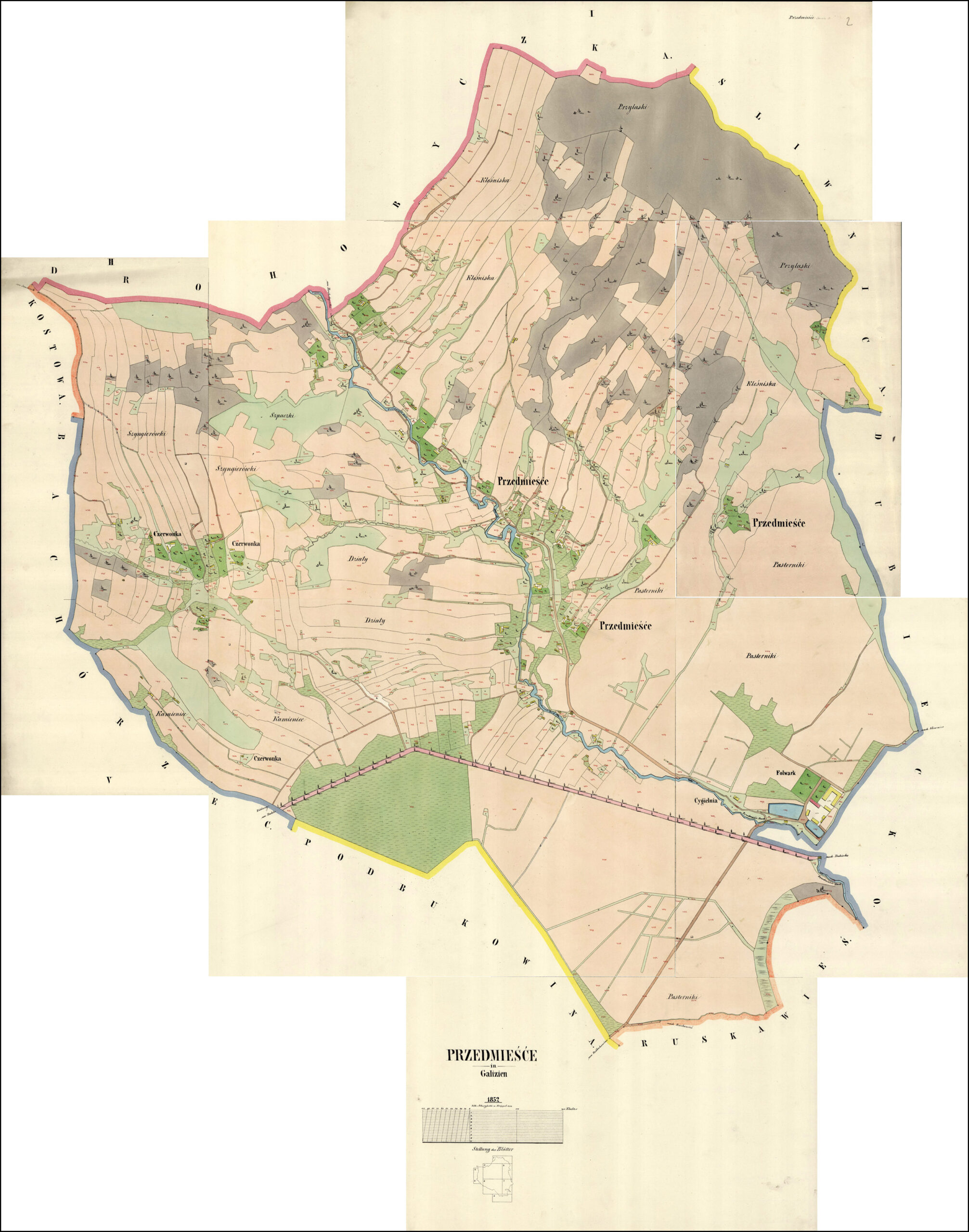
Cadastral Map of the Polish Village of Przedmieście Dubieckie (Dubiecko Parish) – 1854

The cadastral map of the Polish village of Przedmieście Dubieckie, created by officials of the Austrian Empire in 1854 is available on the website of the Polish State Archives at Szukaj w Archiwach. The files at Szukaj w Archiwach include seven images in five files that, together, form the complete map.

Przedmieście Dubieckie Cadastral Map – 1854
Przedmieście in Galizien 1854 (State Archives in Poland); digital images, Szukaj w Archiwach
(https://www.szukajwarchiwach.gov.pl/en/jednostka/-/jednostka/18051214: accessed 02 December 2025)

Copyright © 2025 by Stephen J. Danko

Posted in Daily Journal | Comments Off on Cadastral Map of the Polish Village of Przedmieście Dubieckie (Dubiecko Parish) – 1854

The Dictionary of Polish Place Names – Przedmieście Dubieckie (Dubiecko Parish)

The Dictionary of Polish Place Names (Nazwy Miejscowe Polski) explains the origin of place names in Poland and details how the place name changed over time.

The present-day village of Przedmieście Dubieckie is located in Podkarpackie Voivodeship, about 2 kilometers northwest of Dubiecko. According to Polish Place Names, the village was referred to:
– in Latin as opidum Dubyeczsko cum Suburbia in 1441, Suburbium ante Dubeczsko in 1458, opidum Dubyeczko cum Suburbiis in 1484, Suburbium in 1515, Dubteczense Suburbium in 1589, Przedmyesczye in 1489, Suburbium in 1515, Dubteczense Suburbium in 1589, and as
Przedmieście Dubieckie in 1678,
– in Ukrainian as Peredmistie in 1851,
– in Polish as Przedmieście Dubieckie in 1888 and 1966.

Source: Rymut, Kazimierz, ed., Nazwy Miejscowe Polski (Place Names of Poland) – Krakow 1997, Volume IX, page 293.

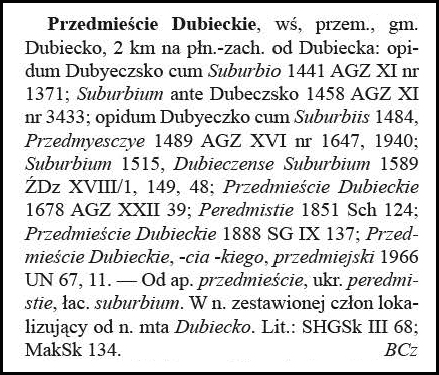
Click the link for a PDF copy of the Nazwy Miejscowe Polski entry for Przedmieście Dubieckie. Translated from the Polish, the entry reads:

Przedmieście Dubieckie, village, Przemyśl, Dubiecko gmina, 2 kilometers northwest of Dubiecko: opidum Dubyeczsko cum Suburbio 1441 AGZ XI no. 1371; Suburbium ante Dubeczsko 1458 AGZ XI no. 3433; opidum Dubyeczko cum Suburbiis 1484, Przedmyesczye 1489 AGZ XVI no. 1647, 1940; Suburbium 1515, Dubteczense Suburbium 1589 ŻDz XVIII/1, 149, 48; Przedmieście Dubieckie 1678 AGZ XXII 39; Peredmistie 1851 Sch 124; Przedmieście Dubieckie 1888 SG IX 137; Przedmieście Dubieckie, -cia -kiego, Przedmieście Dubieckie 1966 UN 67, 11. – From the appellative [common word] przedmieście, Ukrainian: peredmistie, Latin: suburbium. In the juxtaposed name, a locating element from the name of the city of Dubiecko. Lit.: SHGSk III 68; MakSk 134. BCz

Copyright © 2025 by Stephen J. Danko
Posted in Daily Journal | Comments Off on The Dictionary of Polish Place Names – Przedmieście Dubieckie (Dubiecko Parish)

The Polish Village of Przedmieście Dubieckie (Dubiecko Parish)

The Słownik Geograficzny Królestwa Polskiego i Innych Krajów Słowiańskich (Geographical Dictionary of the Kingdom of Poland and other Slavonic Countries) includes an entry for the village of Przedmieście Dubieckie in Dubiecko Parish.

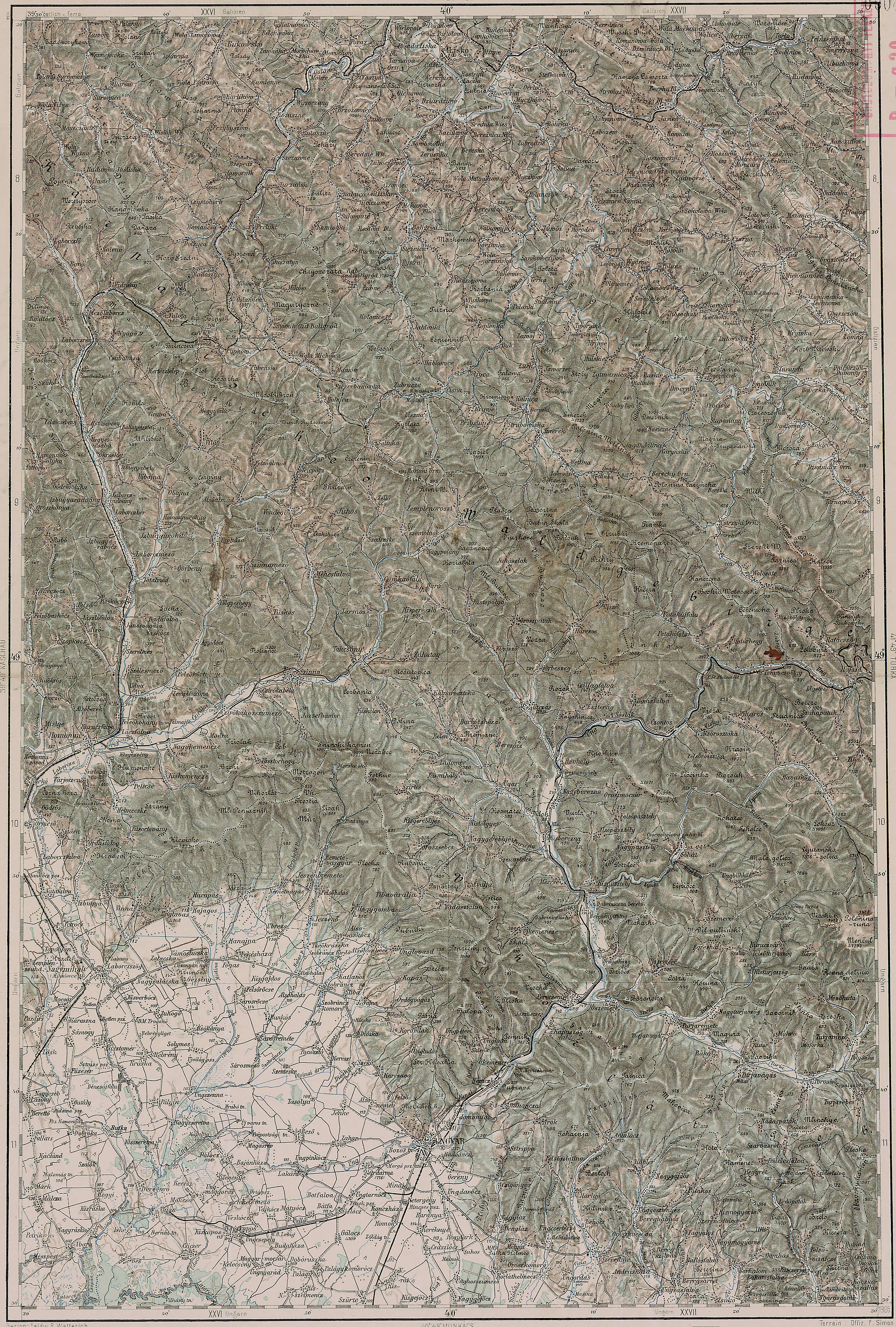
1855 Map of Dubiecko and Environs

Ritter, Karl. 1855. “Administrativ-Karte von Den Königreichen Galizien und Lodomerien.” Wien: Verlag und Eigenthum von Artaria & Co.; digital images, Polona (https://polona.pl/item-view/9341ec1b-5a4b-44a5-9f6b-a22c716faf46?page=36: accessed 30 November 2025)

Source:  Source: Sulimierski, Filip, Bronisław Chlebowski, and Władysław Walewski, eds., Słownik Geograficzny Królestwa Polskiego i Innych Krajów Słowiańskich (Geographical Dictionary of the Kingdom of Poland and other Slavonic Countries) – Warsaw 1882, Volume III, page 202.

Click on the link for a PDF copy of the first Słownik Geograficzny entry for Przedmieście Dubieckie (Dubiecko Parish). Translated from the Polish, the entry reads:

     Przedmieście 1.) Dubieckie, village, Brzozów powiat, northwest of Dubiecko (25 kilometers), on a stream flowing from below Huty Drohobycka and flowing from here to Śliwnica. It occupies a compact stream valley, surrounded by forests. It constitutes a separate gmina with the area of ​​a larger estate (4 houses, 24 residents) and has 108 houses and 688 residents., 528 Roman Catholics, 131 Greek Catholics, and 29 Jews. The gmina’s borrowing fund has 640 złotys in a. [Note: Not sure what this abbreviation means] capital. The Roman Catholic and Greek Catholic parishes are in Dubiecko. The larger estate (Countess Aleksandra Konarska) consists of 357 mórgs [in Galicia 1 morg = 1.422 acres] of arable land, 59 mórgs of meadows and gardens, 125 mórgs of pastures, and 89 mórgs of forest; the minimum land area is 631 mórgs of arable land, 50 mórgs of meadows, 125 mórgs of pastures, and 95 mórgs of forest. The soil here is rye, moderately fertile, consisting mostly of clay and silica, and in higher places of loam. It borders Kosztowa to the west, Drohohyczka to the north, and Śliwnica to the east.

Copyright © 2025 by Stephen J. Danko
Posted in Daily Journal | Comments Off on The Polish Village of Przedmieście Dubieckie (Dubiecko Parish)

Cadastral Map of the Polish Village of Śliwnica (Dubiecko Parish) – 1852

The cadastral map of the Polish village of Śliwnica (Dubiecko parish), created by officials of the Austrian Empire in 1852 is available on the website of the Polish State Archives at Szukaj w Archiwach. The files at Szukaj w Archiwach include four images that, together, form the complete map.

The Gesher Galicia Map Room includes a high-resolution version of the cadastral map of Śliwnica (Dubiecko parish) with the individual images stitched together. One of the great features of the maps in the Gesher Galicia Map Room is that the user can zoom in and out of the maps to view either an overview of the map or concentrate on the smallest details.

Śliwnica (Dubiecko parish) Cadastral Map – 1852
Dorf Sliwnica in Galizien Sanoker Kreis 1852 (State Archives in Poland);
digital images, Szukaj w Archiwach
(https://www.szukajwarchiwach.gov.pl/en/jednostka/-/jednostka/18050215:
accessed 27 November 2025)

Copyright © 2025 by Stephen J. Danko
Posted in Daily Journal | Comments Off on Cadastral Map of the Polish Village of Śliwnica (Dubiecko Parish) – 1852

The Polish Village of Śliwnica (Dubiecko Parish)

The Słownik Geograficzny Królestwa Polskiego i Innych Krajów Słowiańskich (Geographical Dictionary of the Kingdom of Poland and other Slavonic Countries) does not include an entry for the village of Śliwnica in Dubiecko Parish. Furthermore, the Dictionary of Polish Place Names (Nazwy Miejscowe Polski) that would include an entry for Śliwnica has not yet been published.

1855 Map of Dubiecko and Environs

Ritter, Karl. 1855. “Administrativ-Karte von Den Königreichen Galizien und Lodomerien.” Wien: Verlag und Eigenthum von Artaria & Co.; digital images, Polona (https://polona.pl/item-view/9341ec1b-5a4b-44a5-9f6b-a22c716faf46?page=36: accessed 30 November 2025)

There is, however, an entry in the Słownik Geograficzny Królestwa Polskiego i Innych Krajów Słowiańskich for the Śliwnica stream which flows through Śliwnica and Dubiecko, and this entry is shown here.

Source:  Chlebowski, Bronisław, Władysław Walewski, and Filip Sulimierski, eds., Słownik Geograficzny Królestwa Polskiego i Innych Krajów Słowiańskich (Geographical Dictionary of the Kingdom of Poland and other Slavonic Countries) – Warsaw 1889, Volume X, page 767.

Click on the link for a PDF copy of the second Słownik Geograficzny entry for Śliwnica, potok. Translated from the Polish, the entry reads:

Śliwnica, a stream, rises in the vicinity of Śliwnica, Brzozów County, on the northern side, from under the Rączyna hills (452 ​​mt). It flows northward between a hilly valley, through Śliwnica, separates Dubiecko from Przedmieście Dubiecko and flows into the San River on the left bank near the city. Its mouth lies 232 meters above sea level (general height). The length of its course is 10 km. It takes in the Drohobyczka Stream from its right bank, slightly above its mouth.

Copyright © 2025 by Stephen J. Danko
Posted in Daily Journal | Comments Off on The Polish Village of Śliwnica (Dubiecko Parish)

Cadastral Map of the Polish Village of Hucisko Nienadowskie – 1852

The cadastral map of the Polish village of Hucisko Nienadowskie, created by officials of the Austrian Empire in 1852 is available on the website of the Polish State Archives at Szukaj w Archiwach. The files at Szukaj w Archiwach include five images that, together, form the complete map.

Hucisko Nienadowskie Cadastral Map – 1852
Dorf Hucisko in Galizien Przemysler Kreis 1852 (State Archives in Poland); digital images, Szukaj w Archiwach
(https://www.szukajwarchiwach.gov.pl/en/jednostka/-/jednostka/18050397: accessed 01 December 2025)

Copyright © 2025 by Stephen J. Danko
Posted in Daily Journal | Comments Off on Cadastral Map of the Polish Village of Hucisko Nienadowskie – 1852

The Dictionary of Polish Place Names – Hucisko Nienadowskie

The Dictionary of Polish Place Names (Nazwy Miejscowe Polski) explains the origin of place names in Poland and details how the place name changed over time.

The present-day village of Hucisko Nienadowskie is located in Podkarpackie Voivodeship, 28 kilometers northwest of Przemyśl. According to Polish Place Names, the name of the village was Nienadowa cum Huciska Nienaowskie in 1735, Hucisko in 1794, Huciscko nienadowskie in 1882, and Hucisko Nienadowskie in 1966.

Source: Rymut, Kazimierz, ed., Nazwy Miejscowe Polski (Place Names of Poland) – Krakow 1997, Volume III, page 500.

Click the link for a PDF copy of the Nazwy Miejscowe Polski entry for Hucisko Nienadowskie. Translated from the Polish, the entry reads:

Hucisko Nienadowskie, village, Przemyśl, Dubiecko gmina, 28 km northwest of Przemyśl: Nienadowa cum Huciska Nienadowskie 1735 Fast 96; Hucisko 1794 Ga N1v; Hucisko nienadowskie 1882 SG III 202; Hucisko Nienadowskie, –kakiego, huciski 1966 UN 67, 32; jargon hućisko, –ka, hućiḽski. – Clause distinguishing it from the name of the nearby village of Nienadowa; periodically ellipsized. Lithuanian: SHGSk I 154-5; MakSk 73. BCz

Copyright © 2025 by Stephen J. Danko
Posted in Daily Journal | Comments Off on The Dictionary of Polish Place Names – Hucisko Nienadowskie