The Słownik Geograficzny Królestwa Polskiego i Innych Krajów Słowiańskich (Geographical Dictionary of the Kingdom of Poland and other Slavonic Countries) includes an entry for the village of Przedmieście Dubieckie in Dubiecko Parish.

Ritter, Karl. 1855. “Administrativ-Karte von Den Königreichen Galizien und Lodomerien.” Wien: Verlag und Eigenthum von Artaria & Co.; digital images, Polona (https://polona.pl/item-view/9341ec1b-5a4b-44a5-9f6b-a22c716faf46?page=36: accessed 30 November 2025)
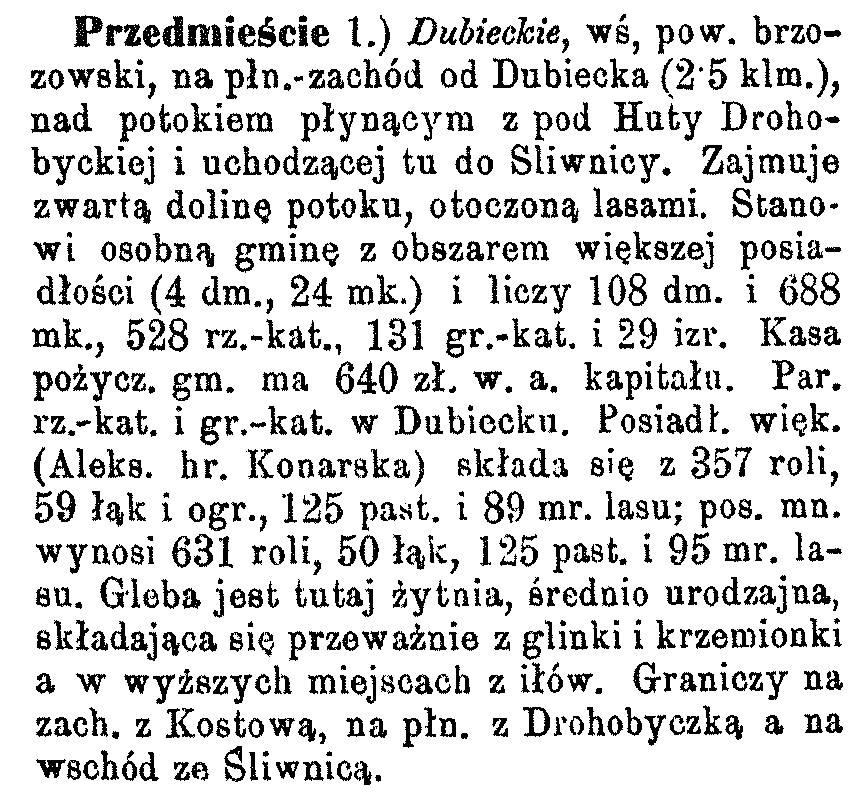
Source: Source: Sulimierski, Filip, Bronisław Chlebowski, and Władysław Walewski, eds., Słownik Geograficzny Królestwa Polskiego i Innych Krajów Słowiańskich (Geographical Dictionary of the Kingdom of Poland and other Slavonic Countries) – Warsaw 1882, Volume III, page 202.
Click on the link for a PDF copy of the first Słownik Geograficzny entry for Przedmieście Dubieckie (Dubiecko Parish). Translated from the Polish, the entry reads:
Przedmieście 1.) Dubieckie, village, Brzozów powiat, northwest of Dubiecko (25 kilometers), on a stream flowing from below Huty Drohobycka and flowing from here to Śliwnica. It occupies a compact stream valley, surrounded by forests. It constitutes a separate gmina with the area of a larger estate (4 houses, 24 residents) and has 108 houses and 688 residents., 528 Roman Catholics, 131 Greek Catholics, and 29 Jews. The gmina’s borrowing fund has 640 złotys in a. [Note: Not sure what this abbreviation means] capital. The Roman Catholic and Greek Catholic parishes are in Dubiecko. The larger estate (Countess Aleksandra Konarska) consists of 357 mórgs [in Galicia 1 morg = 1.422 acres] of arable land, 59 mórgs of meadows and gardens, 125 mórgs of pastures, and 89 mórgs of forest; the minimum land area is 631 mórgs of arable land, 50 mórgs of meadows, 125 mórgs of pastures, and 95 mórgs of forest. The soil here is rye, moderately fertile, consisting mostly of clay and silica, and in higher places of loam. It borders Kosztowa to the west, Drohohyczka to the north, and Śliwnica to the east.
Copyright © 2025 by Stephen J. Danko