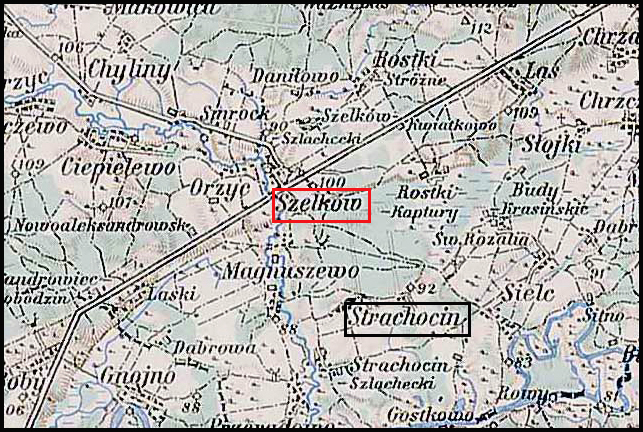
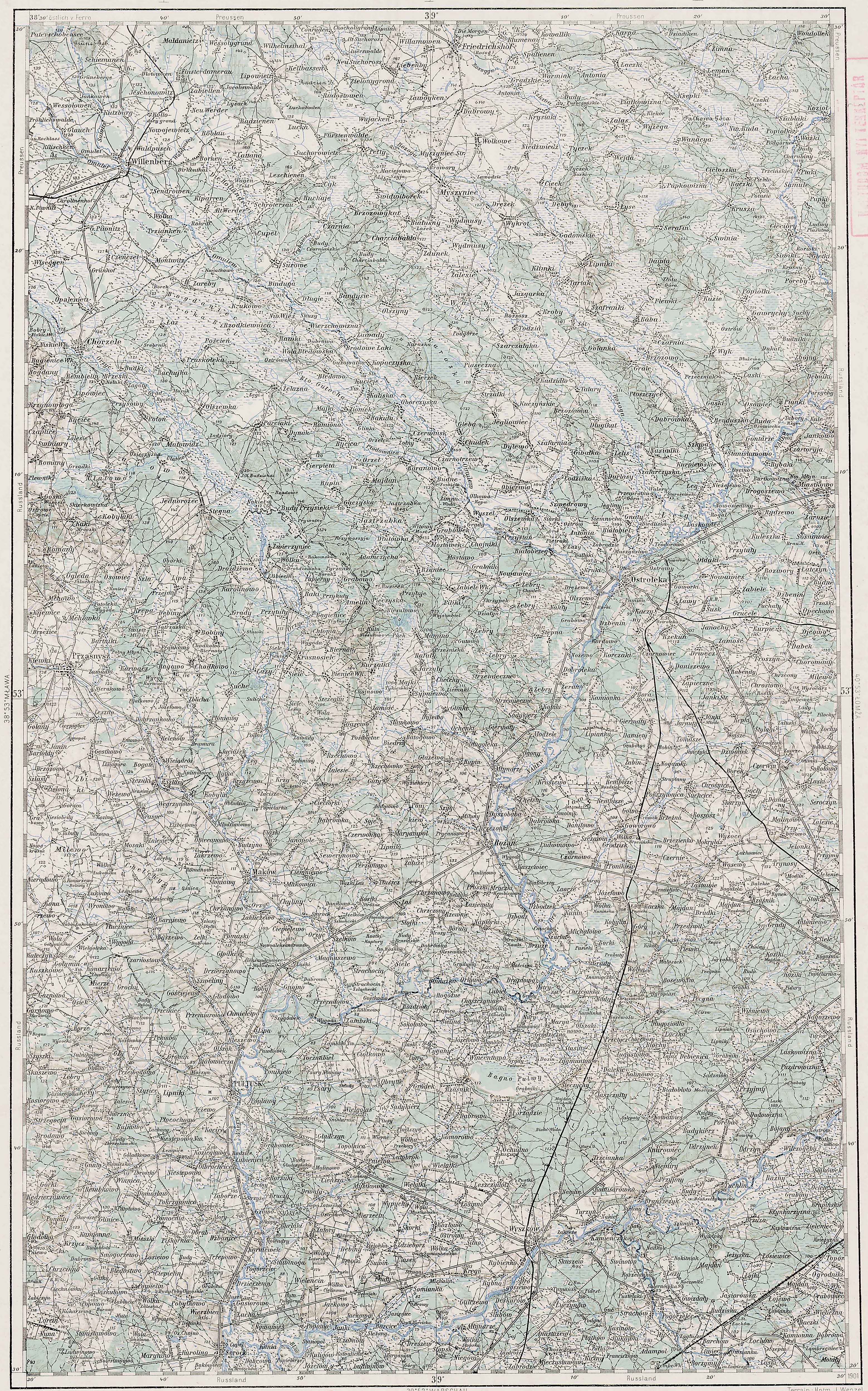
The Słownik Geograficzny Królestwa Polskiego i Innych Krajów Słowiańskich (Geographical Dictionary of the Kingdom of Poland and other Slavonic Countries) includes an entry for the Polish village of Strachocino (now known as the two two villages Stary Strachocin and Nowy Strachocin).
Strachocin and Surrounding Area – 1910
Third Military Mapping Survey of Austria-Hungary (ELTE Faculty of Informatics, Institute of Cartography and Geoinformatics); digital images, Lazarus ELTE (http://lazarus.elte.hu/hun/digkonyv/topo/200e/39-53.jpg: accessed 20 December 2025)
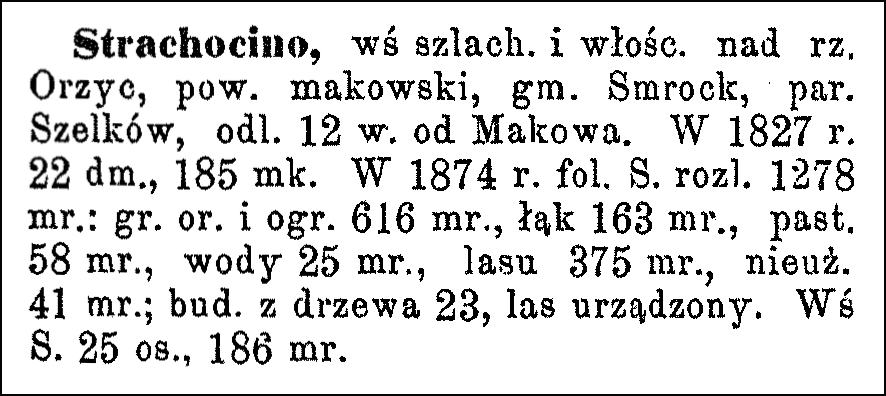
Source: Chlebowski, Bronisław and Władysław Walewski, eds., Słownik Geograficzny Królestwa Polskiego i Innych Krajów Słowiańskich (Geographical Dictionary of the Kingdom of Poland and other Slavonic Countries) – Warsaw 1890, Volume XI,
Click on the link for a PDF copy of the the Słownik Geograficzny entries for Strachocino. Translated from the Polish, the entry reads:
Strachocino, a village of nobles and peasants on the Orzyc River, Maków powiat, Smrock gmina, Szelków parish, 12 versts [1 verst = 1.07 kilometers] from Maków. In 1827, it had 22 houses and 185 inhabitants. In 1874, the Strachocino estate covered 1278 mórgs [Gerald Ortell’s book on Polish Parish Records states that in the Russian partition 1 mórg = 1.388 acres]: arable land and gardens 616 mórgs, meadows 163 mórgs, pastures 58 mórgs, water 25 mórgs, forest 375 mórgs, unused land 41 mórgs; 23 wooden buildings, managed forest. The village of Strachocino had 25 inhabitants and 186 mórgs of land.
The Dictionary of Polish Place Names (Nazwy Miejscowe Polski) explains the origin of place names in Poland and details how the place name changed over time.
Volume II of Nazwy Miejscowe Polski has one entry for a location called Ciepielewo.
Nazwy Miejscowe Polski indicates that Ciepielewo is a village that was in the Szelków gmina, Ostrołęka voivodeship in the years 1975-1998, and is 5 kilometers southeast of Maków Mazowiecki. Mentions of the village include Czepelewo in 1386, Czepelowo in (1421) 1456, Czepellewo in 1427, Czyepyelewo in 1517, Czepieliewo in 1582, Ciepielewo in 1783, Ciepielewo in 1880, Cieplewo Dworskie and Cieplewo Włościańskie in 1921, Ciepielewo Dworskie and Ciepielewo Włościańskie in 1967, and Ciepielewo, -wa, ciepielewski in 1971.
The name of the village was derived from the surname Ciepiel, with the suffix -ewo.
Source: Rymut, Kazimierz, ed., Nazwy Miejscowe Polski (Place Names of Poland) – Krakow 1997, Volume II, page 135.
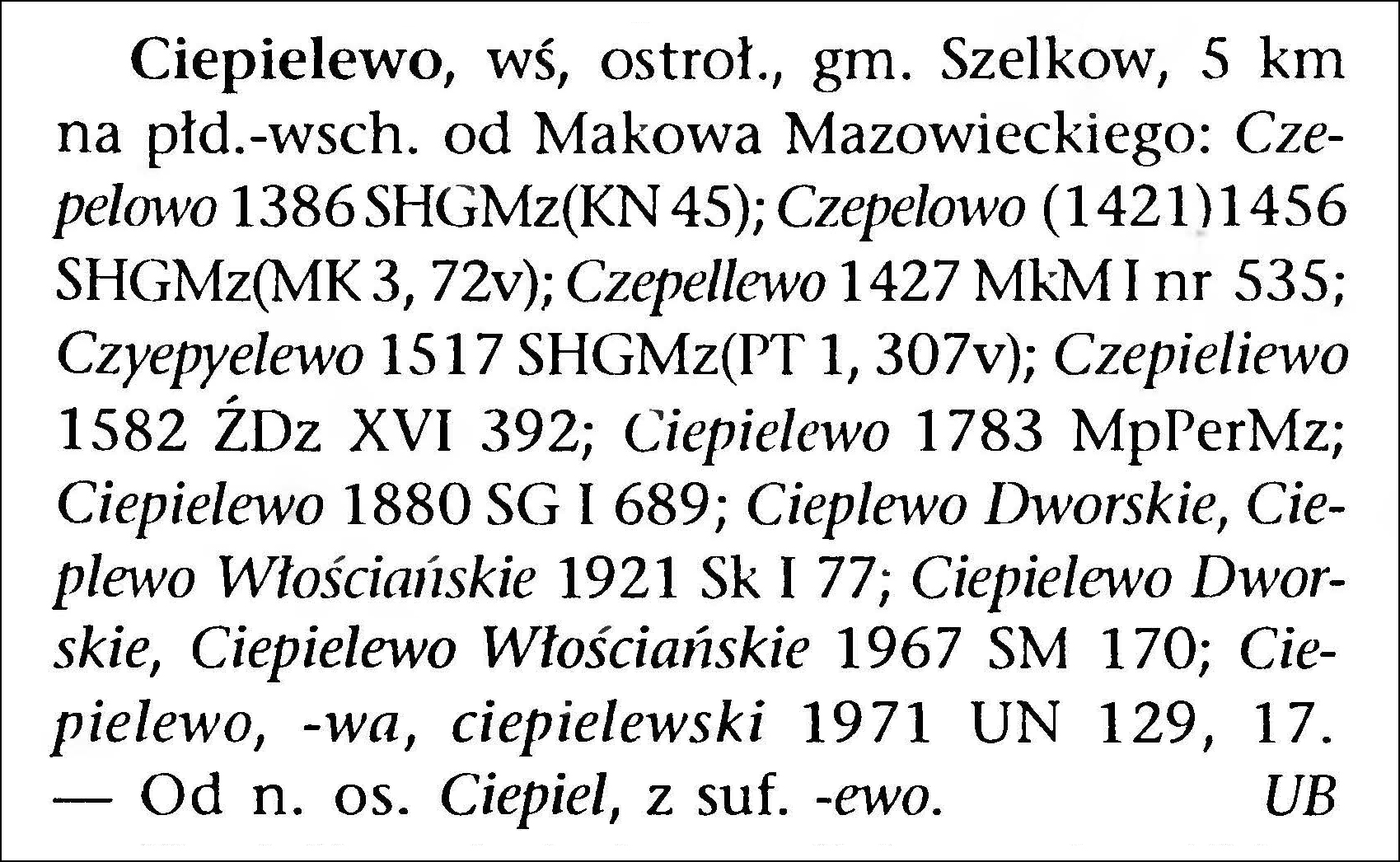
Click the link for a PDF copy of the Nazwy Miejscowe Polski entry for Ciepielewo. Translated rom the Polish, the entry reads:
Ciepielewo, a village in Ostrołęka voivodeship, Szelków gmina [in the years 1975-1998], 5 kilometers southeast of Maków Mazowiecki: Czepelewo 1386 SHGMz (KN 45); Czepelowo (1421) 1456 SHGMz (MK 3, 72v); Czepellewo 1427 MkM I no. 535; Czyepyelewo 1517 SHGMz (PT I, 307v); Czepieliewo 1582 ŹDz XVI 392; Ciepielewo 1783 MpPerMz; Ciepielewo 1880 SG I 689; Cieplewo Dworskie, Cieplewo Włościańskie 1921 Sk I 77; Ciepielewo Dworskie, Ciepielewo Włościańskie 1967 SM 170; Ciepielewo, -wa, ciepielewski 1971 UN 129, 17. – Derived from the name of a settlement Ciepiel, with the suffix -ewo. Ursula Bijak
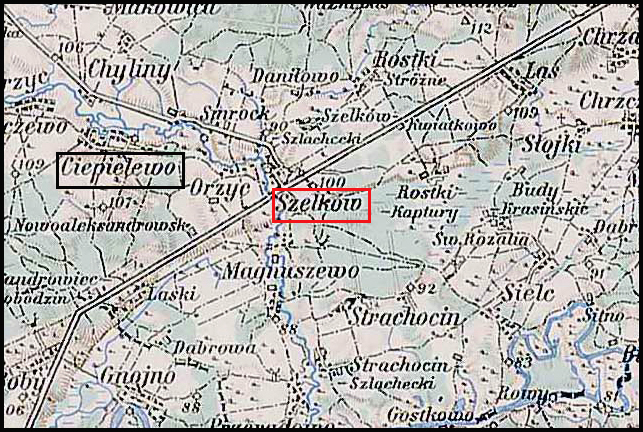
The Słownik Geograficzny Królestwa Polskiego i Innych Krajów Słowiańskich (Geographical Dictionary of the Kingdom of Poland and other Slavonic Countries) includes two entries for the Polish village of Ciepielewo.
Ciepielewo and Surrounding Area – 1910
Third Military Mapping Survey of Austria-Hungary (ELTE Faculty of Informatics, Institute of Cartography and Geoinformatics); digital images, Lazarus ELTE (http://lazarus.elte.hu/hun/digkonyv/topo/200e/39-53.jpg: accessed 20 December 2025)
Source: Sulmierski, Filip, Bronisław Chlebowski, and Władysław Walewski, eds., Słownik Geograficzny Królestwa Polskiego i Innych Krajów Słowiańskich (Geographical Dictionary of the Kingdom of Poland and other Slavonic Countries) – Warsaw 1880, Volume I, Page 689.
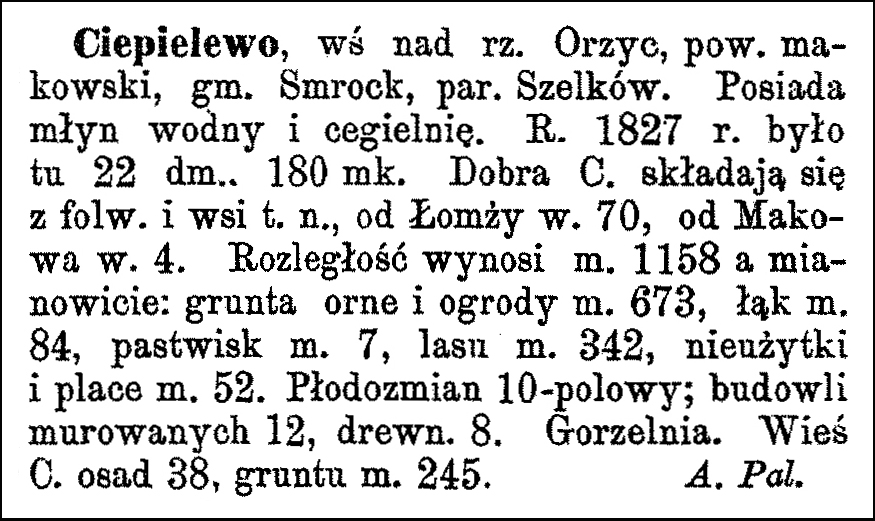
Click on the link for a PDF copy of the the Słownik Geograficzny entries for Ciepielewo. Translated from the Polish, the first entry reads:
Ciepielewo, a village on the Orzyc River, Maków powiat, Smrock gmina, Szelków parish. It has a watermill and a brickyard. In 1827, there were 22 houses and 180 inhabitants. The Ciepielewo estate consists of a manor farm and the village of the same name, 70 versts [1 verst = 1.07 kilometers] from Łomża and 4 versts from Maków. Its area is 1158 mórgs [Gerald Ortell’s book on Polish Parish Records states that in the Russian partition 1 mórg = 1.388 acres], specifically: arable land and gardens 673 mórgs, meadows 84 mórgs, pastures 7 mórgs, forest 342 mórgs, unproductive land and building plots 52 mórgs. It uses a 10-field crop rotation system; there are 12 brick buildings and 8 wooden ones. There is also a distillery. The village of Ciepielewo has 38 settlements and 245 mórgs of land. A. Pal.
Translated from the Polish, the second entry reads:
Ciepielewo, a village in Maków powiat. In 1582 there were 20 peasant farms, 4 smallholdings, 1 craftsman.
The Słownik Geograficzny Królestwa Polskiego i Innych Krajów Słowiańskich (Geographical Dictionary of the Kingdom of Poland and other Slavonic Countries) includes three entries for the Polish village of Szelków, two of which apply to the village currently known as Stary Szelków near Maków Mazowiecki. The third entry applies to the village of Shel’viv (Шельвів) which is now in the Volyn Oblast of Ukraine and which will not be discussed here.
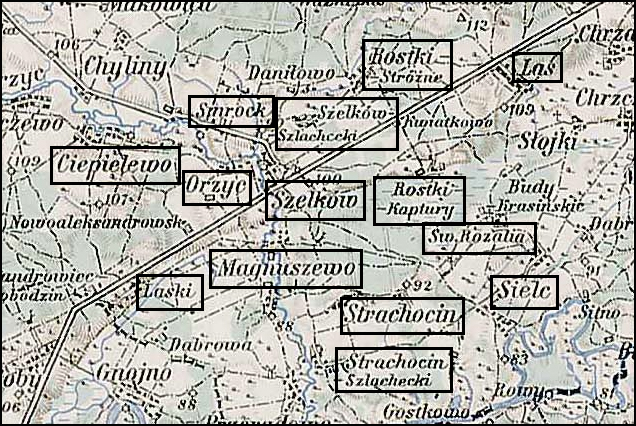
Today, the parish of St. Simon and Jude Thaddeus is seated in Stary Szelkow. According to the parish website, the parish includes the villages of Ciepielewo, Kaptury, Laski, Łaś, Magnuszew Duży, Magnuszew Mały, Nowy Sielc, Nowy Strachocin, Nowy Szelków, Orzyc, Rostki, Smrock Dwór, Smrock Kolonia, Stary Sielc, Stary Strachocin, Stary Szelków, and Św. Rozalia-Słojki.
Szelków and Surrounding Area – 1910
Third Military Mapping Survey of Austria-Hungary (ELTE Faculty of Informatics, Institute of Cartography and Geoinformatics); digital images, Lazarus ELTE (http://lazarus.elte.hu/hun/digkonyv/topo/200e/39-53.jpg: accessed 20 December 2025)
Source: Chlebowski, Bronisław and Władysław Walewski, eds., Słownik Geograficzny Królestwa Polskiego i Innych Krajów Słowiańskich (Geographical Dictionary of the Kingdom of Poland and other Slavonic Countries) – Warsaw 1890, Volume XI, page 890.
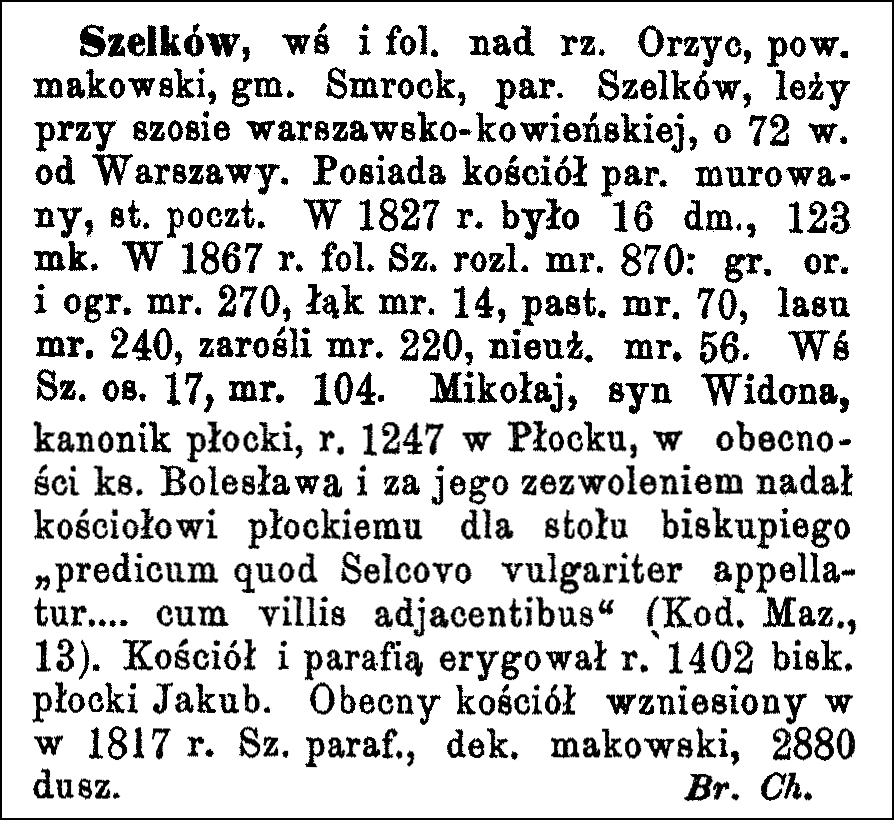
Click on the link for a PDF copy of the the Słownik Geograficzny entries for Szelków. Translated from the Polish, the first entry reads:
Szelków, a village and manor estate on the Orzyc River, Maków powiat, Smrock gmina, Szelków parish, is located on the Warsaw-Kowno highway, 72 km from Warsaw. It has a brick parish church and a post office. In 1827, there were 16 houses and 123 inhabitants. In 1867, the Szelków manor estate covered 870 mórgs [Gerald Ortell’s book on Polish Parish Records states that in the Russian partition 1 mórg = 1.388 acres]: 270 mórgs of arable land and gardens, 14 mórgs of meadows, 70 mórgs of pastures, 240 mórgs of forest, 220 mórgs of thickets, and 56 mórgs of unproductive land. The village of Szelków had 17 settlements and 104 mórgs of land. Mikołaj, son of Widon, a canon of Płock, in 1247 in Płock, in the presence of Prince Bolesław and with his permission, granted to the Płock church for the bishop’s table “the estate which is commonly called Selcovo… with the adjacent villages” (Kod. Maz., 13). The church and parish were established in 1402 by Bishop Jakub of Płock. The present church was built in 1817. Szelków parish, Maków deanery, 2880 souls. Bronisław Chlebowski
Source: Chlebowski, Bronisław, ed., Słownik Geograficzny Królestwa Polskiego i Innych Krajów Słowiańskich (Geographical Dictionary of the Kingdom of Poland and other Slavonic Countries) – Warsaw 1902, Volume XV Part II, page 641.
Translated from the Polish, the second entry reads:
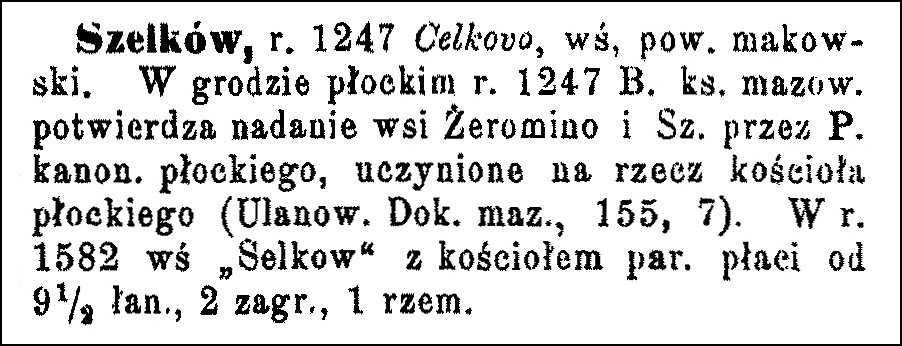
Szelków, Celkovo in the year 1247, village, Maków powiat. In the Płock castle in 1247, Bolesław I, the Duke of Mazovia, confirmed the grant of the villages of Żeromino and Szelków by P., the canon of Płock, to the Płock church (Ulanow. Documents of Mazovia, 155, 7). In 1582, the village of “Selkow” with its parish church paid taxes on 9 1/2 łans (land units), 2 homesteads, and 1 craftsman.
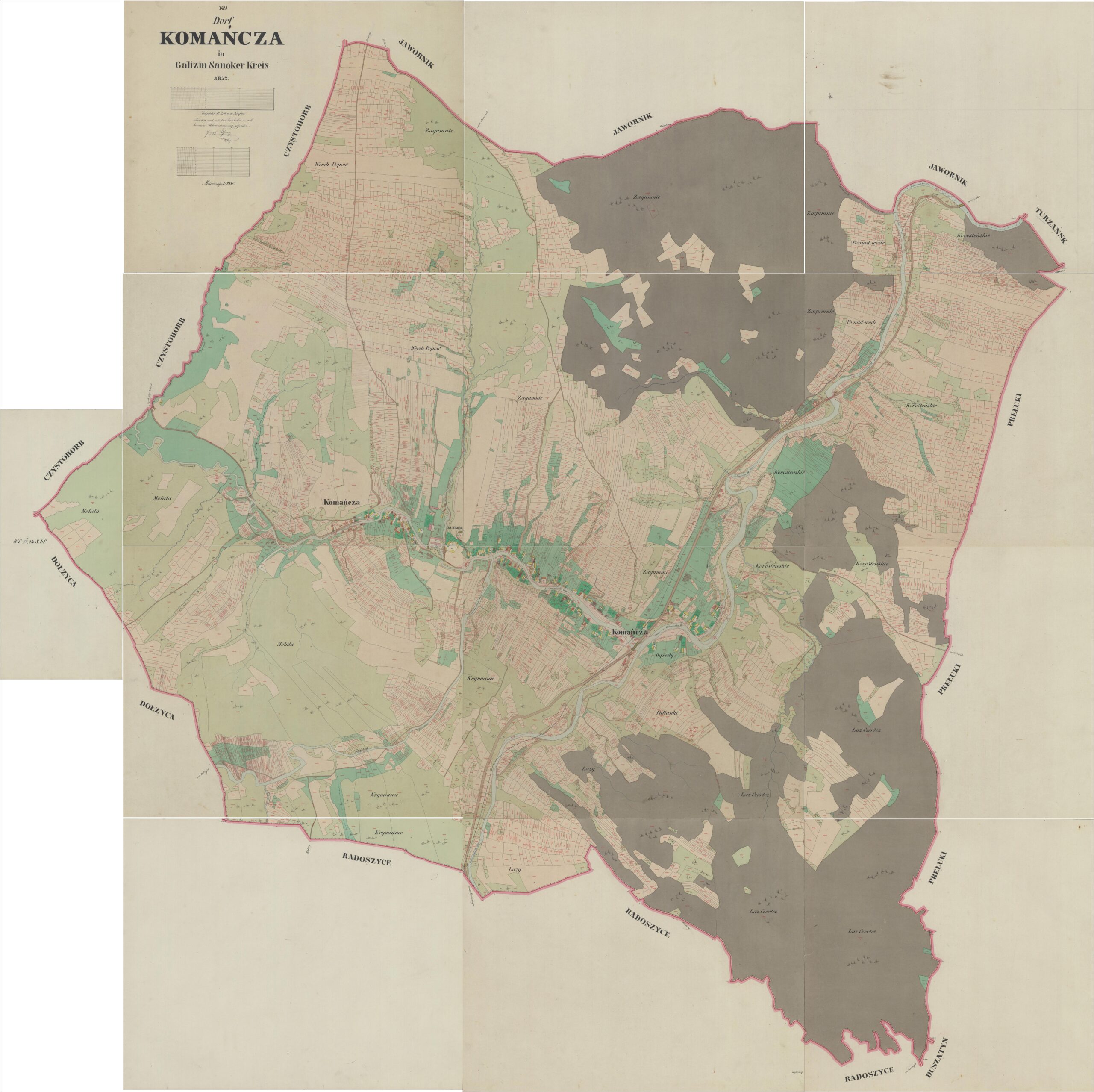
The cadastral map of the Polish village of Komańcza, created by officials of the Austrian Empire in 1852 is available on the website of the Polish State Archives at Szukaj w Archiwach. The files at Szukaj w Archiwach include thirteen images that, together, form the complete map.
The Dictionary of Polish Place Names (Nazwy Miejscowe Polski) explains the origin of place names in Poland and details how the place name changed over time.
Volume V of Nazwy Miejscowe Polski lists one place called Komańcza. The village is currently in Podkarpackie Voivodeship. Szukaj w Archiwach has scanned images of birth/marriage, and death records from 1784-1830 + 1840, and 1830-1851 for the Greek Catholic Church in Komańcza, with branches in Czystohorb and Dołżyca.
Nazwy Miejscowe Polski indicates that Czystogarb was in the Komańcza Gmina, Krosno Voivodeship in the years 1975-1998, and is 25 kilometers southwest of Zagórz. Mentions of the village include “to locate a new village on the river Komanycza, which village will be called Crziemyenna … into the Comancza river” in 1512, Komancza in 1524, “from Komańcza, in Komańcza” in 1561, from Komańcza in 1638, “village of Komancza” in 1786, Komancza in 1794, Komanča in 1860, Komańcza in 1883, and Komańcza, -czy, komaniecki in 1966.
The name of the village may originate with the name of the river Komańcza. Alternatively, the name may be derived from Komanec a member of the Turkic Ko(u)man tribe, also known as Polovtsy, who lived in the territory of Rus’ in the 11th-13th centuries. It may also be derived from the personal name Komanec (Koman, a personal name recorded in the 15th century in the nearby village of Szczawne). The alternative name Krzemienna is from the adjective krzemienny ‘stony’.
Source: Rymut, Kazimierz, ed., Nazwy Miejscowe Polski (Place Names of Poland) – Krakow 2003, Volume V, page 77.
Click the link for a PDF copy of the Nazwy Miejscowe Polski entry for Komańcza. Translated from the Polish, the entry reads:
Komańcza, village, Krosno voivodeship, Komańcza gmina, 25 kilometers southwest of Zagórz: to locate a new village on the river Komanycza, which village will be called Crziemyenna … into the Comancza river 1512 Fast 156, note 655; Komancza 1524 Matr IV/3, no. 23222; from Komańcza, in Komańcza 1561 RZł 61; from Komańcza 1638 RZł 215; village of Komancza 1786 MJ 19, XV, 42, 39; Komancza 1794 Ga R2; Komanča 1860 Sch 119; Komańcza 1883 SG IV 297; Komańcza, -czy, komaniecki 1966 UN 71, 32. – From the river name Komańcza. The name may derive from *Komanec ‘a member of the Turkic Ko(u)man tribe, also known as Polovtsy, who lived in the territory of Rus’ in the 11th-13th centuries’ MakSk 88 or from the personal name *Komanec (: Koman, a personal name recorded in the 15th century in the nearby village of Szczawne Fast 215), with the suffix -ja. Lemkos say komańcza, kumańcza. The alternative name Krzemienna is from the adjective krzemienny ‘stony’. Lithuanian: MakSk 88-9; RiegŁemk 190; Borek, –ьn– 116; RospSEMiG 154. Barbara Czopek-Kopciuch
The Słownik Geograficzny Królestwa Polskiego i Innych Krajów Słowiańskich (Geographical Dictionary of the Kingdom of Poland and other Slavonic Countries) includes an entry for the Polish village of Komańca.
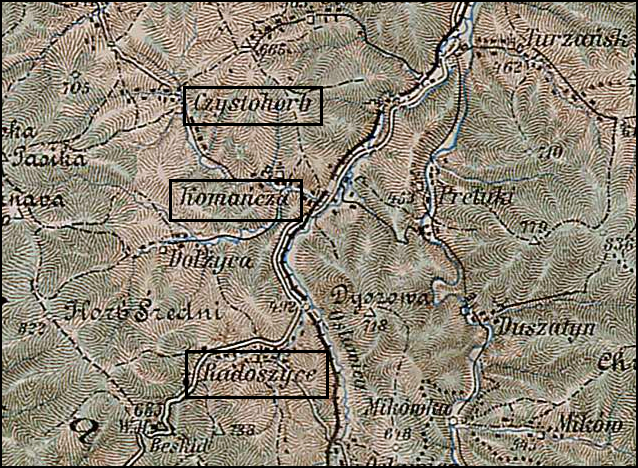
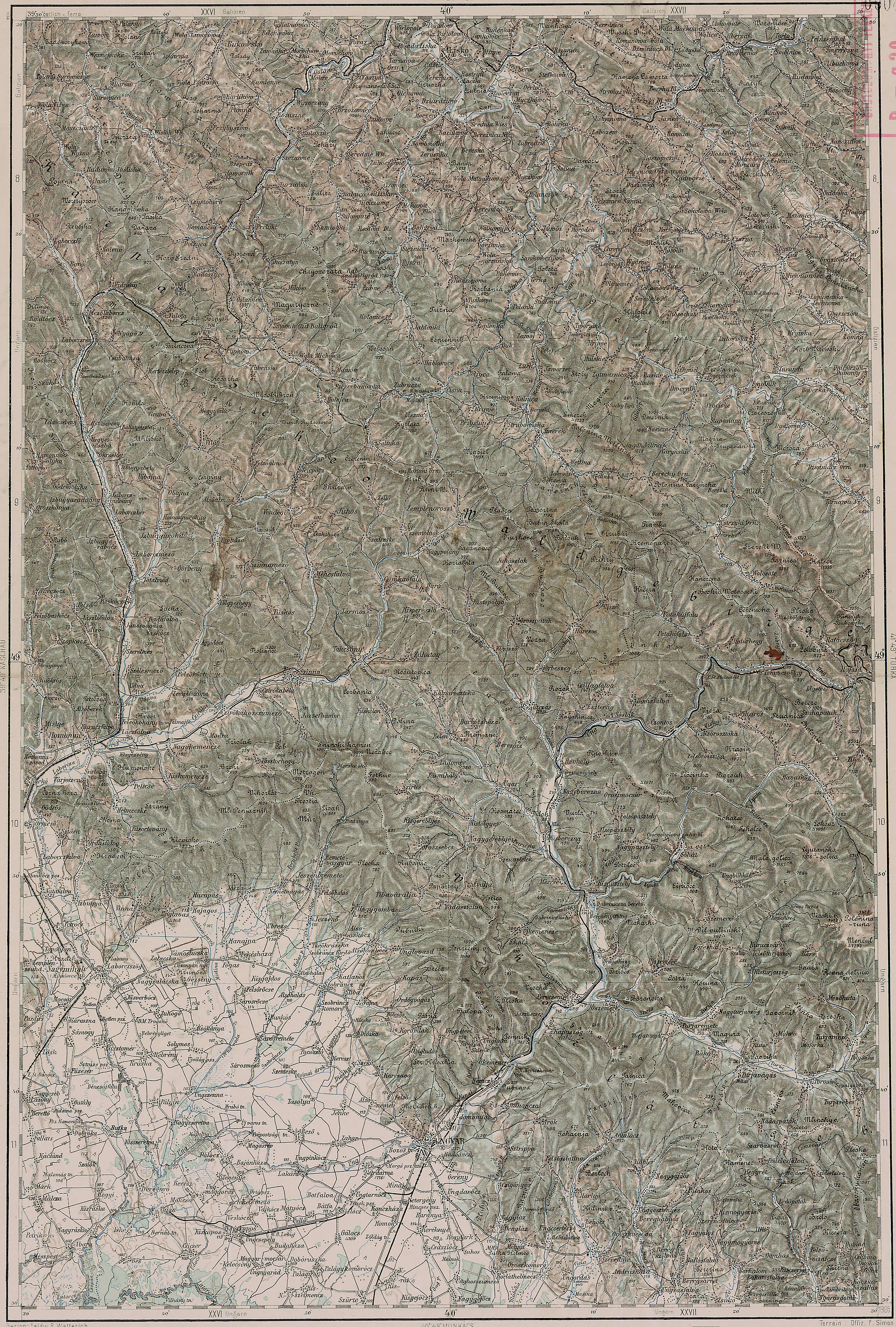
Komańcza and Surrounding Area – 1910
Third Military Mapping Survey of Austria-Hungary (ELTE Faculty of Informatics, Institute of Cartography and Geoinformatics); digital images, Lazarus ELTE (http://lazarus.elte.hu/hun/digkonyv/topo/200e/40-50.jpg: accessed 17 December 2025)
Source: Sulimierski, Filip, Bronisław Chlebowski, and Władysław Walewski, eds., Słownik Geograficzny Królestwa Polskiego i Innych Krajów Słowiańskich (Geographical Dictionary of the Kingdom of Poland and other Slavonic Countries) – Warsaw 1883, Volume IV, pages 296-297.
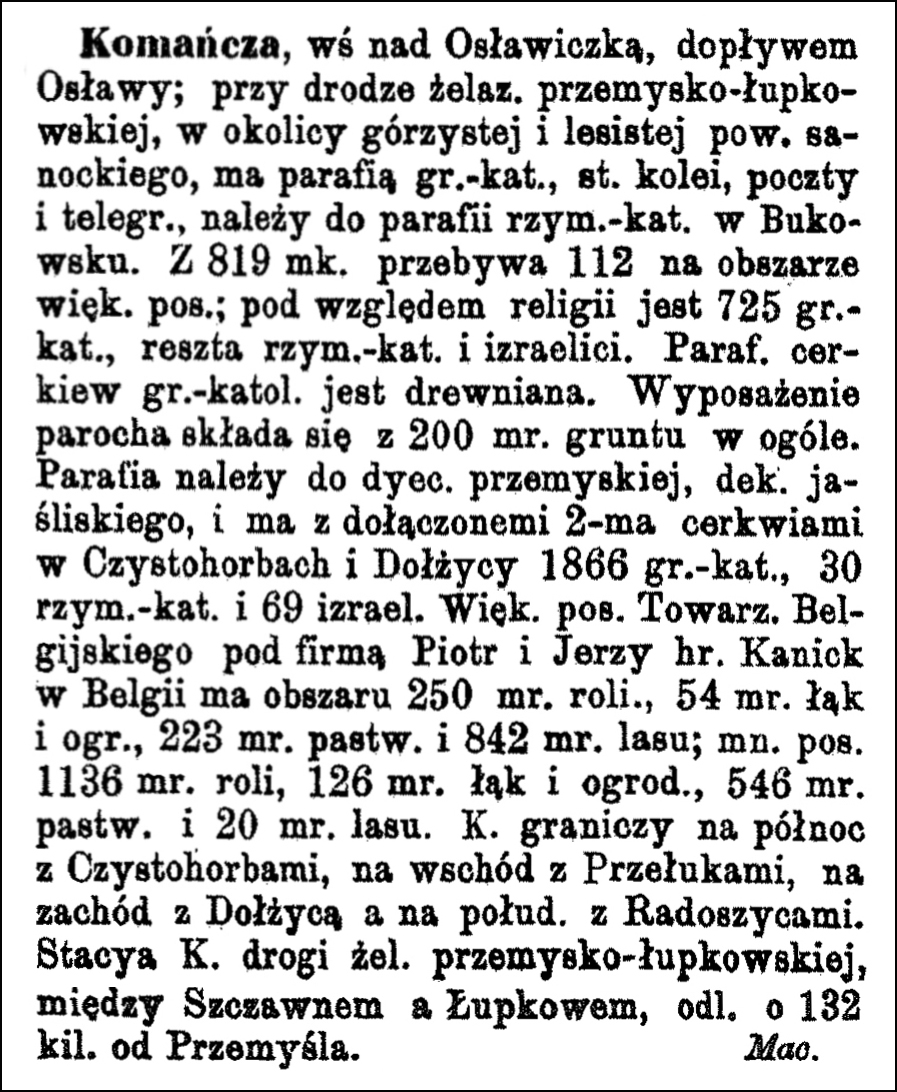
Click on the link for a PDF copy of the first Słownik Geograficzny entries for Komańcza. Translated from the Polish, the entry reads:
Komańcza, a village on the Osławiczka [now known as Osławica] River, a tributary of the Osława; located on the Przemyśl-Łupków railway line, in a mountainous and forested area of the Sanok district. It has a Greek Catholic parish, a railway station, post office, and telegraph office, and belongs to the Roman Catholic parish in Bukowsko. Of the 819 inhabitants, 112 reside on the larger estate; in terms of religion, there are 725 Greek Catholics, the rest are Roman Catholics and Jews. The Greek Catholic parish church is wooden. The parish priest’s endowment consists of 200 acres of land in total. The parish belongs to the Przemyśl diocese, Jaśliska deanery, and, together with the two churches in Czystohorb [now known as Czystogarb] and Dołżyca, has 1866 Greek Catholics, 30 Roman Catholics, and 69 Jews. The larger estate, owned by a Belgian Company under the name of Counts Piotr and Jerzy Kanicki in Belgium, has 250 mórgs [Gerald Ortell’s book on Polish Parish Records states that in Galicia 1 morg = 1.422 acres] of arable land, 54 mórgs of meadows and gardens, 223 mórgs of pastures, and 842 mórgs of forest; the smaller estate has 1136 mórgs of arable land, 126 mórgs of meadows and gardens, 546 mórgs of pastures, and 20 mórgs of forest. Komańcza borders Czystohorb to the north, Przełuki to the east, Dołżyca to the west, and Radoszyce to the south. The Komańcza railway station is on the Przemyśl-Łupków line, between Szczawne and Łupków, 132 km from Przemyśl. M. Maciszewski
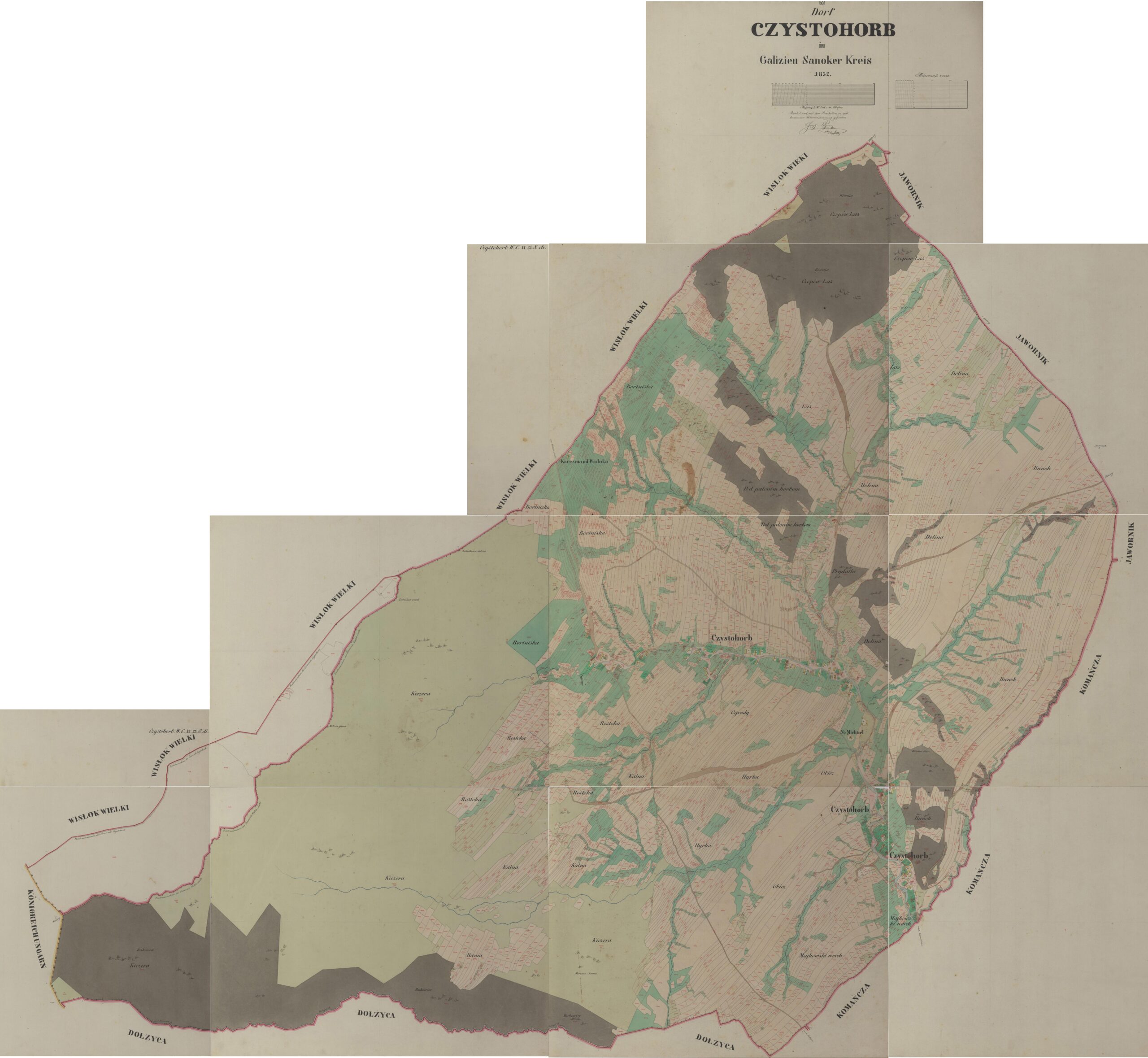
The cadastral map of the Polish village of Czystogarb (Czystohorb), created by officials of the Austrian Empire in 1852 is available on the website of the Polish State Archives at Szukaj w Archiwach. The files at Szukaj w Archiwach include twelve images that, together, form the complete map.
The Dictionary of Polish Place Names (Nazwy Miejscowe Polski) explains the origin of place names in Poland and details how the place name changed over time.
Volume II of Nazwy Miejscowe Polski lists one place called Czystogarb. The village is currently in Podkarpackie Voivodeship. Szukaj w Archiwach has scanned images of birth/marriage, and death records from 1784-1814 and 1814-1887 as well as birth records from 1844-1913 and death records from 1865-1926 for Czystogarb (Czystohorb).
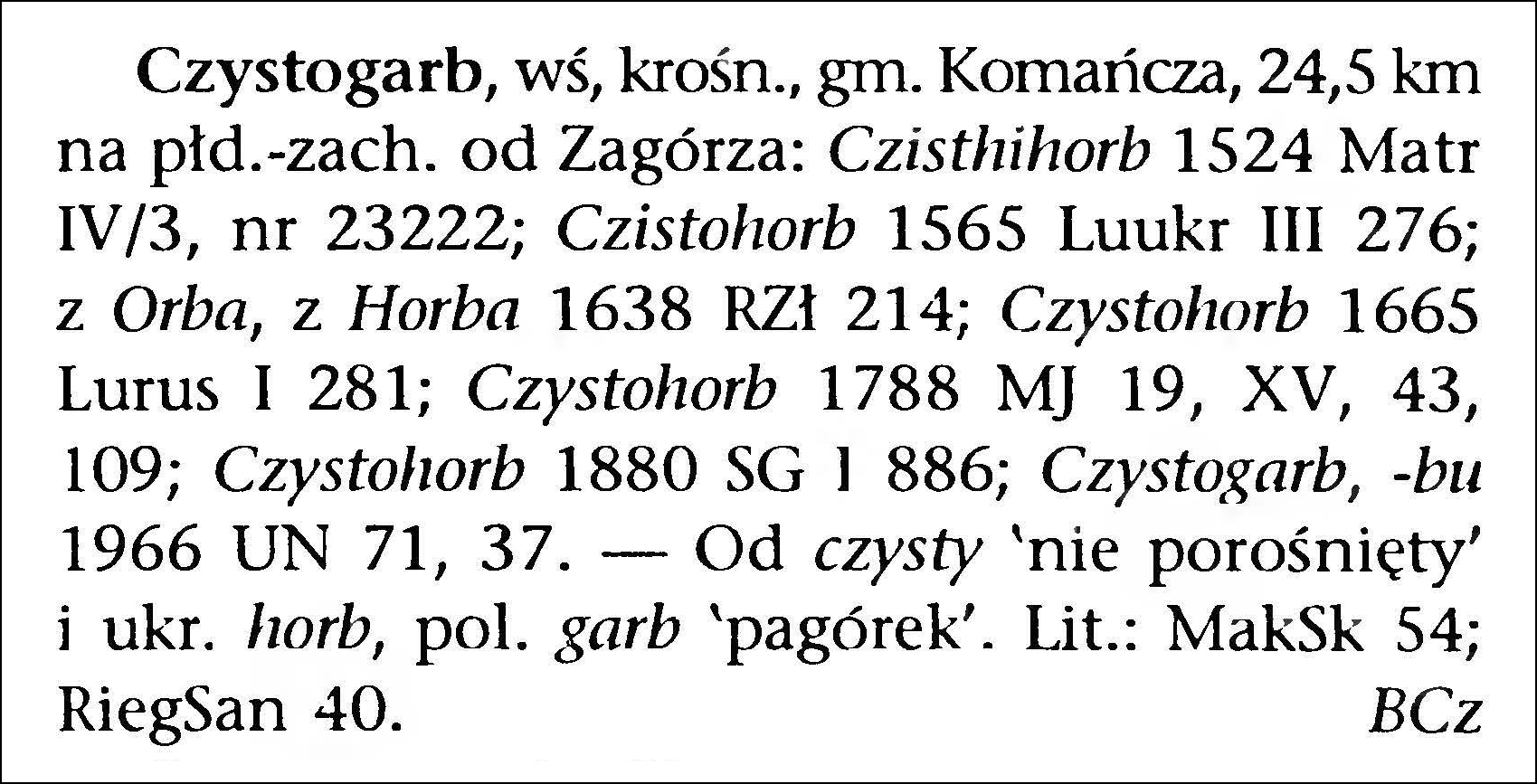
Nazwy Miejscowe Polski indicates that Czystogarb was in the Komańcza Gmina, Krosno Voivodeship in the years 1975-1998, and is 24.5 kilometers southwest of Zagórz. The name of the village was written as Czisthihorb in 1524, Czistohorb in 1565, z Orba and z Horba in 1638, Czystohorb in 1665, Czystohorb in 1788, Czystohorb in 1880, and Czystogarb, -bu in 1966. The name of the village comes from the Polish word “czysty” meaning ‘not overgrown’ and the Ukrainian word “horb” and the Polish word “garb” meaning ‘hillock’.
Source: Rymut, Kazimierz, ed., Nazwy Miejscowe Polski (Place Names of Poland) – Krakow 1997, Volume II, page 243.
Click the link for a PDF copy of the Nazwy Miejscowe Polski entry for Cystogarb (Czystohorb). Translated from the Polish, the entry reads:
Czystogarb, village, Krosno district, Komańcza commune, 24.5 km southwest of Zagórz: Czisthihorb 1524 Matr IV/3, no. 23222; Czistohorb 1565 Luukr III 276; z Orba, z Horba 1638 RZł 214; Czystohorb 1665 Lurus I 281; Czystohorb 1788 MJ 19, XV, 43, 109; Czystohorb 1880 SG I 886; Czystogarb, -bu 1966 UN 71, 37. – From Polish “czysty” ‘not overgrown’ and Ukrainian “horb“, Polish “garb” ‘hillock’. Literature: MakSk 54; RiegSan 40. Barbara Czopek-Kopciuch
The Słownik Geograficzny Królestwa Polskiego i Innych Krajów Słowiańskich (Geographical Dictionary of the Kingdom of Poland and other Slavonic Countries) includes an entry for the Polish village of Czystohorb (now known as Czystogarb).
Czystohorb and Surrounding Area – 1910
Third Military Mapping Survey of Austria-Hungary (ELTE Faculty of Informatics, Institute of Cartography and Geoinformatics); digital images, Lazarus ELTE (http://lazarus.elte.hu/hun/digkonyv/topo/200e/40-50.jpg: accessed 17 December 2025)
Source: Sulmierski, Filip, Bronisław Chlebowski, and Władysław Walewski, eds., Słownik Geograficzny Królestwa Polskiego i Innych Krajów Słowiańskich (Geographical Dictionary of the Kingdom of Poland and other Slavonic Countries) – Warsaw 1880, Volume I, page 886.
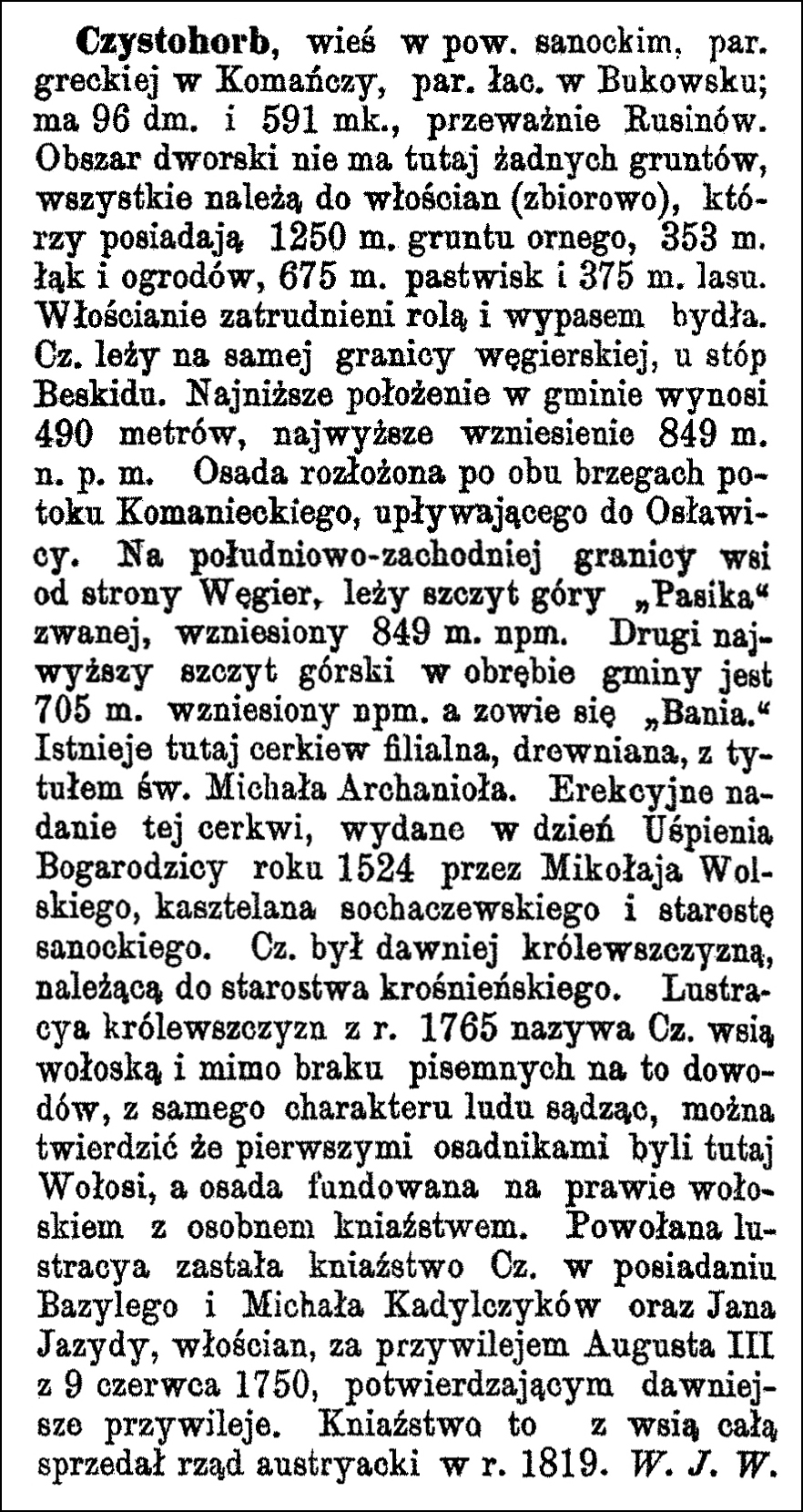
Click on the link for a PDF copy of the first Słownik Geograficzny entry for Czystohorb. Translated from the Polish, the entry reads:
Czystohorb, [now known as Czystogarb] a village in the Sanok powiat, Greek Catholic parish in Komańcza, Roman Catholic parish in Bukowsko; it has 96 houses and 591 inhabitants, mostly Ruthenians. The manor estate does not own any land here; all land belongs to the villagers (collectively), who own 1250 mórgs of arable land, 358 mórgs of meadows and gardens, 675 mórgs of pastures, and 375 mórgs of forest. The villagers are engaged in agriculture and cattle grazing. Czystohorb lies on the very Hungarian border, at the foot of the Beskid Mountains. The lowest point in the commune is 490 meters above sea level; the highest elevation is 849 meters above sea level. The settlement is spread along both banks of the Komańcza stream, which flows into the Osławica river. On the southwestern border of the village, on the Hungarian side, lies the peak of the mountain called “Pasika,” rising to 849 meters above sea level. The second highest mountain peak within the commune is 705 meters above sea level and is called “Bania.” There is a filial wooden church here, dedicated to St. Michael the Archangel. The founding charter for this church was issued on the day of the Dormition [Death and Assumption] of the Mother of God in 1524 by Mikołaj Wolski, castellan of Sochaczew and starost of Sanok. Czystohorb was formerly a royal estate belonging to the Krosno starosty [a storost was a senior administrative official]. The royal estate survey of 1765 calls Czystohorb a Wallachian village, and despite the lack of written evidence, judging from the character of the people, it can be argued that the first settlers here were Wallachians, and the settlement was founded under Wallachian law with a separate principality. The inspection that was carried out found the principality of Czystohorb in the possession of Basil and Michael Kadylczyk and John Jazydy, peasants, by virtue of a privilege granted by Augustus III on June 9, 1750, confirming earlier privileges. The Austrian government sold this principality, along with the entire village, in 1819. W. J. W.