Sunday at Jamboree 2007 – Schelly Talalay Dardashti

Now that Jamboree 2077 is over, I’m back in San Francisco. Today was another busy day, and I attended five lectures, the first one beginning at 7:30 AM and the last ending at 4 PM.

Creating Hope

I was pleased to be able to meet Schelly Talalay Dardashti who presented a breakfast lecture entitled “Creating Hope”. Schelly is a native New Yorker who now resides in Tel Aviv. She is currently in the United States visiting relatives, attending conferences and giving lectures.

When Schelly proposed to write a column on genealogy for the Jerusalem Post, her editor told her “Who wants to read about dead people?” Nonetheless, Schelly wrote her column “It’s All Relative” from 1999-2005 and now works as a freelance writer . Several of her recent articles including, “Never give up the hope of finding family”, “A tale of three women – and a lost family”, and “Cutting-edge genealogy” can be found online.

When approached to write a blog, she reminded her editor that she was over 20 years old. In its brief existence, Shelly’s Tracing the Tribe has become an enormously popular blog that targets those studying Jewish genealogy yet is relevant to all genealogists.

Schelly described her first forays into genealogy in 1989 when her daughter came home with an assignment to fill in a sheet with information up to her great-grandparents. Schelly noted that her own ancestry included origins in Belarus, with anecdotal evidence that the family arrived in Belarus from Spain, an unusual migration, indeed. Her husband’s family was Persian, where there were no written records.

Despite these obstacles, Schelly set out with her daughter to study those records she could find and, after looking at so many microfilms in their quest to discover their family history, her daughter now claims that looking at microfilms makes her dizzy. Through her research, Schelly has traced both her own ancestry and her husband’s ancestry through Belarus, Russia, Lithuania, Spain, Iran, and other countries back to about 1740.

Schelly wrote an article for the JTA entitled “Ashkenazi or Sephardi? DNA Unites Jewish Families, but Raises Questions” in which she discusses the DNA evidence for a group of Litvaks and Galizianers who all genetically match Sephardi and Catholics from Spain and Puerto Rico. As Schelly described the groups, if a Litvak and a Galizianer cross the street to avoid each other, it’s a good day, and so the connection was unexpected.

Other information provided by Schelly is that Sephardic genealogy is relatively new, and DNA analysis of Sephardic Jews in Colorado has shown that these people carry the Ashkenazi breast cancer gene BRCA1.

Many Sicilians may have Jewish ancestry since Jews once comprised a large population in Sicily. Although Jews were expelled from Sicily in 1493, many stayed, and so many present-day Sicilians have Jewish ancestry.

Schelly also told a story of a Catholic in Canada who thought that his mother may have been a “hidden child”, delivered by Jews to a Catholic family shortly before the entire Jewish population of that village was removed to concentration camps by the Nazis. Mitochondrial DNA analysis showed a connection to Ashkenazi Jews.

In another story, Schelly explained that the Cohanim gene is carried by less than 1% of non-Jews, since the gene tracks with the Jewish priestly line who didn’t marry non-Jews. A full 30% of the residents of one town carried this gene, although the residents did not identify as Jewish.

As Schelly put it, DNA provides a spark to us to get where we’re going. When you know where you’re from, you know better where you’re going.

Jewish genealogical resources mentioned in Schelly’s talk include: Yad Vashem – the Central Database of Shoah Victims, the Istanbul Jewish Genealogy Project, the JewishGen Online Worldwide Burial Registry, the Israeli Telephone Company (for which Stephen Morse once provided a portal in English), Litvak on JewishGen, Gesher Galicia, and the general JewishGen website.

When asked why genealogists are so nice, Schelly replied that you have to be nice to everyone, because you don’t know who will have the next piece of the puzzle on which you’re working.

Later this week, I’ll post more about the other Sunday lectures.

Copyright © 2007 by Stephen J. Danko

Posted in Daily Journal | Tagged | 4 Comments

Saturday at Jamboree 2007

The second day of Jamboree 2007 is over, and what a busy day it was! I was up at 6:45 AM to get ready for the first event of the day. I thought I was on vacation this weekend!!??!!

When I registered for Jamboree 2007, I also joined the Southern California Genealogical Society. I suppose that means that this weekend I’m blogging not only for myself, but also for one of the societies to which I belong!

Effective Society Management

The first event this morning was a panel discussion on Effective Society Management over breakfast. Jana Sloan Broglin, Cath Trindle, and Drew Smith answered questions from the audience on Society Management.

The first question asked “How do you find free speakers for your local society?” The panel reminded the audience that you often get what you pay for, although universities, high schools, law firms, local authors, reporters, other local societies in the area, and society members are good sources of local speakers.

Another question was “How do you get people to volunteer”. The panel advised the audience not to beg people to volunteer, but to show members how they are the best choices for the job, make them feel special, ask them what the like to do, and observe those who show up regularly to meetings, since those members are likely to be more reliable than those who don’t regularly attend society functions.

The panel answered several other questions, though space doesn’t allow me to go into more detail here.

Finding Naturalization Records and Ethnic Origins

Lou Szucs began her talk on Finding Naturalization Records and Ethnic Origins by asking if anyone in the audience had witnessed a naturalization ceremony. What did naturalization mean to those being naturalized? Often, naturalization is an emotional event for those becoming citizens.

The biggest problem in finding naturalization records is finding the court in which the records are  maintained. Often, the Certificate of Citizenship was very valuable to the naturalized citizen and may have survived through the years in the hands of family members.

Declarations of Intention and Petitions for Naturalization have been microfilmed for some courts throughout the country. The microfilms may be found in the Family History Library or in State Archives. In some areas, the Works Progress Administration (WPA) indexed the naturalization records.

Lou, who lives in the Chicago area, described an example of where the original naturalization records burned in the Great Chicago fire. In that case, she found a document where an applicant reregistered for naturalization, stating “Through no fault of mine, the city of Chicago burned…”

Sometimes, religious records can provide clues to the ethnic origins of ancestors. In one example, Lou explained how she researched an ancestor in the religious records, didn’t find the person for who she searched, but she found records for the siblings of the individual. Using those records, she was able to trace the ancestor to Ireland, and was able to trace the family back further in time using Griffith’s Valuation.

2007 Update on the Use of DNA in Tracing Your Ancestry

Bennett Greenspan, president of Family Tree DNA, discussed the latest information on Tracing Ancestry Using DNA.

Using markers on the Y chromosome, men can trace their paternal ancestry (father-to-father-to-father-etc) directly. Using mitochondrial DNA markers, both men and women can trace their maternal ancestry (mother-to-mother-to-mother-etc).

Family Tree DNA has over 4000 surname projects and hundreds of geographic projects. Each participant can join up to 6 projects. As long as people have signed releases, participants receive reports showing the names and addresses of those people whose DNA matches their own.

Y DNA can point you in the direction of your ancestral migratory path. Mitochondrial DNA results can also point you in the direction of your ancestral migratory path, but also provide evidence for deep relationships or haplogroups.

Family Tree DNA has a relationship with National Geographic. Family Tree DNA has sold 93,000 test kits directly, and National Geographic has sold 208,000 test kits.

Hanging Y Chromosome Data on Your Family Tree

Diahan Southard, a molecular biologist with Relative Genetics, presented a cogent talk on using Y chromosomal DNA in genealogical research.

Diahan showed how analysis of Y chromosomal DNA can be used to sort out questionable family relationships. In particular, she showed how analysis of Y DNA enabled Relative Genetics to sort out family relationships in the Ethington family.

A four step process was used to understand these relationships, using the DNA analysis of several family members.

  1. Evaluate the data table. To determine if two individuals hare a common ancestor, simply count how many times the two individuals have different values for the same marker.
  2. Visualize the results with a cladogram (haplocation diagram). A cladogram first separates the group of individuals into genetic lineages that includes individuals with no more than four differences from anyone else in the group. For each lineage determine the most common allele at each marker – this is the modal haplotype. Represent each lineage with a circle and connect lineages (circles) with lines to represent a single difference between two lineages.
  3. Find the Most Recent Common Ancestor (MRCA) by carefully analyzing the mutations observed among the individuals in the study.
  4. Compare the genetics data with the genealogical data to determine if the family relationships derived by traditional genealogy are correct.

This is certainly a difficult concept to describe in a limited amount of space here, but it was astonishing to see how analysis of the DNA of a number of individuals who are theoretically related can clearly identify relationships (or lack thereof) even if the traditional genealogical records are ambiguous or conflicting.

Genealogy Resources in the California History Room

Catherine Hanson-Tracy described the Genealogy Resources in the California History Room at the California State Library in Sacramento.

The California State Library has an online catalog that includes a number of genealogically relevant resources including:

  • Books: County and local histories, biographies, diaries, guidebooks, cookbooks, novels, business and institutional histories.
  • Newspapers: 1846 to the present, more than 2200 titles, at least one major newspaper from every county, over 140,000 microfilm reels.
  • Magazines and Journals: more than 4,000 titles, 1856 to the present, scholarly and popular, historical society periodicals.
  • Maps: more than 5,000 items, originals and microfiche copies, early city and county maps, Sanborn Fire Insurance Maps.
  • Manuscripts: Personal correspondence, organization records, business records, more than 700 processed collections.
  • Pictorial Resources: Over 125,000 photographs, albums, and portfolios, postcards, letter sheets, lithographs, online picture catalog (with an emphasis on Southern California), and a lot of stereographs.
  • Ephemera: Posters, promotional brochures, menus, campaign literature, advertisements. Print-on-demand copies of some of these ephemera can be obtained through Zazzle.com.
  • Unique Indexes and Files: California Information File, San Francisco Newspaper Index, Biographical Card File, Biographical Information File.
  • Directories: City Directories as early as the 1850s, Telephone Directories 1899- Present, originals and microfilm copies.
  • Great Registers of Voters: 1866-1944, providing name, address, age, occupation of voters, arranged by county.
  • Vital Records Indexes: California marriage and death indexes, Nevada marriage and divorce indexes.
  • Census Records: California Federal Census Records, California State Census Records for 1852.

The location of the library is 900 N Street, Room 200, Sacramento, CA. The library is open Monday through Friday, 9:30 AM – 4 PM.

The California State Library supports Research at a Distance with an online catalog, website, online archive, interlibrary loan, and assistance by email or phone.

The California Gold Rush

I have little knowledge of the California Gold Rush, and I’ve never found any connection of the California Gold Rush with my family history. Nonetheless, I decided to attend this lecture by Chuck Knuthson to provide myself with some background on the Gold Rush, primarily to learn more of the local history (I didn’t grow up in California, so even though I’ve lived here for 18 years, my knowledge of local and state history is woefully lacking).

In 1769, California’s first Mission and Presidio were established in San Diego.

For 200 years Europeans thought California was an island, and most early inhabitants arrived by sea.

In 1846, the United States declared war on Mexico, a war that ended in February 1848, shortly after gold was discovered in California. Mexico ceded more than half its territory, including California, to the United States.

In 1850, California achieved statehood and, notably, entered the union as a free state, rather than a slave state.

On 24 Jan 1848, James Marshall was building a sawmill on the American River for John Sutter, and discovered gold at Cullumah (now Coloma). In May 1848, a merchant named Samuel Brannan stocked up his store with mining supplies, and then ran through the streets of San Francisco waving a bottle of gold dust and crying, “Gold! Gold! Gold from the American River!” By the summer of that year, there were 2,000 miners at Coloma, and by 1849 there were 10,000 miners.

Early prospectors were called “Forty-Niners” because they arrived in California in 1849. In 1850, 90% of the people in California were men.

When researching records from the Gold Rush, one should apply the same techniques as one generally applies to American Records, tracing ancestry from the present to the past. Some records specific to the Gold Rush include Mining Claims (sometimes called Placer and Quartz Claims), water rights, and mineral rights.

Footnote.com

In the evening, I attended an update on Footnote.com hosted by Beau Sharbrough.

Beau gave a tour of the Footnote.com website, reviewing the organization of the site, the content provided, and the plans for the future.

To be brief here (it’s getting very late and I have to be up again at 6:45 AM), I was impressed by the ambitious goals for Footnote.com and look forward to seeing new content in the coming months.

One clear advantage of the subscription structure Footnote.com has established is that one can examine a low resolution image and the metadata for the image without subscribing. One can purchase a single image at a time, a monthly subscription to all images, or an annual subscription to all images. This pricing structure means that you don’t have to purchase anything until you know there is a document of interest, and you don’t have to commit to a long subscription term.

Look for great new content on Footnote.com in the coming months!

Copyright © 2007 by Stephen J. Danko
Posted in Daily Journal | Tagged | Comments Off on Saturday at Jamboree 2007

Friday at Jamboree 2007

The first day of Jamboree 2007 is over and I thoroughly enjoyed my day. I met several old friends and made a few new ones.

State and Territorial Censuses and Substitutes 

The first presentation I attended was on State and Territorial Censuses and Substitutes by Bill Dollarhide. Bill discussed sources that describe the various state censuses available and mentioned a book by Henry J. Dubester, one by Ann S . Lainhart, The Source, The Red Book, and The Genealogy Bulletin. Each of these is good for a particular purpose, and each has its weaknesses.

One of the points that Bill Dollarhide made several times during his talk was that genealogy is in the county courthouse, and the census records can get you to the right courthouse.

Bill pointed out that many census records were lost. Most of the 1890 US Federal Census was lost in a fire, but other census records, such as the 1790-1810 records for Georgia, the 1790 census for Kentucky, and the 1790-1820 records for New Jersey are also missing.

Most states conducted a state census at some time, and the state censuses frequently asked more questions than did the federal censuses. Ancestry.com has started to post digital images of the state census records online.

When census records are not available, other records may be able to substitute for the census. The 1860-1993 Arizona Obituary Card Index, the Florida 1845 election returns, and the 1862-1866 Internal Revenue Assessment Lists for New Hampshire are just some of the available records.

Reverse Genealogy: Finding Your Lost Loved Ones

The second presentation I attended was entitled Reverse Genealogy: Finding Your Lost Loved Ones and was presented by Megan Smolenyak Smolenyak . Some reasons one may have to trace relationships forward, rather than backward in time include finding homes for orphan heirlooms, finding missing kin or friends, attracting reunion attendees, finding DNA study participants, and locating of returning family photos and Bibles.

Two different strategies can work to trace families forward in time: Help them find you (Broadcast) and Go find them (Seeking).

Broadcast strategies include posting on message boards and mailing lists, websites, email campaigns, photobases such as DeadFred and AncientFaces. Seeking strategies include adopting a surround and conquer mentality to first find clusters of associated people and then home in on the relevant individuals; starting with the most recently born, those with the most unusual names, and/or a male; going backwards in time in order to come forward; and following the trail of the deceased to find the living.

Megan has evaluated the value of resources to study Reverse Genealogy and mentioned that the relative rank of these resources changes with time. Currently, she ranks the resources as follows

  1. Census indexes
  2. Online phone directories
  3. Online lineage collections
  4. Online newspaper collections
  5. Social Security Death Index
  6. Online state vital records
  7. Search engines (such as Google)
  8. Other sources such as FindAGrave.com and Interment.net

Bring ‘Em Back to Life – Creating an Ancestor Profile

Drew Smith presented Bring ‘Em Back to Life – Creating an Ancestor Profile. Drew discussed a process to understand our ancestors as real people who lived full lives, rather than just disconnected pieces of information.

Creating a profile of our ancestors can help us to identify how much information we have, identify the quality of our sources, identify gaps in our research, place events in the lives of our ancestors in chronological order, understand why our ancestors may have made certain decisions during their lives, and form the basis for biographies of our ancestors.

To do this, we should locate our ancestors at every possible point in time through census records, land records, tax records, court records, estate records, and religious records. We should learn about other people in our ancestors’ lives, study historical events that may have influenced our ancestors, and study the personal events in our ancestors lives that may have influenced them.

One online resource for placing our ancestors in historical perspective is OurTimeLines.com.

I look forward to tomorrow – an even busier day!

Copyright © 2007 by Stephen J. Danko
Posted in Daily Journal | Tagged | Comments Off on Friday at Jamboree 2007

The 38th Annual Southern California Genealogy Jamboree and Resource Expo

I just have time for a short post this morning. I’m off to the 38th Annual Southern California Genealogy Jamboree and Resource Expo in Burbank for three days of genealogy seminars.

I just installed a wireless network card on my notebook computer just in case the Burbank Airport Marriott Hotel has wireless available. The wireless network I installed in my house seems to be working, and all is well with the world.

Friday’s sessions at the Jamboree include a number of well-known speakers. There are several lectures scheduled concurrently, but after much thought, I decided to attend the following:

  • Bill Dollarhide – Alternatives to the US Census
  • Megan Smolenyak Smolenyak – Reverse Genealogy: Techniques for Finding Your Lost Loved Ones
  • George G. Morgan – Bring ’em Back to Life: Developing an Ancestor Profile

After all these lectures, I’ll be at the Conference Banquet listening to Leland Meitzler talk about The End of Life.

Copyright © 2007 by Stephen J. Danko
Posted in Daily Journal | Tagged | Comments Off on The 38th Annual Southern California Genealogy Jamboree and Resource Expo

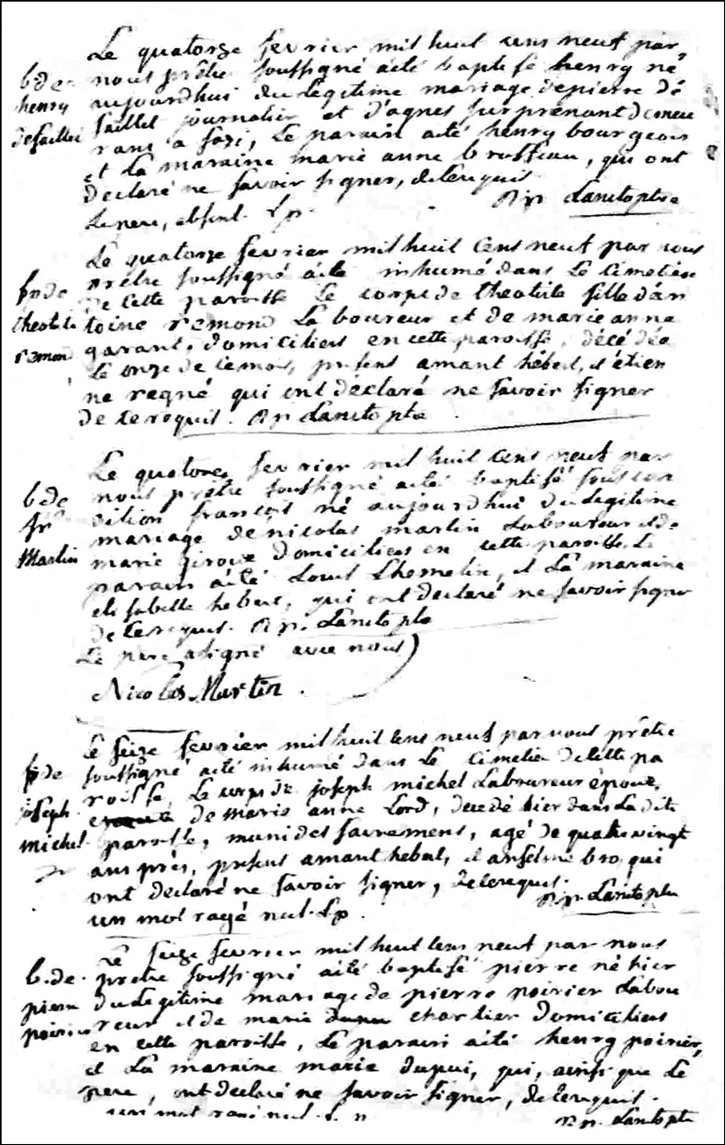
The Birth and Baptism of Franí§ois Martin – 1809

Another son of Nicolas Martin and Marie Giroux was born on 14 Feb 1809 and was named Franí§ois.

The Birth and Baptismal Record of Francois Martin -1809

The Birth and Baptismal Record of Franí§ois Martin – 1809

SOURCE: Gabriel Drouin, comp. Drouin Collection. Montréal, Québec, Canada: Institut Généalogique Drouin. Parish of Ste. Marguerite de Blairfindie, L’Acadie, St. Jean County, Lower Canada, 1809. Birth and Baptismal Record of Franí§ois Martin, Back of Folio 7, B.

Click on the link for a PDF copy of the Birth and Baptismal Record of Franí§ois Martin – 1809. Translated from the French, the record states:

Baptism
of
Fr[aní§ois]
Martin

On the fourteenth of February, one thousand eight one thousand eight hundred and nine, by us, the undersigned priest, was baptized under condition Franí§ois, born today of the legitimate marriage of Nicolas Martin, farmer, and Marie Giroux, residing in this parish. The Godfather was Louis Lhernelin, and the Godmother was Sabelle Lebus, who have declared that they do not know how to sign as required.
[signed] R[ené] P[aschal] Laneto, priest
The father has signed with us.
[signed] Nicolas Martin

This record can be found as image 8 of 42 in the Québec Vital Records (Drouin Collection), 1621-1967 on Ancestry.com in the records for L’Acadie L’Acadie Ste-Marguerite-de-Blairfindie in the year 1809. The record appears on the back of folio 7.

There are two words in this record that precede the name Franí§ois. These two words may be additional first names, but I can’t make them out. The margin shows that the child’s name is Fr, which is an abbreviation for Franí§ois. Oddly enough, the name in the index to these records looks like Theolisle, which doesn’t match the unknown words or the clearly defined name Franí§ois. Perhaps some other record for this child will help clarify this mystery.

UPDATE 08 Jun 2007: Bob Chenard wrote “The two words are: sous condition (under condition) and thus are not names. He is Francois Martin, period.” Thanks so much for your help, Bob. I was stumped!

Several other names in this record are also difficult to read. I’m not absolutely certain of the surname of the Godfather, the first name of the Godmother, or the surname of the Godmother, but I think I’ve transcribed these names correctly. One difficulty with these records is that the priest sometimes misspelled the names, so even if I think I know what the names are supposed to be, the priest may have erred in the spelling.

Copyright © 2007 by Stephen J. Danko
Posted in Daily Journal, Martin | Comments Off on The Birth and Baptism of Franí§ois Martin – 1809

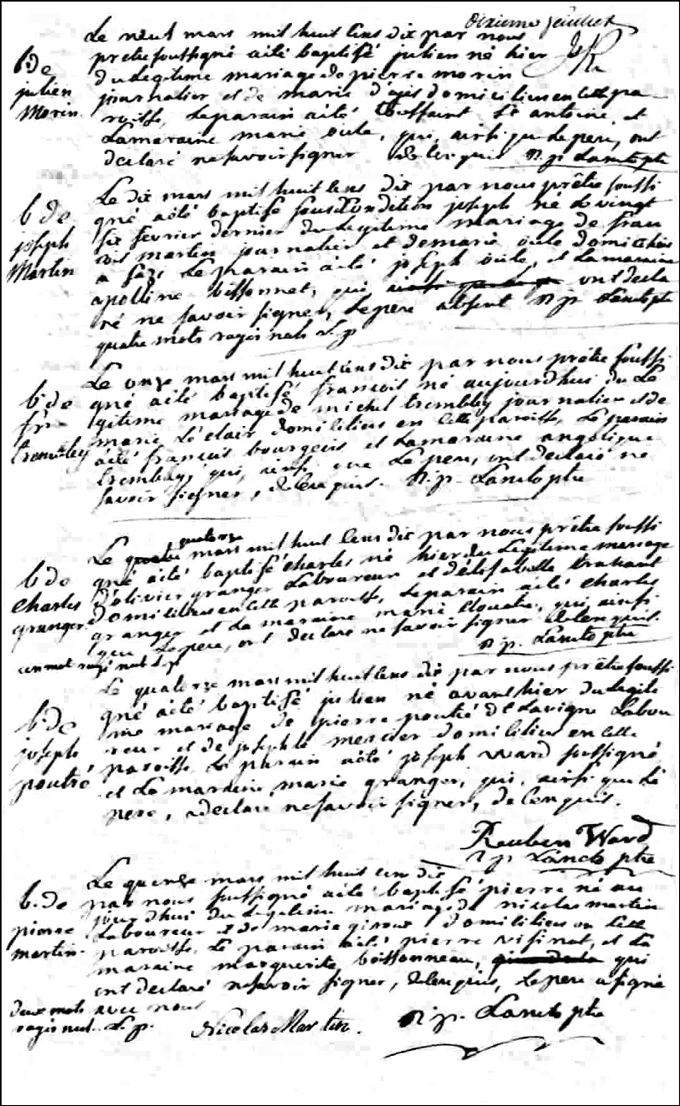
The Birth and Baptism of Pierre Martin – 1810

Moving back still further in time, a son, Pierre, was born to Nicolas Martin and Marie Giroux on 15 Mar 1810.

The Birth and Baptismal Record of Pierre Martin - 1810

The Birth and Baptismal Record of Pierre Martin -1810

SOURCE: Gabriel Drouin, comp. Drouin Collection. Montréal, Québec, Canada: Institut Généalogique Drouin. Parish of Ste. Marguerite de Blairfindie, L’Acadie, St. Jean County, Lower Canada, 1810. Birth and Baptismal Record of Pierre Martin, Front of Folio 10, B.

Click on the link for a PDF copy of the Birth and Baptismal Record of Pierre Martin -1810. Translated from the French, the record states:

Baptism
of
Pierre
Martin

On the fifteenth of March, one thousand eight one thousand eight hundred and ten, by us, the undersigned, was baptized Pierre, born today of the legitimate marriage of Nicolas Martin, farmer, & Marie Giroux, residing in this parish. The Godfather was Pierre Visinot, and the Godmother was Marguerite Boissonneau who declare who have declared that they do not know how to sign as required, the father has signed with us.

[four words?] L[aneto] p[riest]

[signed] Nicolas Martin [signed] R[ené] P[aschal] Laneto, priest

This record can be found as image 10 of 44 in the Québec Vital Records (Drouin Collection), 1621-1967 on Ancestry.com in the records for L’Acadie L’Acadie Ste-Marguerite-de-Blairfindie. The record appears on the front of folio 10.

Copyright © 2007 by Stephen J. Danko
Posted in Daily Journal, Martin | 2 Comments

The Birth and Baptism of Simon Jules Martin – 1812

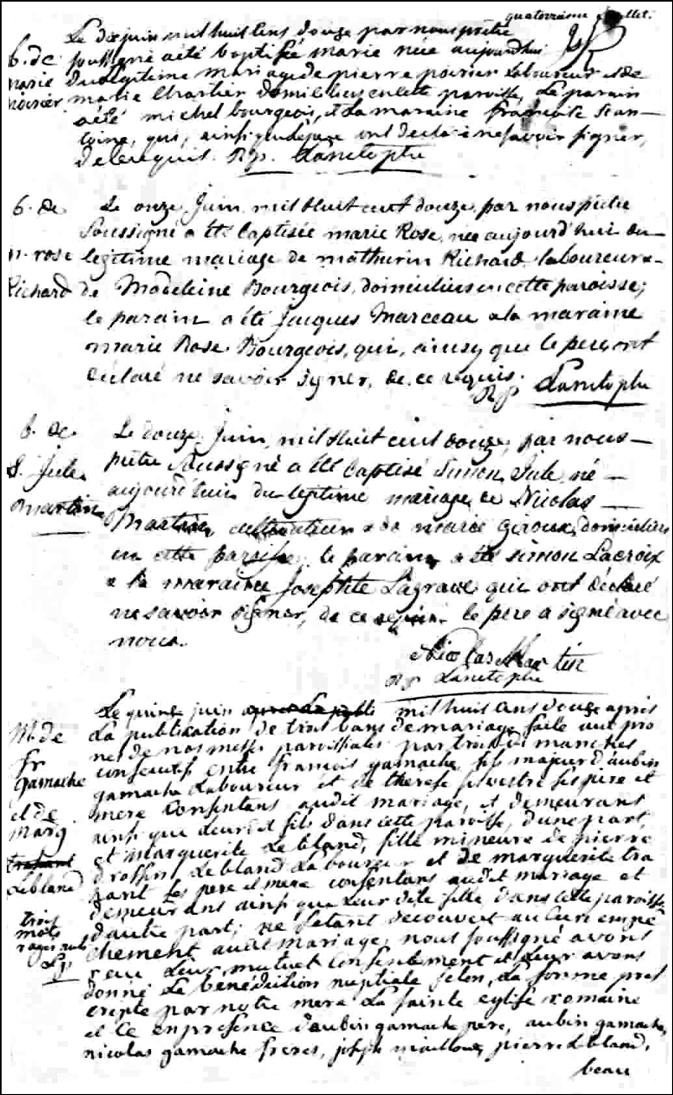
On 12 June 1812, a year before Etienne Martin was born, Simon Jules Martin was born.

The Birth and Baptismal Record of Simon Jules Martin -1812

The Birth and Baptismal Record of Simon Jules Martin – 1812

SOURCE: Gabriel Drouin, comp. Drouin Collection. Montréal, Québec, Canada: Institut Généalogique Drouin. Parish of Ste. Marguerite de Blairfindie, L’Acadie, St. Jean County, Lower Canada, 1812. Birth and Baptismal Record of Simon Jules Martin, Front of Folio 14, B.

Click on the link for a PDF copy of the Birth and Baptismal Record of Simon Jules Martin – 1812. Translated from the French, the record states:

Baptism
of
S. Jules
Martin

On the twelfth of June, one thousand eight hundred and twelve, by us, the undersigned priest, was baptized Simon Jules, born today of the legitimate marriage of Nicolas Martin, farmer, & Marie Giroux, residing in this parish. The Godfather was Simon Lacroix and the Godmother was Josephte Lagrave who have declared that they do not know how to sign as required, the father has signed with us.

[signed] Nicolas Martin
[signed] R[éné] P[aschal] Laneto, priest

This record can be found as image 14 of 38 in the Québec Vital Records (Drouin Collection), 1621-1967 on Ancestry.com in the records for L’Acadie L’Acadie Ste-Marguerite-de-Blairfindie. The record appears on the front of folio 14.

Copyright © 2007 by Stephen J. Danko
Posted in Daily Journal, Martin | Comments Off on The Birth and Baptism of Simon Jules Martin – 1812

The Birth and Baptism of Etienne Martin – 1813

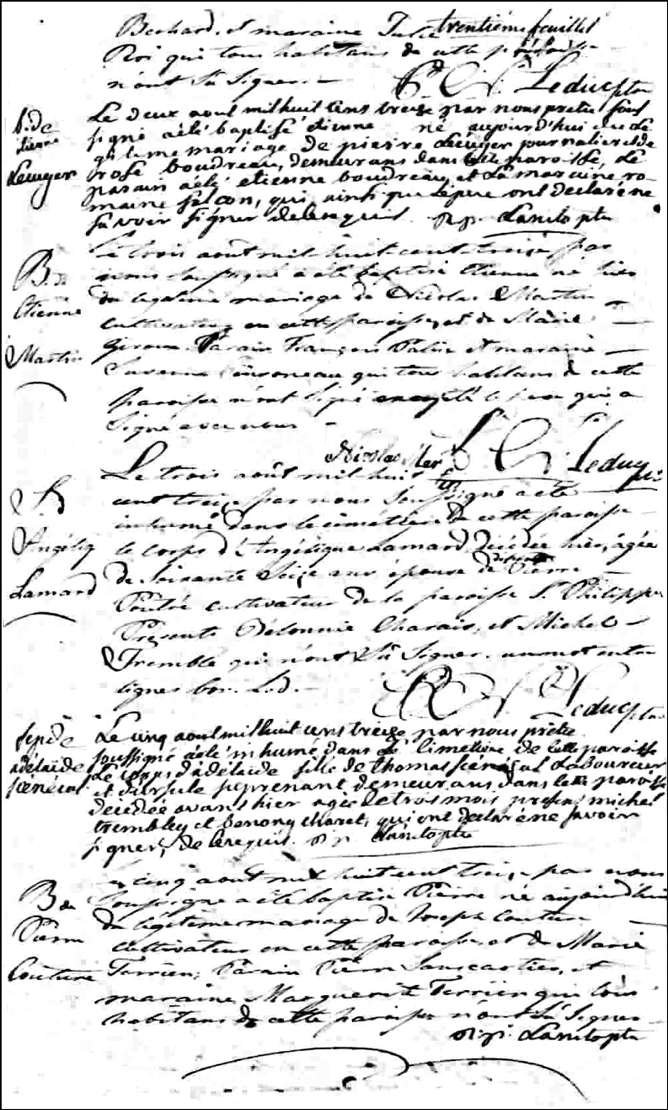
While continuing to follow the records of the parish of Ste. Marie de Blairfindie in L’Acadie back in time, I found the Birth and Baptismal Record of Etienne Martin, the son of Nicolas Martin and Marie Giroux. He was born on 02 Aug 1813.

The Birth and Baptismal Record of Etienne Martin - 1813

The Birth and Baptismal Record of Etienne Martin -1813

SOURCE: Gabriel Drouin, comp. Drouin Collection. Montréal, Québec, Canada: Institut Généalogique Drouin. Parish of Ste. Marguerite de Blairfindie, L’Acadie, St. Jean County, Lower Canada, 1813. Birth and Baptismal Record of Etienne Martin, Front of Folio 30, B.

Click on the link for a PDF copy of the Birth and Baptismal Record of Etienne Martin – 1813. Translated from the French, the record states:

Baptism
Etienne
Martin

On the third of August one thousand eight one thousand eight hundred and thirteen, we, the undersigned, have baptized Etienne born yesterday of the legitimate marriage of Nicolas Martin, farmer in this parish, and Marie Giroux, the Godfather Franí§ois Palin and the Godmother Susanne [Bissoneau?] who all live in this parish, did not sign [one word] the father who has signed with us –

[signed] Nicolas Martin                               [signed] L. C. Leduc, priest

Etienne’s yonger sister Désanges was born in 1817, and the time between their births was four years. I generally would have expected another child or two to be born in that period. Perhaps I missed a birth. I’ll have to review the records for 1814-1816 again to make sure I didn’t miss someone.

This record can be found in the Québec Vital Records (Drouin Collection) 1621-1967 on Ancestry.com as image 30 of 43 in the records of L’Acadie L’Acadie Ste-Marguerite-de-Blairfindie for the year 1813. The record is on the front of folio 30.

Copyright © 2007 by Stephen J. Danko
Posted in Daily Journal, Martin | Comments Off on The Birth and Baptism of Etienne Martin – 1813

The Birth and Baptism of Désanges Martin – 1817

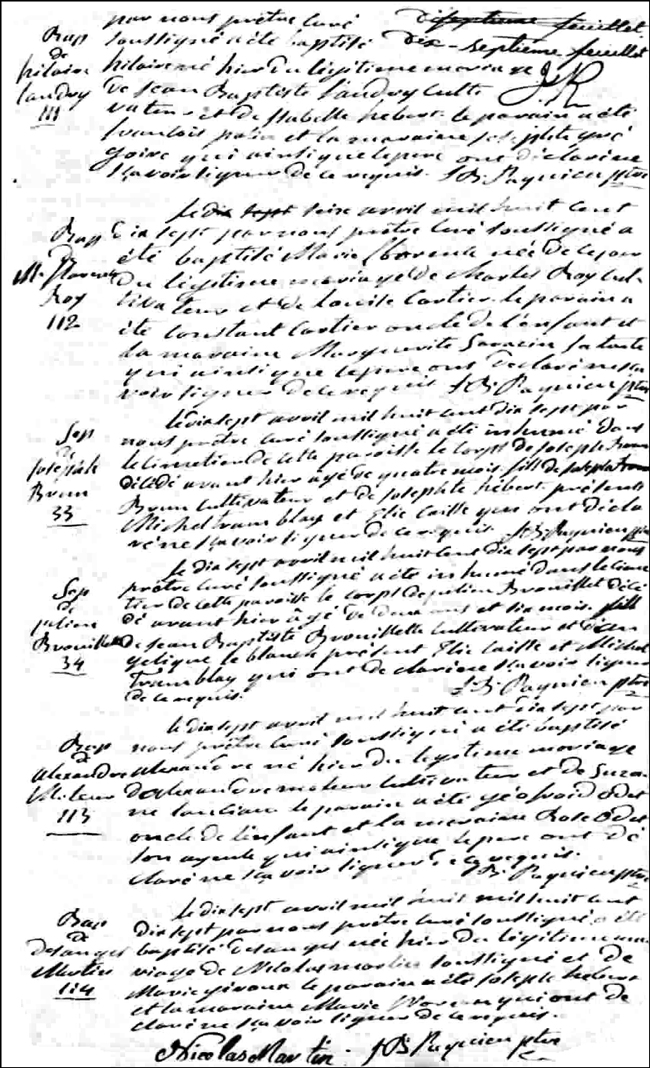
After finding the Birth and Baptismal Record of Ausite Martin in the records of the parish of Ste. Marguerite de Blairfinde in L’Acadie in 1818, I started searching backwards in time, year-by-year, looking for the marriage of Ausite’s parents, Nicolas Martin and Marie Giroux. Before finding the marriage, I found the birth and baptismal records of several of Ausite’s siblings, including that for Désanges Martin, born on 16 April 1817. The record of her birth and baptism is recorded as baptism number 114 at the bottom of the image, below.

The Birth and Baptismal Record of D탩sanges Martin - 1817

The Birth and Baptismal Record of Désanges Martin – 1817

SOURCE: Gabriel Drouin, comp. Drouin Collection. Montréal, Québec, Canada: Institut Généalogique Drouin. Parish of Ste. Marguerite de Blairfindie, L’Acadie, St. Jean County, Lower Canada, 1817. Birth and Baptismal Record of Désanges Martin, Front of Folio 17, B.114.

Click on the link for a PDF copy of the Birth and Baptismal Record of Désanges Martin – 1817. Translated from the French, the record states:

Baptism
of
Desanges
Martin
114

On the seventeenth of April one thousand eight one thousand eight hundred and seventeen, by us, the undersigned parish priest, have baptized Desanges, born yesterday of the legitimate marriage of the undersigned Nicolas Martin, and Marie Giroux. The Godfather was Joseph Lebeau and the Godmother was Marie Noreau, who declared that they cannot sign as required.

[signed] Nicolas Martin          [signed] J[ean] B[aptiste] Paquien, priest

In the original record, the priest wrote the words “mil huit” twice, and so in the translation above, I’ve faithfully recorded the translated year of birth as “one thousand eight one thousand eight hundred and seventeen”.

At first, I wasn’t certain whether Désanges was the name of a male or female child, although I found the name in a list of French Canadian given names. The key to the child’s sex lies in the French word for “born”, which is spelled “née”, indicating that the child is female. If the child had been masculine, the verb would have been “né”, rather than “née”.

Oddly enough, the Birth and Baptismal Record for Ausite Martin, born of the same parents a year later, the priest wrote that the father could not sign his name. This record shows that the father was perfectly capable of signing his name in 1817, so why couldn’t he sign in 1818?

This record can be found in the Québec Vital Records (Drouin Collection), 1621-1967 on Ancestry.com as image 17 of 55 in the records for L’Acadie L’Acadie Ste.-Marguerite-de-Blairfindie for the year 1817. The record appears on the front of folio 17.

Copyright © 2007 by Stephen J. Danko
Posted in Daily Journal, Martin | 2 Comments

The Birth and Baptism of Ausite Martin – 1818

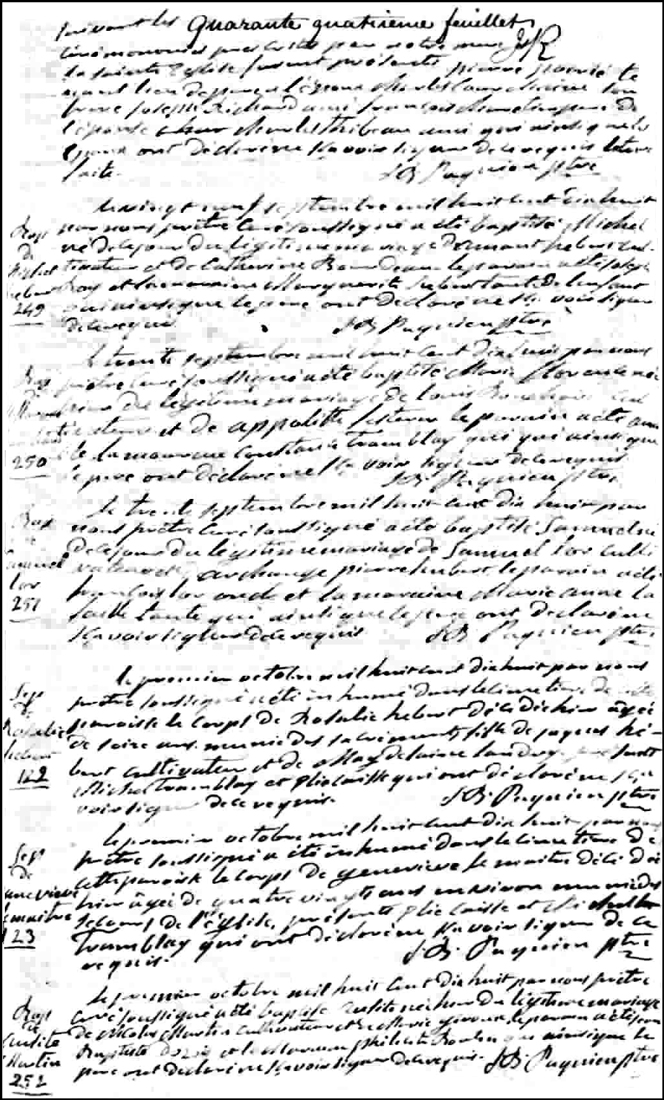
The mother of Osithe Gamache was Ausite (Osithe) Martin, who was born in L’Acadie on 30 Sep 1818 and baptized on 01 Oct 1818. Her birth and baptism is recorded in the folios of the parish of Ste. Marguerite de Blairfindie as baptism number 252 at the bottom of the folio.

The Birth and Baptismal Record of Ausite Martin -1818

The Birth and Baptismal Record of Ausite Martin – 1818

SOURCE: Gabriel Drouin, comp. Drouin Collection. Montréal, Québec, Canada: Institut Généalogique Drouin. Parish of Ste. Marguerite de Blairfindie, L’Acadie, St. Jean County, Lower Canada, 1818. Birth and Baptismal Record of Ausite Martin, Front of Folio 44, B.252.

Click on the link for a PDF copy of the Birth and Baptismal Record of Ausite Martin – 1818. Translated from the French, the record states:

Baptism
of
Ausite
Martin
252

On the first of October, one thousand eight hundred eighteen, by us, the undersigned parish priest, was baptized Ausite, born yesterday of the legitimate marriage of Nicolas Martin, farmer, and Marie Giroux. The Godfather was Jean Baptiste [Dupuis?] and the Godmother was [Philosote?] Boutin who, as well as the father, declared that they cannot sign as required.

[signed] J[ean] B[aptiste] Paquien, priest

This record can be found in the Québec Vital Records (Drouin Collection), 1621-1967 on Ancestry.com as baptism number 252 on image 44 of 58 in the records of the L’Acadie Ste-Marguerite-de-Blairfindie for the year 1818. The record is on the front of folio 44.

Ausite Martin was born in L’Acadie and, although she lived in Napierville after her marriage, she returned to L’Acadie to give birth to her first child, Osithe.

Copyright © 2007 by Stephen J. Danko

Posted in Daily Journal, Martin | Comments Off on The Birth and Baptism of Ausite Martin – 1818