The Marriage of Józef Milewski and Teresa née Chodkowska Perzanowska – 1834

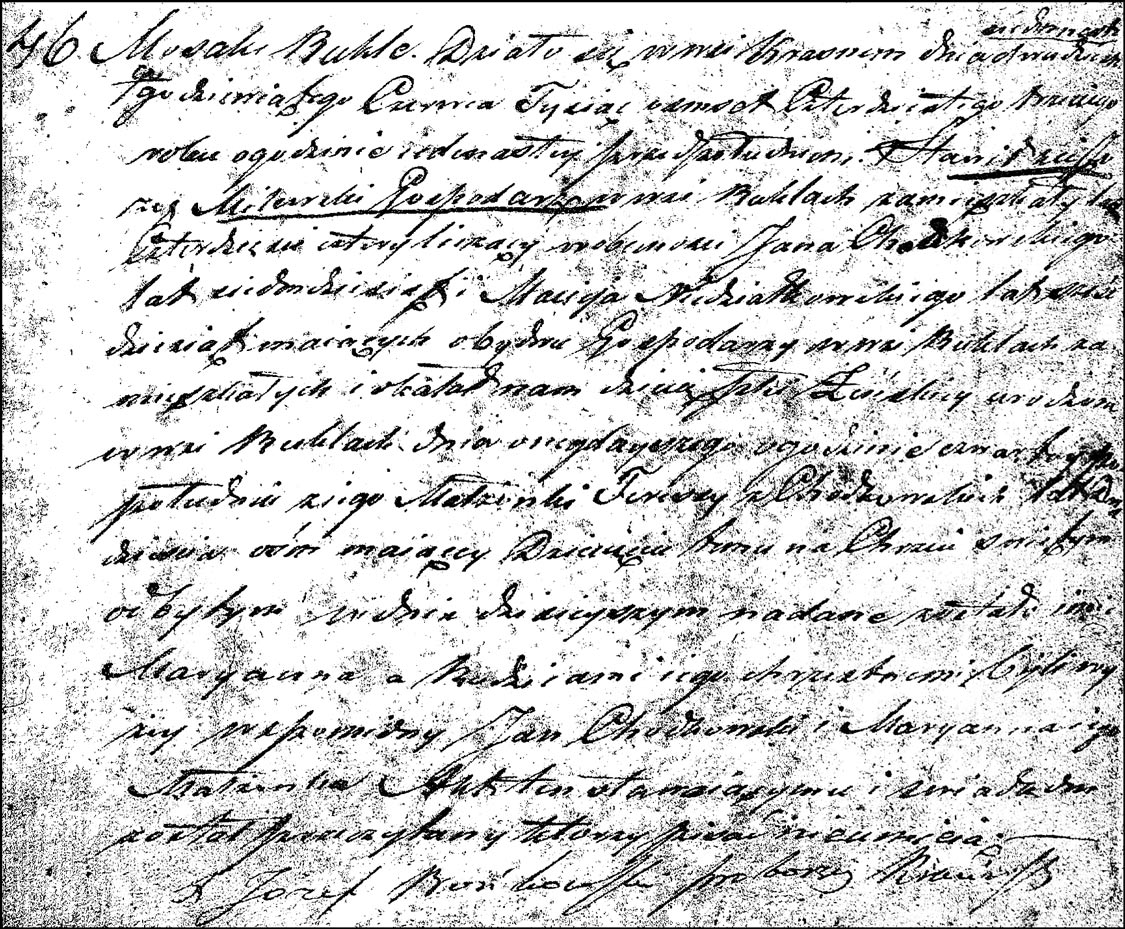
Józef Milewski (son of the Jan Milewski and Salomea Mossakowska) and Teresa née Chodkowska Perzanowska (daughter of Jan Chodkowski and Marianna Obidzińska) were married in the parish church in Krasne, Przasnysz Obwód, Płock Voivodeship, Congress Kingdom of Poland on 23 January 1834.

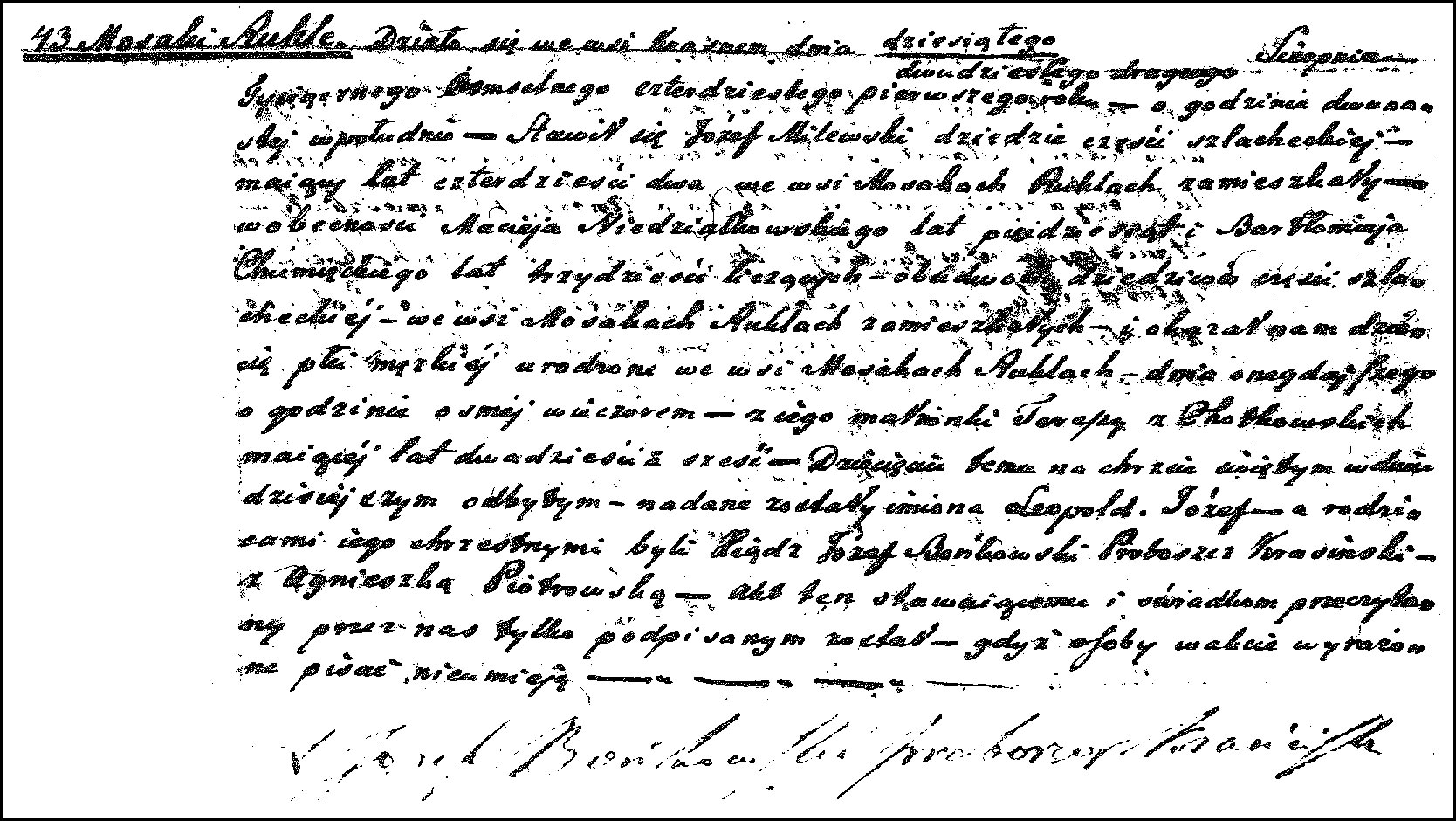
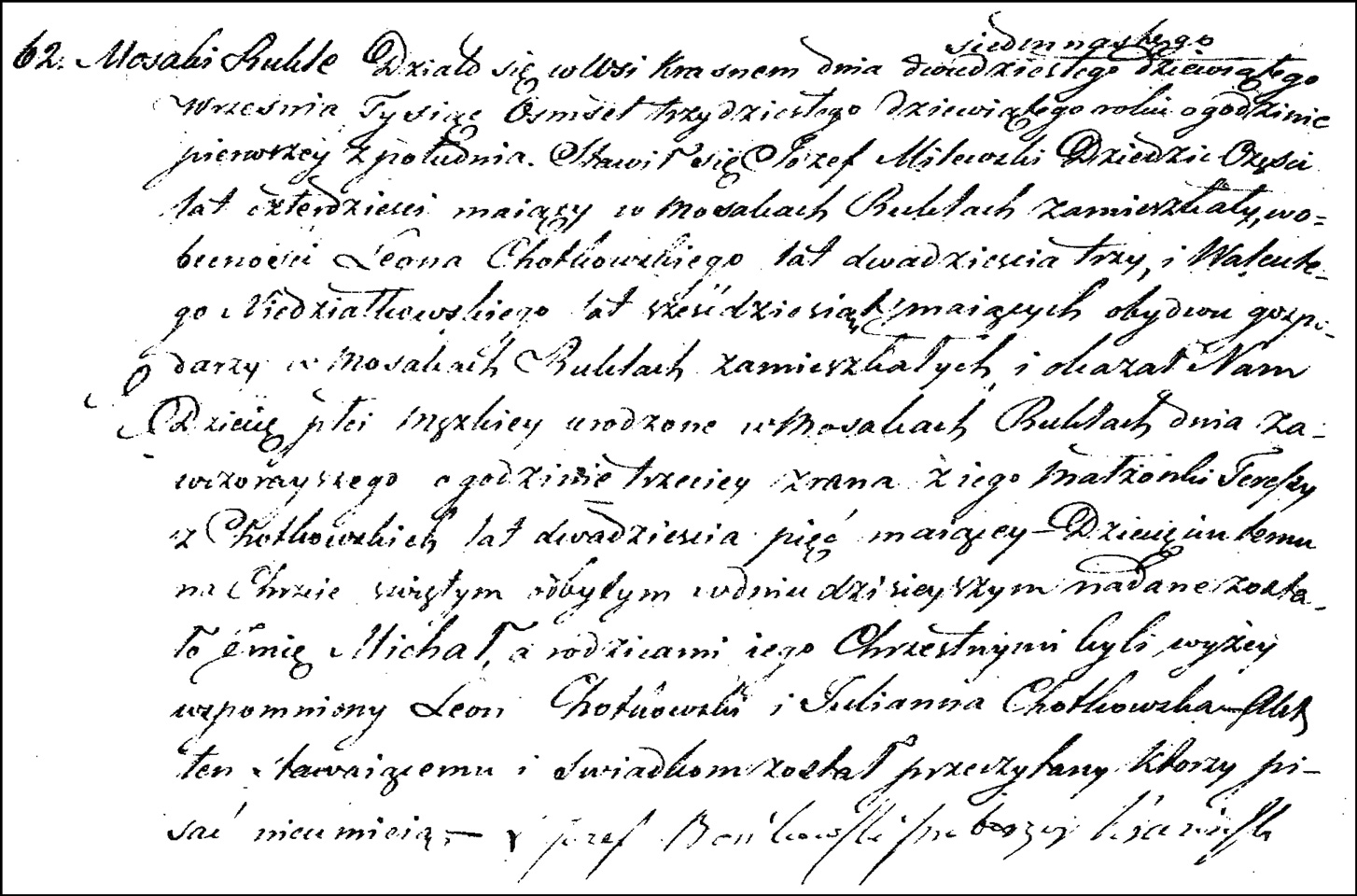
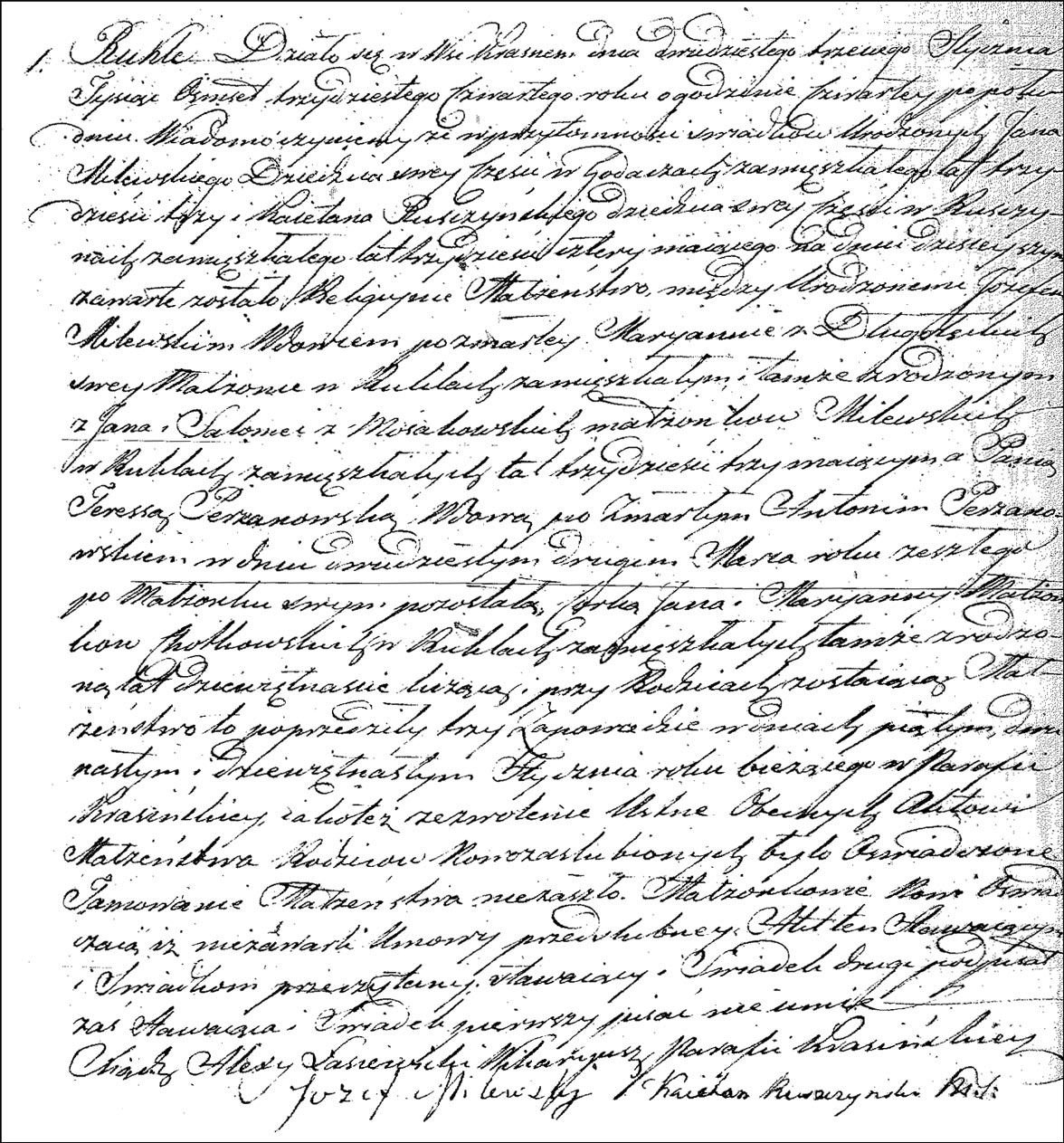
The Marriage Record of Józef Milewski and Teresa née Chodkowska Perzanowska - 1834

The Marriage Record of Józef Milewski and Teresa née Chodkowska Perzanowska – 1834

Parafia pw. św. Jana Chrzciciela (Krasne, Przasnysz Obwód, Płock Voivodeship, Congress Kingdom of Poland), “Akta urodzeń, małżeństw, zgonów 1826-1840. [Records of Births, Marriages, Deaths 1826-1840.],” page 37, entry 1, Józef Milewski and Teresa née Chodkowska Perzanowska, 23 Jan 1834; filmed as Kopie księg metrykalnych, 1808-1892; FHL INTL microfilm 0,702,793.

Click on the image above to view a higher resolution image. Click on the link for a PDF copy of the Marriage Record of Józef Milewski and Teresa née Chodkowska Perzanowska. Translated from the Polish, the record reads:

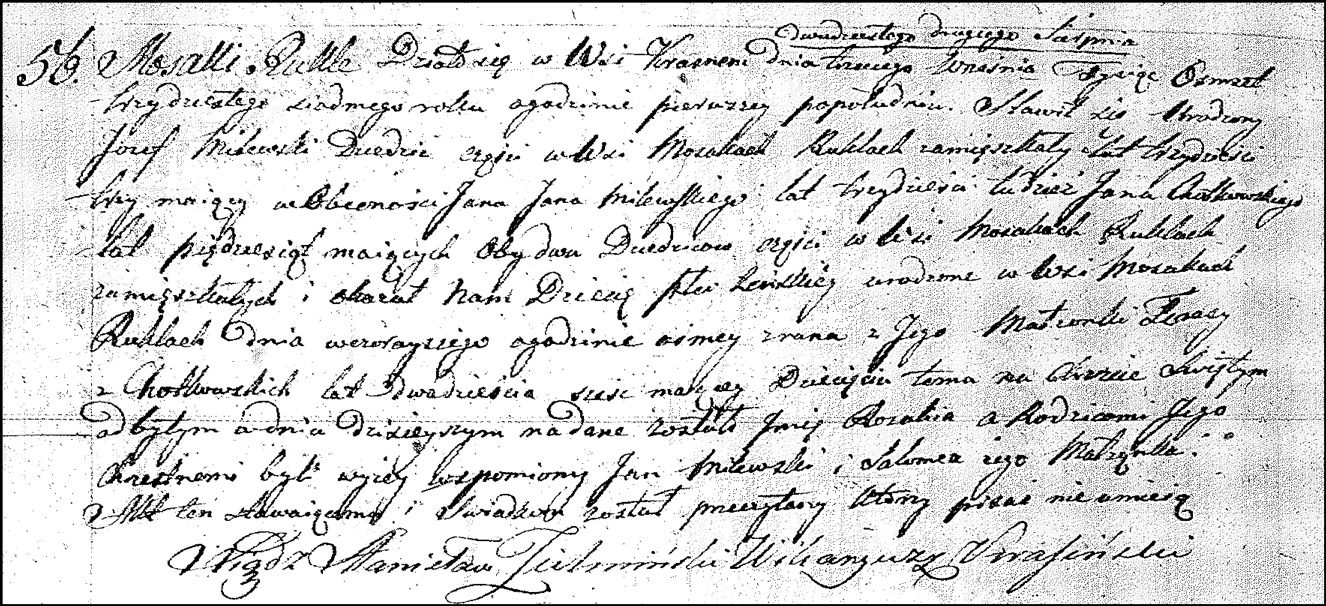
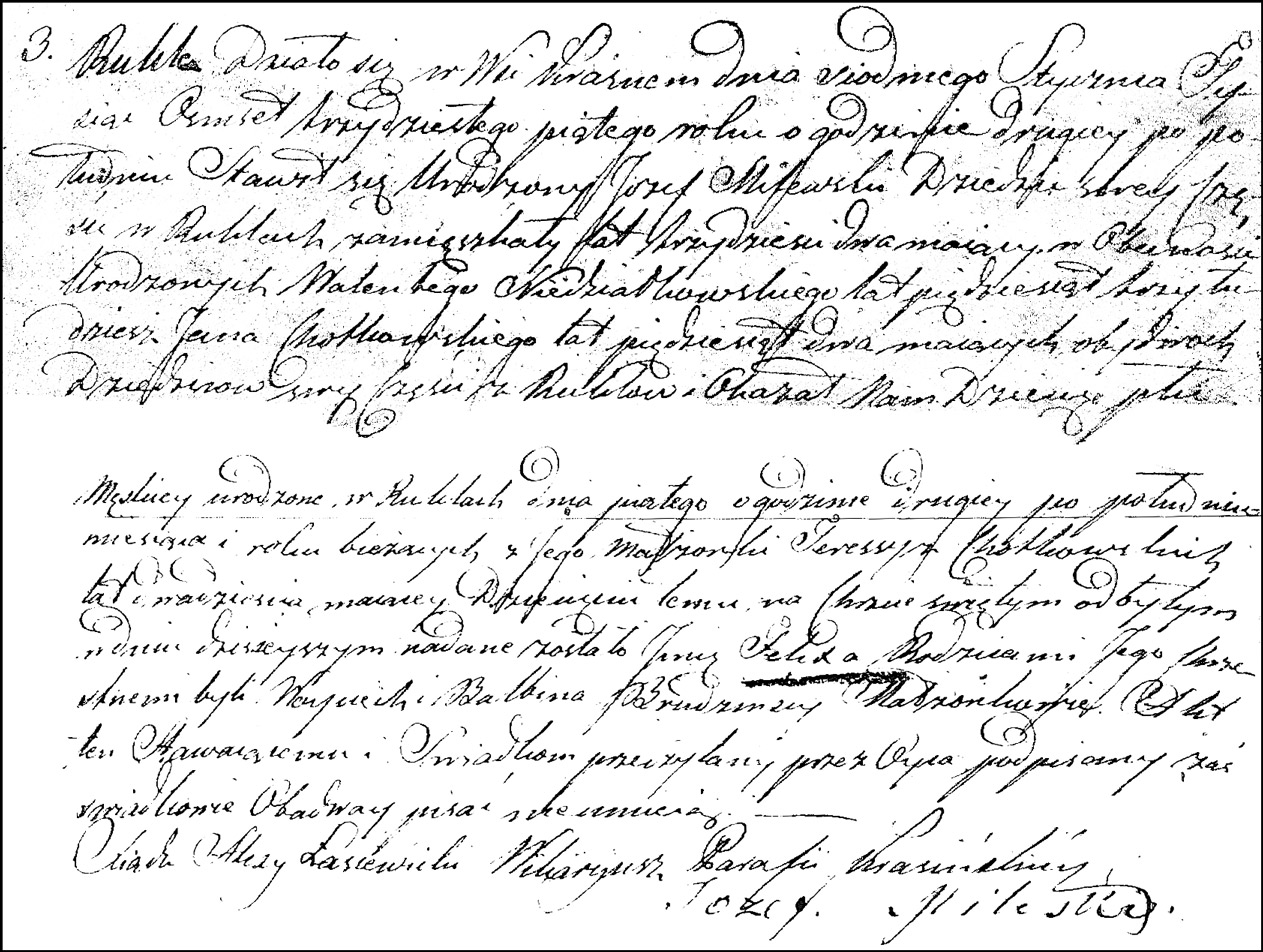
1 . Â  [Mosaki] Rukle .  This happened in the village of Krasne on the twenty-third day of January in the year one-thousand eight-hundred thirty-four at the hour of four in the afternoon. We make it known in the presence of witnesses Jan Milewski, owner of his part [of the village] and residing in [Mosaki] Godacze, thirty-three years of age, and Kajetan Rusczyński, owner of his part [of the village] and residing in Rusczyń, thirty-four years of age, on this day a religious marriage was contracted between the well-born Józef Milewski, a widower after the death of his wife Marianna née Długołęcka, residing in [Mosaki] Rukle and also born there of the married couple Jan Milewski and Salomea née Mossakowska, residing in [Mosaki] Rukle, thirty-three years of age, and the woman Teresa Perzanowska, widow surviving after the death of her husband Antoni Perzanowski on the twenty-second day of March of the previous year, daughter of the married couple Jan and Marianna Chodkowski and Marianna, nineteen years of age, residing in [Mosaki] Rukle and also born there, and residing with her parents. This wedding was preceded by three readings of the banns on the fifth, twelfth, and nineteenth days of January in the same year in the parish of Krasne, as well as the oral consent of the parents of the newlyweds who were present for the marriage record and of the guardians on the side of the bridegroom. It was stated that there was no impediment to the marriage. The newlyweds stated that they had made no premarital agreement. This document was read aloud to the declarants and witnesses and was signed by Us and was signed by the bridegroom and the second witness. The bride and the first witness do not know how to write.
[signed] The Reverend Aleksy Łasiewicki, Vicar of the Parish of Krasne
[signed] Józef Milewski    [signed] Kajetan Ruszyński [MS:?]

Teresa née Chodkowska Perzanowska was my 2nd cousin, 4X removed.

Copyright © 2010 by Stephen J. Danko
Posted in Chodkowski, Milewski, Mossakowski, Obidziński, Perzanowski | Tagged | Comments Off on The Marriage of Józef Milewski and Teresa née Chodkowska Perzanowska – 1834

The Polish Village of Tłucznice Karniewo

The village of Tłucznice Karniewo is significant in my family history because it was the location where Jan Łyszkowski, the husband of my cousin Waleria Chodkowska, was born.

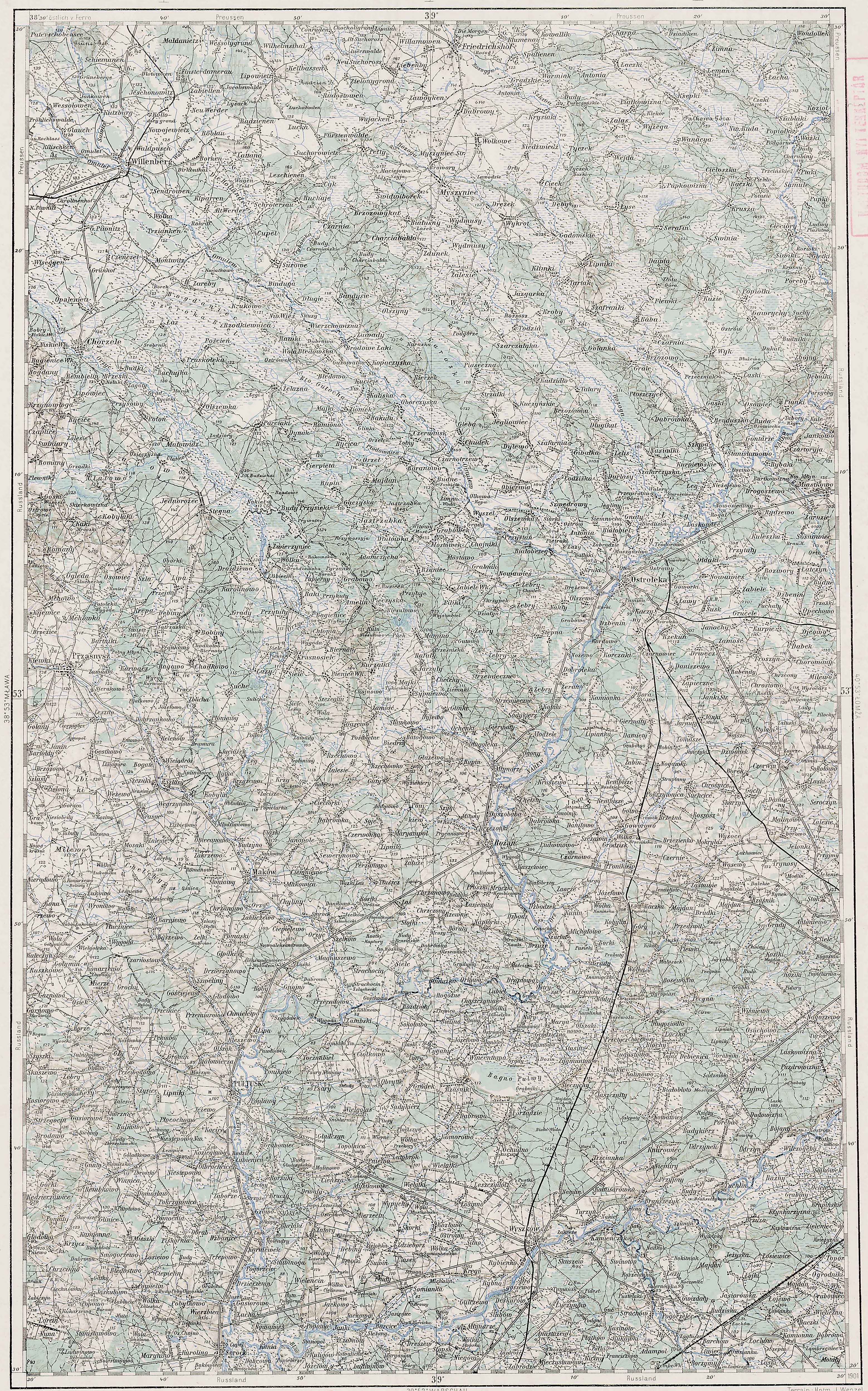
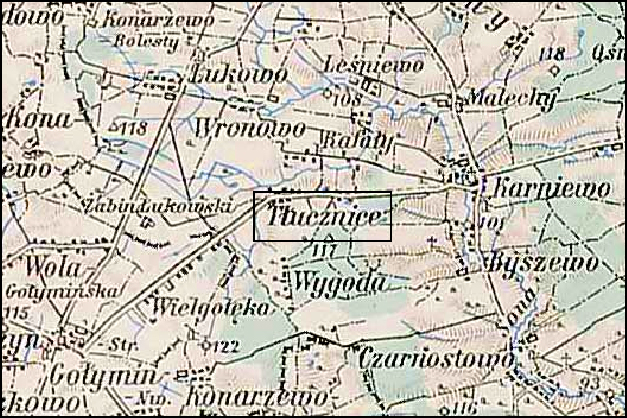
Austrian Military Map of the Tłucznice Area - 1910

Austrian Military Map of the Tłucznice Karniewo Area – 1910

SOURCE: Third Military Mapping Survey of Austria-Hungary, Sheet 39-53, Ostrołęcka. Online http://lazarus.elte.hu/hun/digkonyv/topo/200e/39-53.jpg; downloaded 25 May 2010.

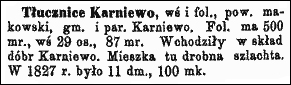
Słownik Geograficzny Entry for Tłucznice

Słownik Geograficzny Entry for Tłucznice Karniewo

Source:  Chlebowski, Bronisław, Filip Sulimierski, and Władysław Walewski, eds., Słownik Geograficzny Królestwa Polskiego i Innych Krajów Słowiańskich (Geographical Dictionary of the Kingdom of Poland and other Slavonic Countries) – Warsaw 1892, Volume XII, page 346.

Click on the link for a PDF copy of the Słownik Geograficzny entry for Tłucznice Karniewo. Translated from the Polish, the entry reads:

Tłucznice Karniewo, a village and grange [a large manorial farmstead] in the Maków Powiat, Karniewo Gmina and Parish. The grange has 500 morgs [in the Russian partition 1 morg = 1.388 acres], the village has 29 settlers and 87 morgs. It goes into the storehouse of the property of Karniewo. A few nobles live there. In the year 1827 there were 11 homes and 100 residents.

The maps of the Third Military Mapping Survey of Austria-Hungary and the entries in the Słownik Geograficzny were prepared at about the same time and make a good pair for studying places in and around the Congress Kingdom of Poland at the end of the 19th century and beginning of the 20th century, a time period when the Eastern European ancestors of present-day Americans left their homelands for the United States.

Copyright © 2010 by Stephen J. Danko
Posted in Chodkowski, Łyszkowski | Tagged , | 1 Comment

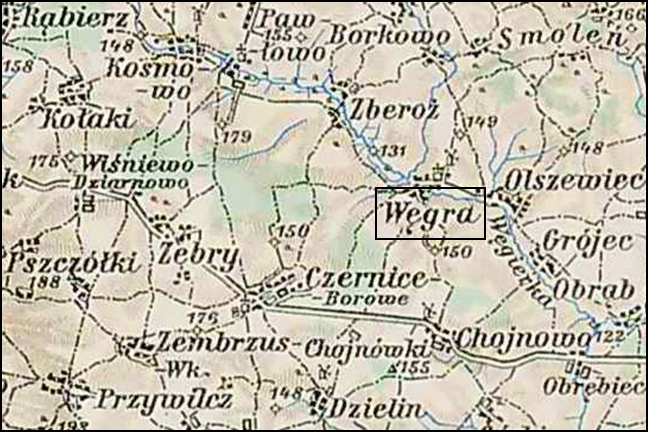
The Polish Village of Węgra

The village of Węgra is significant in my family history because it was the location where some of my Chodkowski cousins were married.

Austrian Military Map of the Węgra Area - 1910

Austrian Military Map of the Węgra Area – 1910

SOURCE: Third Military Mapping Survey of Austria-Hungary, Sheet 38-53, Mława. Online http://lazarus.elte.hu/hun/digkonyv/topo/200e/39-53.jpg; downloaded 25 May 2010.

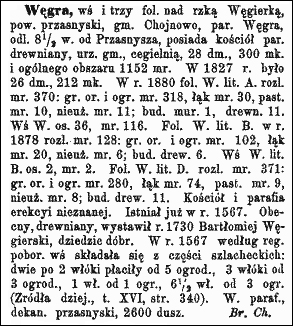
Słownik Geograficzny Entry for Węgra

Słownik Geograficzny Entry for Węgra

Source:  Chlebowski, Bronisław, Filip Sulimierski, and Władysław Walewski, eds., Słownik Geograficzny Królestwa Polskiego i Innych Krajów Słowiańskich (Geographical Dictionary of the Kingdom of Poland and other Slavonic Countries) – Warsaw 1893, Volume XIII, page 256.

Click on the link for a PDF copy of the Słownik Geograficzny entry for Węgra. Translated from the Polish, the entry reads:

Węgra, a village and three granges on the Węgierka River in the Przasnysz Powiat, Chojnowo Gmina, and Węgra Parish, 8 ½ versts [0.66 miles per verst] from Przasnysz. It includes a parish church of wood, the municipal offices, a brickyard, 28 homes, 300 residents, and a total area of 1152 morgs [in the Russian partition 1 morg = 1.388 acres]. In the year 1827 there were 26 homes and 212 residents. In the year 1880 the Węgra grange letter A extended 370 morgs: 318 morgs of arable land and gardens, 30 morgs of meadows, 10 morgs of pastures, 11 morgs of wastelands, 1 stone building and 11 wooden buildings. The village of Węgra letter B included 2 settlements and 2 morgs. The Węgra grange letter D extended 371 morgs: 280 morgs of arable land and gardens, 74 morgs of meadows, 9 morgs of pastures, 8 morgs of wastelands, and 11 wooden buildings. The date the church and parish were erected is unknown. They already existed in the year 1567. Bartłomiej Węgierski, the owner of the property, raised the current wooden church in the year 1730. In the year 1567, according to the conscription records, the village consisted of noble parts: two after 2 włóki [one włóka equaled about 16.8 hectares] paid for 5 gardens, 1 włóka for 1 garden, 6 ½ włóki for 3 gardens. (Źródła dziejowe volume XVI, page 340). In the parish which belonged to the Przasnysz Deanery, there were 2600 souls.
                                                  Bronisław Chlebowski

The notation (Źródła dziejowe volume XVI, page 340) refers to:

Pawiński, Adolf. 1892. Mazowsze. Polska XVI wieku pod względem geograficzno-statystycznym, t. 5. Warszawa: skł. gł. w Księgarni Gebethnera i Wolffa.

This publication is available online at the Digital Library of Wielkopolska.

The maps of the Third Military Mapping Survey of Austria-Hungary and the entries in the Słownik Geograficzny were prepared at about the same time and make a good pair for studying places in and around the Congress Kingdom of Poland at the end of the 19th century and beginning of the 20th century, a time period when the Eastern European ancestors of present-day Americans left their homelands for the United States.

Copyright © 2010 by Stephen J. Danko
Posted in Chodkowski | Tagged , | Comments Off on The Polish Village of Węgra

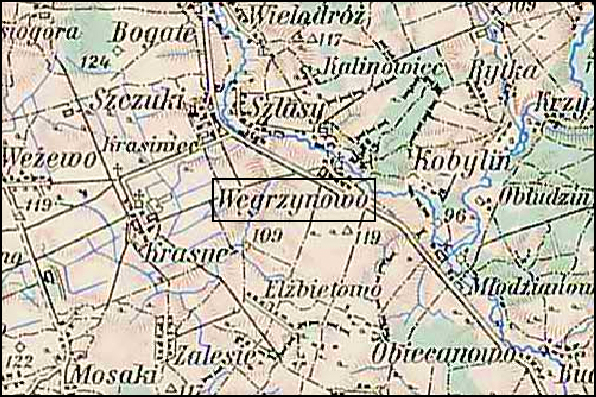
The Polish Village of Węgrzynowo

The village of Węgrzynowo is significant in my family history because it was the location where some of my Chodkowski cousins were married.

Austrian Military Map of the Węgrzynowo Area - 1910

Austrian Military Map of the Węgrzynowo Area – 1910

SOURCE: Third Military Mapping Survey of Austria-Hungary, Sheet 39-53, Ostrolecka. Online http://lazarus.elte.hu/hun/digkonyv/topo/200e/39-53.jpg; downloaded 24 May 2010.

Słownik Geograficzny Entry for Węgrzynowo

Słownik Geograficzny Entry for Węgrzynowo

Source:  Chlebowski, Bronisław, Filip Sulimierski, and Władysław Walewski, eds., Słownik Geograficzny Królestwa Polskiego i Innych Krajów Słowiańskich (Geographical Dictionary of the Kingdom of Poland and other Slavonic Countries) – Warsaw 1893, Volume XIII, page 262.

Click on the link for a PDF copy of the Słownik Geograficzny entry for Węgrzynowo. Translated from the Polish, the entry reads:

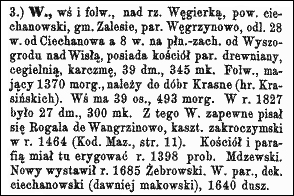
3.) Węgrzynowo, a village and grange [a large manorial farmstead] in Ciechanów Powiat, Zalesie Gmina, and Węgrzynowo Parish, 28 versts [0.66 miles per verst] from Ciechanów and 8 versts to the northwest of Wyszogrod on the Vistula River. It includes a wooden parish church, a brickyard, a tavern, 39 homes, and 345 residents. The grange includes 1370 morgs [in the Russian partition 1 morg = 1.388 acres]; it belongs to the property of Krasne (Count Krasiński). The village has 39 settlements and 493 morgs. In the year 1827 there were 27 homes and 300 residents. Rogala of Wangrzinowo, the castellan of Zakroczym, probably wrote in this Węgrzynowo in the year 1464 (Kodeks dyplomatyczny Księstwa Mazowieckiego, page 11). The church and parish were erected here in the year 1398 by the Pastor Mdzewski. Żebrowski raised a new one in the year 1684. There were 1640 souls in the parish which belonged to the Ciechanów Deanery (later, the Maków Deanery).

The notation (Kod. Maz., str. 11) or (Kodeks dyplomatyczny Księstwa Mazowieckiego, page 11) refers to:

Lubomirski, Tadeusz Jan. 1863. Kodeks Dyplomatyczny Księstwa Mazowieckiego, obejmujący Bulle Papieżów, Przywileje Krolów Polskich i Książąt Mazowieckich, tudzież Nadamia tak korporacyj jako i osób prywatnych. Warszawa: Druk. Gazety Polskiej.

This publication is available online at the Digital Library of Wielkopolska.

The place described in this entry is only one of at least 4 places in Poland called Mierzęcin.

The maps of the Third Military Mapping Survey of Austria-Hungary and the entries in the Słownik Geograficzny were prepared at about the same time and make a good pair for studying places in and around the Congress Kingdom of Poland at the end of the 19th century and beginning of the 20th century, a time period when the Eastern European ancestors of present-day Americans left their homelands for the United States.

Copyright © 2010 by Stephen J. Danko
Posted in Chodkowski | Tagged , | 1 Comment

The Polish Village of Mierzęcin

The village of Mierzęcin is significant in my family history because it was the location where I believe some of my Wiśniewski cousins were born.

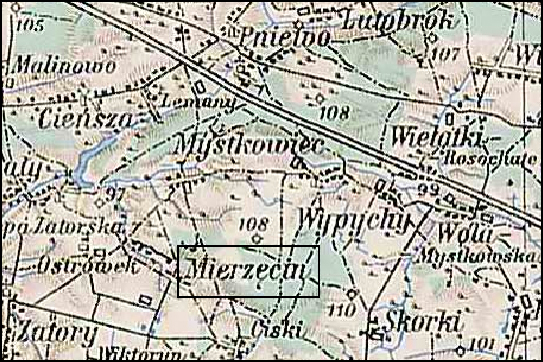
Austrian Military Map of the Mierzęcin Area - 1910

Austrian Military Map of the Mierzęcin Area – 1910

SOURCE: Third Military Mapping Survey of Austria-Hungary, Sheet 39-53, Ostrolecka. Online http://lazarus.elte.hu/hun/digkonyv/topo/200e/39-53.jpg; downloaded 23 May 2010.

Słownik Geograficzny Entry for Mierzęcin

Słownik Geograficzny Entry for Mierzęcin

Source:  Sulimierski, Filip, Bronisław Chlebowski, and Władysław Walewski, eds., Słownik Geograficzny Królestwa Polskiego i Innych Krajów Słowiańskich (Geographical Dictionary of the Kingdom of Poland and other Slavonic Countries) – Warsaw 1885, Volume VI, page 355.

Click on the link for a PDF copy of the Słownik Geograficzny entry for Mierzęcin. Translated from the Polish, the entry reads:

Mierzęcin1.) a village in the Pułtusk Powiat, Zatory Gmina, and Pniewo Parish. In the year 1827 there were 6 homes and 75 residents.

The place described in this entry is only one of at least 5 places in Poland called Mierzęcin.

The maps of the Third Military Mapping Survey of Austria-Hungary and the entries in the Słownik Geograficzny were prepared at about the same time and make a good pair for studying places in and around the Congress Kingdom of Poland at the end of the 19th century and beginning of the 20th century, a time period when the Eastern European ancestors of present-day Americans left their homelands for the United States.

Copyright © 2010 by Stephen J. Danko
Posted in Wiśniewski | Tagged , | Comments Off on The Polish Village of Mierzęcin

The Polish Villages of Zbiki

The villages of Zbiki are significant in my family history because they were locations where some of my Chodkowski cousins lived. In particular, some of my Chodkowski cousins lived in Zbiki Gawronki and Zbiki Kierzki.

Austrian Military Map of the Zbiki Area - 1910

Austrian Military Map of the Zbiki Area – 1910

SOURCE: Third Military Mapping Survey of Austria-Hungary, Sheet 39-53, Ostrolecka. Online http://lazarus.elte.hu/hun/digkonyv/topo/200e/39-53.jpg; downloaded 22 May 2010.

Słownik Geograficzny Entry for Zbiki

Słownik Geograficzny Entry for Zbiki

Source:  Chlebowski, Bronisław, Józef Krzywicki, Filip Sulimierski, and Władysław Walewski, eds., Słownik Geograficzny Królestwa Polskiego i Innych Krajów Słowiańskich (Geographical Dictionary of the Kingdom of Poland and other Slavonic Countries) – Warsaw 1895, Volume XIV, page 518.

Click on the link for a PDF copy of the Słownik Geograficzny entry for Zbiki. Translated from the Polish, the entry reads:

Zbiki 1.) in the 16th century, Zdbiki, a village in the Żegocin Parish (Kalisz Powiat), see Żbiki. 2.) Zbiki, in the 16th century Zdbyki, the name of an area in the Ciechanów Powiat, Zalesie Gmina, and Krasne Parish, 24 versts [0.66 miles per verst] from Ciechanów. In this area the following villages and granges [large manorial farmsteads] are found:  Zbiki Antosy, a village that has 6 homes, 54 residents, and 185 morgs [in the Russian partition 1 morg = 1.388 acres]. A few nobles live here. In the year 1827 there were 8 homes and 61 residents. Zbiki Gawronki, a village that has 8 homes, 82 residents, and 210 morgs. A few nobles live here. In the year 1827 there were 11 homes and 66 residents. Zbiki Kierzki, a village that has 12 homes, 91 residents, and 308 morgs. A few nobles live here. In the year 1827 there were 8 homes and 54 residents. Zbiki Starki, a grange that has 2 homes, 22 residents, and 140 morgs. It belongs to the property of Krasne. In the year 1827 there were 2 homes, 11 residents. Zbiki Wielkie, a grange and village that had 14 homes, 63 residents, and 910 morgs in the grange, 41 morgs in the manor. The grange belongs to the property of Augustów in the domain of Krasne. In the year 1827 there were 20 homes and 150 residents. In the year 1567 Zdbyki Antoni had 4 włóki [1 włóka = 16.8 hectares]; Zbiki Gawronki had 5 divisions of ½ włóka, 10 morgs, and 1 garden; Zbiki Janusze has 1 włóka, 6 morgs, and 2 parts of ¼ włóka; Zbiki Stara Wieś had 3 włóki, 3 divisions of ½ włoka, 7 parts of 1 włóka, 10 craftsmen, 3 włóki, 9 craftsmen; Zbiki Karpieta (Wielkie) ½ włóka and 2 parts of 3/8 włóka (Pawiński, Mazowsze, 345).The place labeled as 2.) in this entry is the one in which my cousins resided.

The notation (Pawiński, Mazowsze, 345) refers to:

Pawiński, Adolf. 1892. Mazowsze. Polska XVI wieku pod względem geograficzno-statystycznym, t. 5. Warszawa: skł. gł. w Księgarni Gebethnera i Wolffa.

This publication is available online at the Digital Library of Wielkopolska.

The maps of the Third Military Mapping Survey of Austria-Hungary and the entries in the Słownik Geograficzny were prepared at about the same time and make a good pair for studying places in and around the Congress Kingdom of Poland at the end of the 19th century and beginning of the 20th century, a time period when the Eastern European ancestors of present-day Americans left their homelands for the United States.

Copyright © 2010 by Stephen J. Danko
Posted in Chodkowski | Tagged , | Comments Off on The Polish Villages of Zbiki

The Polish Village of Zakrzewo

The village of Zakrzewo is significant in my family history because it was the location where some of my Chodkowski cousins were born.

Austrian Military Map of the Zakrzewo Area - 1910

Austrian Military Map of the Zakrzewo Area – 1910

SOURCE: Third Military Mapping Survey of Austria-Hungary, Sheet 39-53, Ostrolecka. Online http://lazarus.elte.hu/hun/digkonyv/topo/200e/39-53.jpg; downloaded 21 May 2010.

Słownik Geograficzny Entry for Zakrzewo

Słownik Geograficzny Entry for Zakrzewo

Source:  Chlebowski, Bronisław, Józef Krzywicki, Filip Sulimierski, and Władysław Walewski, eds., Słownik Geograficzny Królestwa Polskiego i Innych Krajów Słowiańskich (Geographical Dictionary of the Kingdom of Poland and other Slavonic Countries) – Warsaw 1895, Volume XIV, page 319.

Click on the link for a PDF copy of the Słownik Geograficzny entry for Zakrzewo. Translated from the Polish, the entry reads:

11.) Zakrzewo, a village and grange [large manorial farmstead] in the Maków Powiat, Karniewo Gmina, and Maków Parish (4 versts distant) versts [0.66 miles per verst]. In the year 1885, the Zakrzewo grange extended 206 morgs [in the Russian partition 1 morg = 1.388 acres]: 167 morgs of [arable] land and gardens, 20 morgs of meadows, 12 morgs of pastures, 8 morgs of wastelands. There are 7 wooden buildings. The village of Zakrzewo includes 4 settlements and 5 morgs.

The place described in this entry is only one of at least 37 places in Poland called Zakrzewo.

The maps of the Third Military Mapping Survey of Austria-Hungary and the entries in the Słownik Geograficzny were prepared at about the same time and make a good pair for studying places in and around the Congress Kingdom of Poland at the end of the 19th century and beginning of the 20th century, a time period when the Eastern European ancestors of present-day Americans left their homelands for the United States.

Copyright © 2010 by Stephen J. Danko
Posted in Chodkowski | Tagged , | 1 Comment

The Polish Village of Wężewo

The village of Wężewo is significant in my family history because it was the location where the spouses of some distant Chodkowski relatives lived.

Austrian Military Map of the Wężewo Area - 1910

Austrian Military Map of the Wężewo Area – 1910

SOURCE: Third Military Mapping Survey of Austria-Hungary, Sheet 39-53, Ostrolecka. Online http://lazarus.elte.hu/hun/digkonyv/topo/200e/39-53.jpg; downloaded 20 May 2010.

Słownik Geograficzny Entry for Wężewo

Słownik Geograficzny Entry for Wężewo

Source:  Chlebowski, Bronisław, Filip Sulimierski, and Władysław Walewski, eds., Słownik Geograficzny Królestwa Polskiego i Innych Krajów Słowiańskich (Geographical Dictionary of the Kingdom of Poland and other Slavonic Countries) – Warsaw 1893, Volume XIII, page 113.

Click on the link for a PDF copy of the Słownik Geograficzny entry for Wężewo. Translated from the Polish, the entry reads:

Wężewo, a village in Ciechanów Powiat, Zalesie Gmina, and Bogate Parish, 25 versts [0.66 miles per verst] from Ciechanów. It has 21 homes, 184 residents, and 453 morgs morgs [in the Russian partition 1 morg = 1.388 acres] of land (9 morgs of wastelands); a clearcut settlement belonging to the property of Augustów. In the year 1567, the village of Wężewo in the Bogate Parish consisted of 4 parts, having from 2 ½ to 3 ½ włóki [1 włóka = 16.8 hectares] (Pawiński, Mazowsze, 347). In the year 1827 there were 12 homes and 112 residents. It belonged to the Krasne Parish.

The reference to Pawiński, Mazowsze, 347 refers to:

Pawiński, Adolf. 1892. Mazowsze. Polska XVI wieku pod względem geograficzno-statystycznym, t. 5. Warszawa: skł. gł. w Księgarni Gebethnera i Wolffa.

This publication is available online at the Digital Library of Wielkopolska.

Note that the village of Wężewo belonged to the Krasne Parish in 1827, but belonged to the Bogate Parish in 1567. The Słownik Geograficzny entry inplies that Wężewo belonged to the Bogate Parish at the time the Słownik was written (1893), but a search of Internet resources show that, today, Wężewo belongs to the Krasne Parish.

The maps of the Third Military Mapping Survey of Austria-Hungary and the entries in the Słownik Geograficzny were prepared at about the same time and make a good pair for studying places in and around the Congress Kingdom of Poland at the end of the 19th century and beginning of the 20th century, a time period when the Eastern European ancestors of present-day Americans left their homelands for the United States.

Copyright © 2010 by Stephen J. Danko
Posted in Chodkowski | Tagged , , | Comments Off on The Polish Village of Wężewo

The Polish Village of Niesiobędy

The village of Niesiobędy is significant in my family history because it was the location where some distant Grabowski relatives lived.

Austrian Military Map of the Niesiobędy Area - 1910

Austrian Military Map of the Niesiobędy Area – 1910

SOURCE: Third Military Mapping Survey of Austria-Hungary, Sheet 39-53, Ostrolecka. Online http://lazarus.elte.hu/hun/digkonyv/topo/200e/39-53.jpg; downloaded 19 May 2010.

Słownik Geograficzny Entry for Niesiobędy

Słownik Geograficzny Entry for Niesiobędy

Source:  Chlebowski, Bronisław, Władysław Walewski, and Filip Sulimierski, eds., Słownik Geograficzny Królestwa Polskiego i Innych Krajów Słowiańskich (Geographical Dictionary of the Kingdom of Poland and other Slavonic Countries) – Warsaw 1886, Volume VII, page 113

Click on the link for a PDF copy of the Słownik Geograficzny entry for Niesiobędy. Translated from the Polish, the entry reads:

Niesiobędy,(Stara wieś [Old Village]), a village in Ciechanów Powiat, Bartołdy Gmina, and Zielona Parish, about 15 versts [0.66 miles per verst] from Ciechanów. It has 7 homes, 62 residents, 262 morgs [in the Russian partition 1 morg = 1.388 acres] of land, and 8 morgs unused.

The maps of the Third Military Mapping Survey of Austria-Hungary and the entries in the Słownik Geograficzny were prepared at about the same time and make a good pair for studying places in and around the Congress Kingdom of Poland at the end of the 19th century and beginning of the 20th century, a time period when the Eastern European ancestors of present-day Americans left their homelands for the United States.

Copyright © 2010 by Stephen J. Danko
Posted in Grabowski | Tagged , | Comments Off on The Polish Village of Niesiobędy

The Polish Village of Zielona

The village of Zielona is significant in my family history because it was the location of the parish church that many of my Chodkowski relatives and their spouses attended.

Austrian Military Map of the Zielona Area - 1910

Austrian Military Map of the Zielona Area – 1910

SOURCE: Third Military Mapping Survey of Austria-Hungary, Sheet 39-53, Ostrolecka. Online http://lazarus.elte.hu/hun/digkonyv/topo/200e/39-53.jpg; downloaded 18 May 2010.

Słownik Geograficzny Entry for Zielona

Słownik Geograficzny Entry for Zielona

Source:  Chlebowski, Bronisław, Józef Krzywicki, Filip Sulimierski, and Władysław Walewski, eds., Słownik Geograficzny Królestwa Polskiego i Innych Krajów Słowiańskich (Geographical Dictionary of the Kingdom of Poland and other Slavonic Countries) – Warsaw 1895, Volume XIV, pages 596-597.

Click on the link for a PDF copy of the Słownik Geograficzny entry for Zielona. Translated from the Polish, the entry reads:

11.) Zielona, a village on the Sona River, Ciechanów Powiat, Bartołdy Gmina, and Zielona Parish, 19 versts [0.66 miles per verst] from Ciechanów. It includes a wooden parish church, an elementary school, 18 homes, 186 residents, 403 morgs [in the Russian partition 1 morg = 1.388 acres] of which 61 belong to the peasants. A few nobles live here. In the year 1827 there were 12 homes and 62 residents. The parish church already existed here in 1567. The current [church] originated in the year 1774. In the year 1567 a few nobles lived here, having a few lots and in which there were altogether 1 ¾ włóki (1 włóka = 16.8 hectares), 4 gardens, 1 slaughterhouse, and in the parts of Zielona Stoszie ¼ włóka (Pawiński, Mazowsze, 331). The Parish of Zielona belonged to the Ciechanów Deanery (formerly it belonged to the Przasznysz Deanery) [and served] 2100 souls.

The reference to Pawiński, Mazowsze, 331 refers to:

Pawiński, Adolf. 1892. Mazowsze. Polska XVI wieku pod względem geograficzno-statystycznym, t. 5. Warszawa: skł. gł. w Księgarni Gebethnera i Wolffa.

This publication is available online at the Digital Library of Wielkopolska.

The place described here is only one of many places in Poland called Zielona. In this entry, the Sona River is mentioned. The Słownik Geograficzny entry for the Sona River was previously translated.

The maps of the Third Military Mapping Survey of Austria-Hungary and the entries in the Słownik Geograficzny were prepared at about the same time and make a good pair for studying places in and around the Congress Kingdom of Poland at the end of the 19th century and beginning of the 20th century, a time period when the Eastern European ancestors of present-day Americans left their homelands for the United States.

Copyright © 2010 by Stephen J. Danko
Posted in Chodkowski | Tagged , | 1 Comment