Resolving Conflicting Evidence in the Spelling of Names

Jasia of Creative Gene recently raised the question of how to record given names and surnames in databases and written family histories when the original records themselves provide different variants of those names.

Jasia provided examples from her own family where different records provided different surname variants, and where the original records provided spellings of given names in a language different from the native language of those named.

Jasia dilemma is one that is frequently encountered by genealogists and family historians.

Initially, I attempted to leave a comment on Jasia’s blog, but I worried that my response would exceed the length of her original post! And, so, I’ll discuss my opinions here.

Two suggestions that I have often heard are:

  1. Use the spelling of the name exactly as it appeared in the birth/baptismal record, and
  2. Use the spelling of the name as it appeared in the earliest proof document.

There is a great deal of sense in these recommendations; both seem to lead to the same conclusion. If one can find a birth/baptismal record written at or near the time of the birth (as is the case with most Polish Roman Catholic birth/baptismal records), one would have both the birth/baptismal record and the earliest proof document. In the absence of a birth/baptismal record made at the time of the event, the earliest proof document would fit the bill.

Names in Old Polish Records

Early Polish records are generally limited to registers of birth/baptism, marriage, and death recorded by the Roman Catholic parish priest. When civil registration of birth, marriage, and death were mandated by the state, the Roman Catholic priest acted was the Civil Registrar. People of all faiths, not just Roman Catholics, were required to register vital events at the local Roman Catholic parish.

Complicating matters is the fact that, prior to the 20th Century, relatively few Polish people could read or write. The same holds true for the rest of the world, although widespread literacy was achieved earlier in some parts of the world than others. When registering vital events, the spellings of both given names and surnames was left to the wisdom of the priest who may have been the only person in the village who would read and write.

Given names generally did not present a problem for the priest. Relatively few given names were in common use and the spellings of given names were fairly well standardized. Surnames were another matter entirely. Priests spelled the surnames as they heard them, leading to records where the spellings of the surnames could vary from record to record, especially when different priests recorded the same name.

Sometimes, spellings of surnames evolved. In my own family, Dziura became Dziurzyński, Trupiło became Tropiło, and Markowicz became Markiewicz. The spelling of a given family’s surname sometimes changed over time. Anglicization of Polish surnames after immigration to the United States was a common occurrence, though the families changed their names after settling in their new homes, not at Ellis Island as the popular press often declares.

Even more confusing is the fact that Polish records were written in a variety of languages, including Latin, Polish, Russian, and German . Although those named in these records were Poles who spoke Polish, their names were often recorded in a foreign language. The name of my ancestor Wojciech Dańko was recorded in Latin as Adalbertus Danko.

In the Russian partition, Polish names were transliterated from Polish to Russian using the Cyrillic alphabet. Transliteration back from Russian to Polish may result in a spelling that is significantly different from the original Polish spelling. In particular, Polish names containing the letter H cannot be accurately transcribed into Russian. Since the Russian alphabet lacks the letter H, that letter in a Polish name will be transcribed as the letter G.

The problem of identifying the “correct” spelling of a Polish name, therefore, originates in many ways. How, then, to best deal with the issue of which spelling to record in genealogy databases and written family histories?

The simplest approach, of course, is to simply record the name exactly as spelled in the earliest proof document. This approach doesn’t account for the fact that names are sometimes inadvertently misspelled and doesn’t account for the fact that names translated into a foreign language were seldom the names the people actually used.

The Genealogical Proof Standard

The Genealogical Proof Standard provides another alternative. The Genealogical Proof Standard requires:

    • a reasonably exhaustive search;
    • complete and accurate source citations;
    • analysis and correlation of the collected information;
    • resolution of any conflicting evidence; and
    • a soundly reasoned, coherently written conclusion.

Thus, the Genealogical Proof Standard states that the researcher should examine the evidence and come to a conclusion based on a sound analysis of that evidence. And so, the Genealogical Proof Standard not only allows, but requires more than just routinely recording names as spelled in the earliest proof document.

How I Approach the Problem

When names actually changed with time, I record the spelling of the name as it was used at the time. My database reflects the changes in surnames as I observe them over the years, so that the surnames of children may be different from that of their father. Recording these changes adds another dimension to the family history since it documents real changes through time.

In cases where several different documents exist for a single individual or single family, a misspelled name in one document may be identified fairly easily. In this case, I record the correct spelling of the name, document the suspected misspelling with an analysis of the reasons I think the spelling in the document is in error.

Sometimes, identifying misspellings can be difficult. In the nine birth records of her children, my grandmother’s maiden name is spelled eight different ways. I have not yet found any proof documents earlier than the birth records of her children that recorded her maiden name. My grandmother’s maiden name, as recorded in these documents were (from the earliest to the most recent) Dziura, Dziurzyńska, Dziurznska, Ginsky, Dzevirzynska, Jusaka, Guginski, Dziurzynski, and Dziurzynski.

Resolving the correct spelling required weeding out the those that were clearly in error . Some spellings contained combinations of letters that don’t occur in the Polish language (there is no letter V in the Polish alphabet), and some were rough phonetic spellings of her maiden name. Two spellings reflected the fact that the surnames of Polish women usually had different endings than the corresponding names for Polish men . In addition, one source document revealed that the family actually changed their surname while in Poland, thus accounting for one more variant.

The resolution is that the original spelling of the name was Dziura, but the family changed the name to Dziurzyński in Poland . Being a woman, her surname would have been changed from Dziura to Dziurzyńska. Properly, I should list her surname as Dziura, which just happens to be the same as the spelling in the earliest source document. My conclusion, however, was based on an examination of all the evidence, not just the earliest source document.

When it comes to names in documents written in Latin, I prefer to translate the names into Polish, since those are the names that were actually used by those named in the documents. Adalbertus Dańko therefore becomes Wojciech Dańko and Sophia Szymańska becomes Zofia Szymańska. In Russian documents, the names can be difficult to transliterate to Polish, and so I continue to search records earlier in time to find the correct spelling when the records for the same parish were written in Polish. Such a search revealed that a name I originally transliterated as Niedzialkowski was actually Niedziałkowski, an important difference in Polish. Russian (and English, too, for that matter) has no equivalent for the Polish letter ł.

Sometimes, the names people were given at birth were not the names by which they were known for most of their lives. This issue frequently applies to immigrants, but sometimes applies to those born in the United States, too. For those whose names were changed, I prefer to use the name they were given at birth (we’re back to the earliest proof document, here), but I make note that the person’s name was changed. And so, Stefania Chmielewska was also known as Stephania Meleski.

There will be times when, despite near-heroic efforts, a researcher will still encounter difficulties deciding how to record a name. In general, I try to use the name given at birth/baptism, translated into the person’s native tongue. However, I do examine all records where the individuals and their family members are named and I apply the Genealogical Proof Standard to resolve conflicts and discrepancies.

Copyright © 2008 by Stephen J. Danko

Posted in Daily Journal | 7 Comments

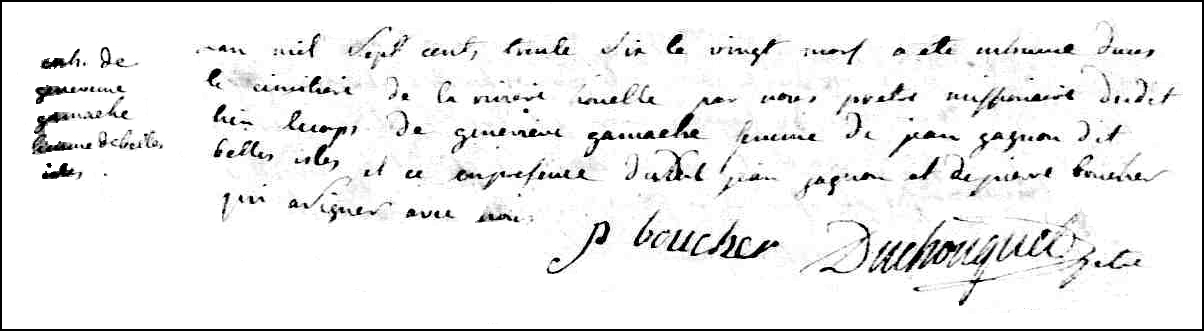
The Death and Burial of Genevií¨ve Gamache – 1736

On 20 Mar 1736, Genevií¨ve Gamache, daughter of Nicolas Gamache and í‰lisabeth Ursule Cloutier, was buried in the cemetery of the parish of Rivií¨re Ouelle, New France.

The Death and Burial Record of Genevieve Gamache - 1736

The Death and Burial Record of Genevií¨ve Gamache – 1736

SOURCE: Gabriel Drouin, comp. Drouin Collection. Montréal, Québec, Canada: Institut Généalogique Drouin. Parish of Rivií¨re Ouelle, New France, 1736. Death and Burial Record of Genevií¨ve Gamache, Front of Folio 3.

Click on the image above to enlarge it. Click on the link for a PDF copy of the Death and Burial Record of Genevií¨ve Gamache – 1736. Translated from the French the record reads:

Bur[ial] of Genevií¨ve Gamache, wife of Belles Isles

In the year one thousand seven hundred thirty six on the twentieth of March was buried in the cemetery of Rivií¨re Ouelle by us, the missionary priest of this place, the body of Genevií¨ve Gamache, wife of Jean Gagnon dit Belles Isles in the presence of the said Jean Gagnon and Pierre Boucher, who has signed with me.
                 [signed] P Boucher           Duchouquet, priest

This record can be found as image 4/20 in the Québec Vital Records (Drouin Collection), 1621-1967 on Ancestry.com in the records for Rivií¨re Ouelle 1735-1740. The record appears on the front of folio 3.

Genevií¨ve is described as the wife of Jean Gagnon dit Belles Isles, the husband of her second marriage.

Copyright © 2008 by Stephen J. Danko
Posted in Daily Journal, Gamache | Comments Off on The Death and Burial of Genevií¨ve Gamache – 1736

Around the Oakland Temple

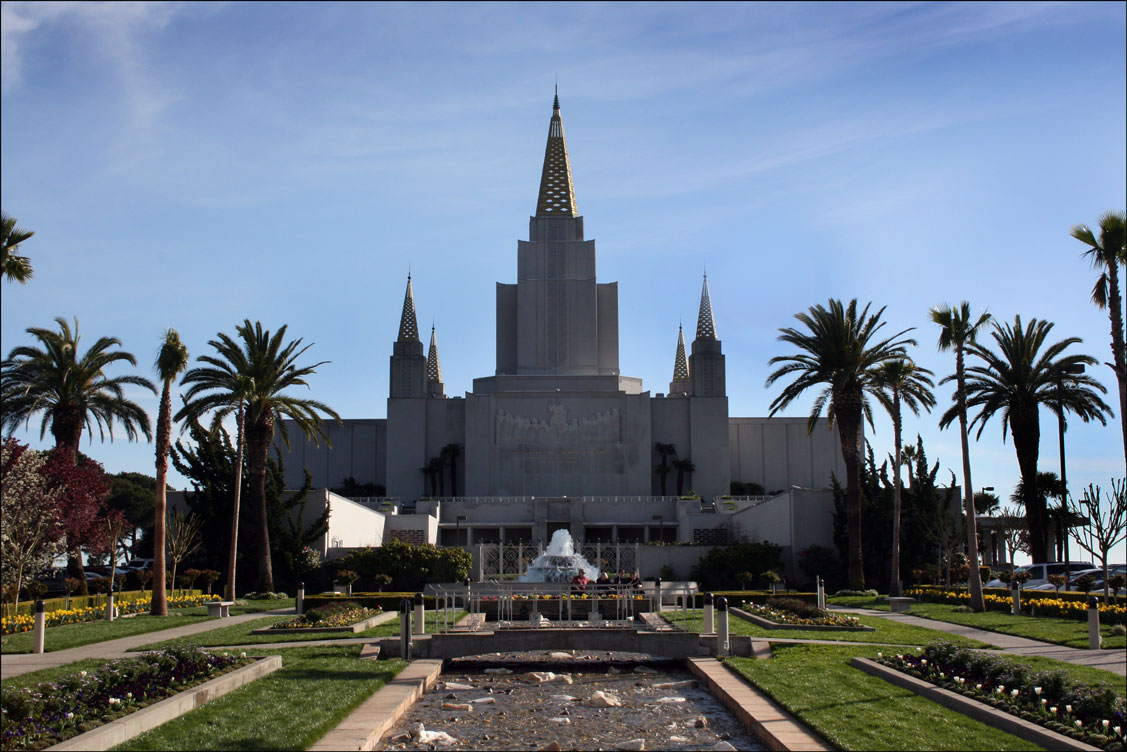
On Saturday, I took some photos around the Oakland Temple where the California Genealogical Society’s meeting was held.

The Oakland Temple

The Oakland Temple

SOURCE: The Oakland Temple (Oakland, Alameda Co., California). Photographed by Stephen J. Danko on 08 Mar 2008.

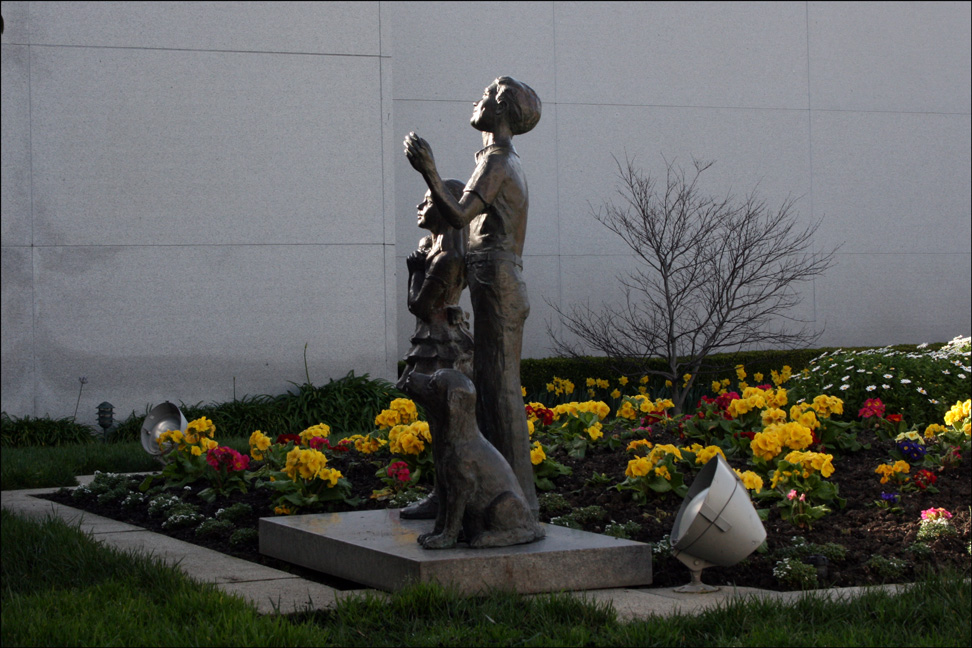
Statue at the Oakland Temple

Statue in Front of the Oakland Temple

SOURCE: Statue in Front of the Oakland Temple (Oakland, Alameda Co., California). Photographed by Stephen J. Danko on 08 Mar 2008.

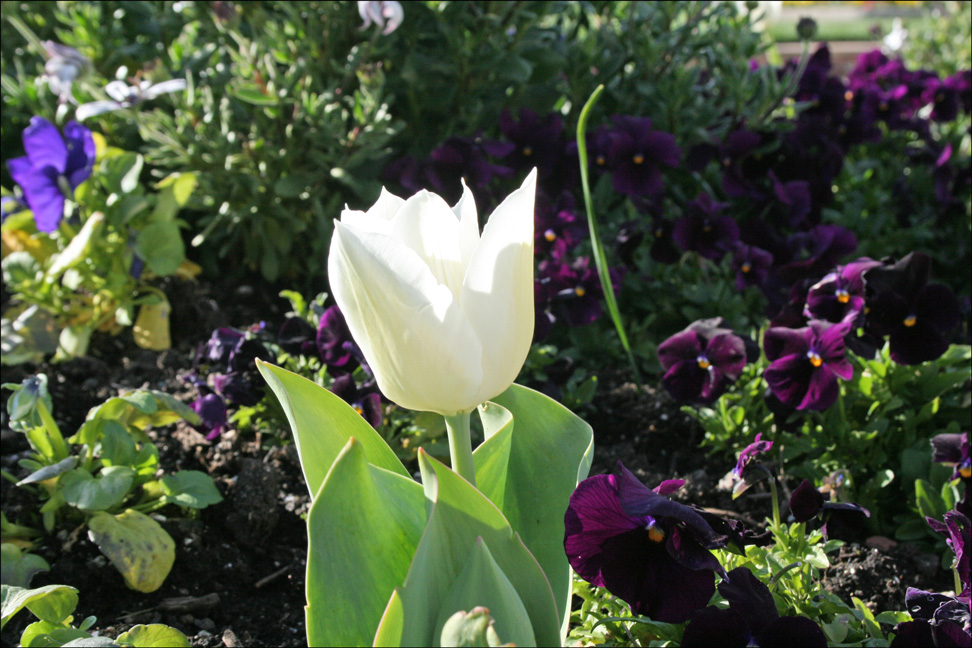
Tulip and Pansies at the Oakland Temple

Tulip and Pansies at the Oakland Temple

SOURCE: Tulip and Pansies at the Oakland Temple (Oakland, Alameda Co., California). Photographed by Stephen J. Danko on 08 Mar 2008.

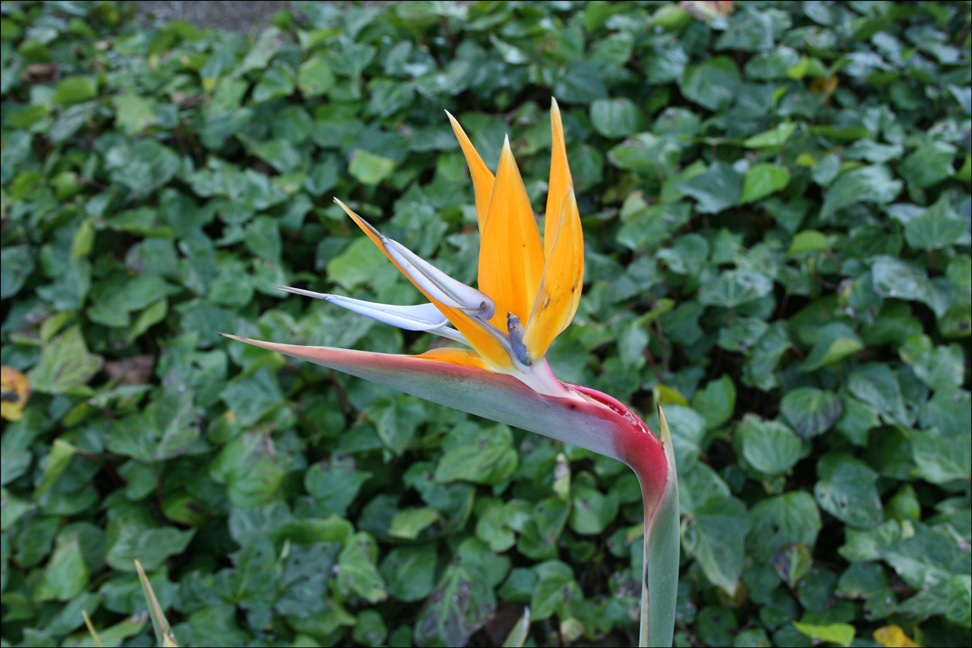
Bird of Paradise Flower at the Oakland Temple

Bird of Paradise (Strelitzia reginae Ait.) at the Oakland Temple

SOURCE: Bird of Paradise (Strelitzia reginae Ait.) at the Oakland Temple (Oakland, Alameda Co., California). Photographed by Stephen J. Danko on 08 Mar 2008.

Copyright © 2008 by Stephen J. Danko 
Posted in Daily Journal | Tagged | Comments Off on Around the Oakland Temple

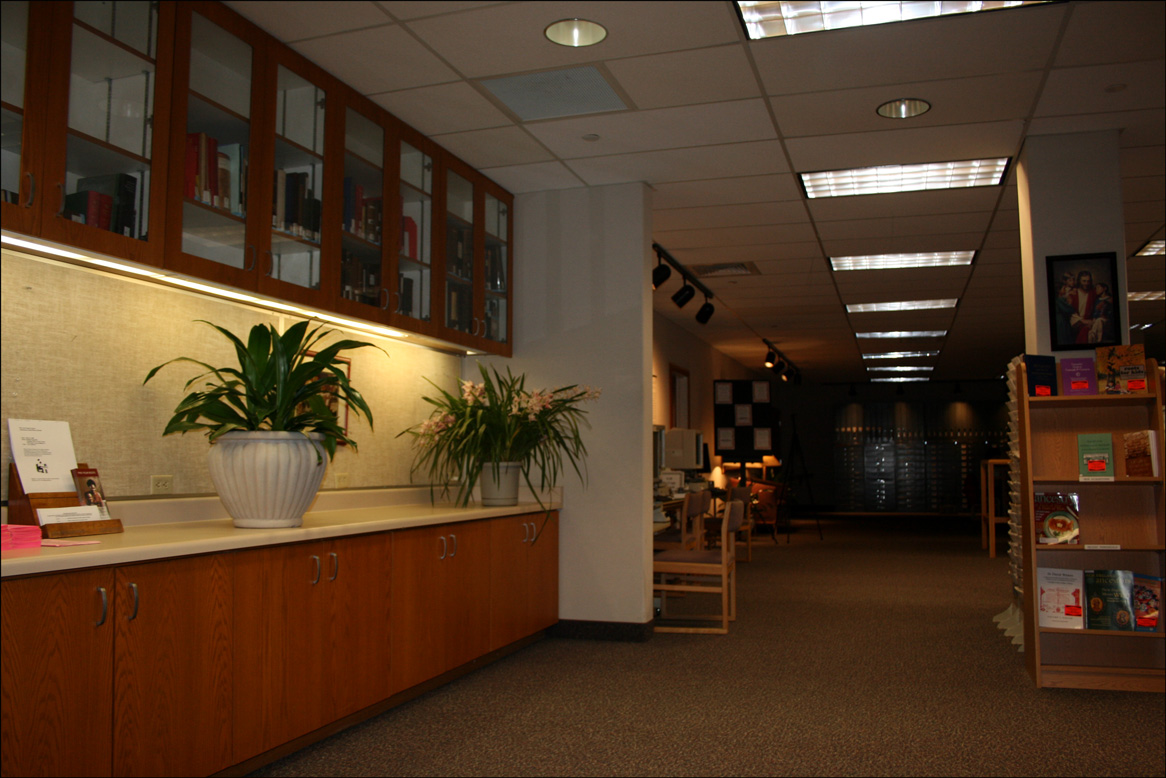
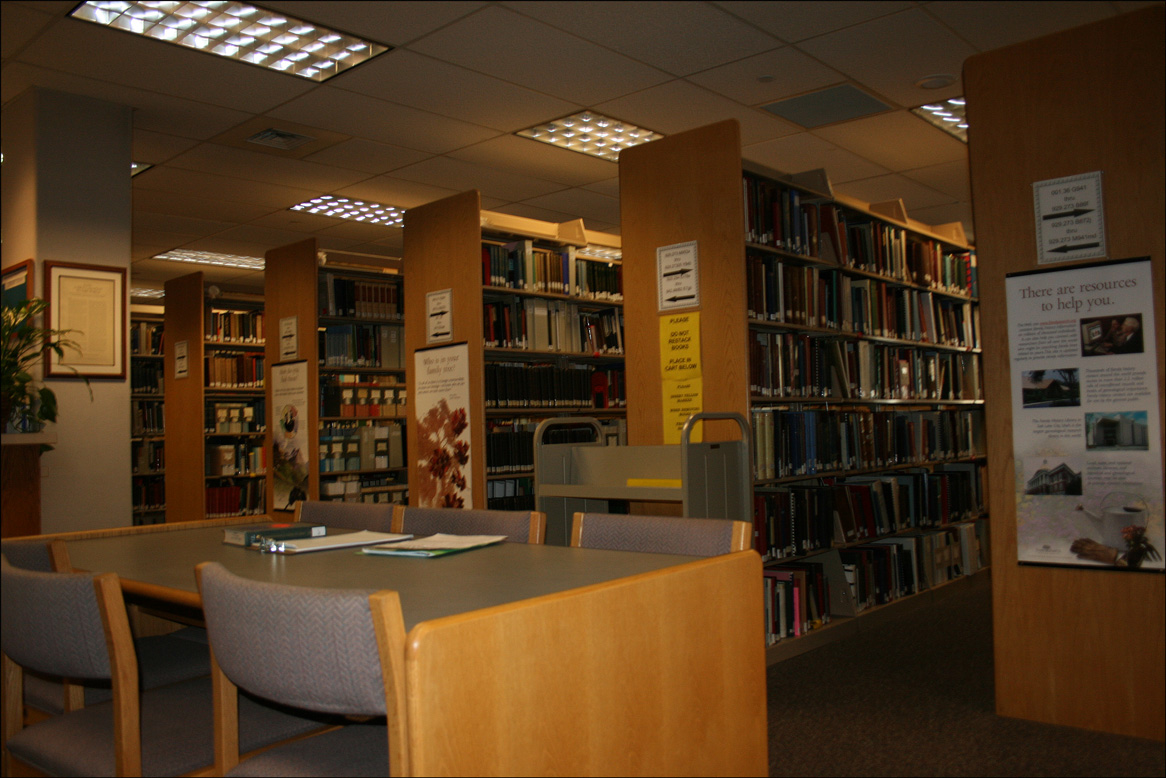
Inside the Oakland Regional Family History Center

While at the Oakland Regional Family History Center on Saturday, I took a few photos inside the facility. The place was hopping on Saturday, but I took care to avoid people in the photos.

A View from the Front Desk of the Oakland FHC

A View from the Front Desk of the Oakland FHC

SOURCE: A View from the Front Door of the Oakland FHC (Oakland, Alameda Co., California). Photographed by Stephen J. Danko on 08 Mar 2008.

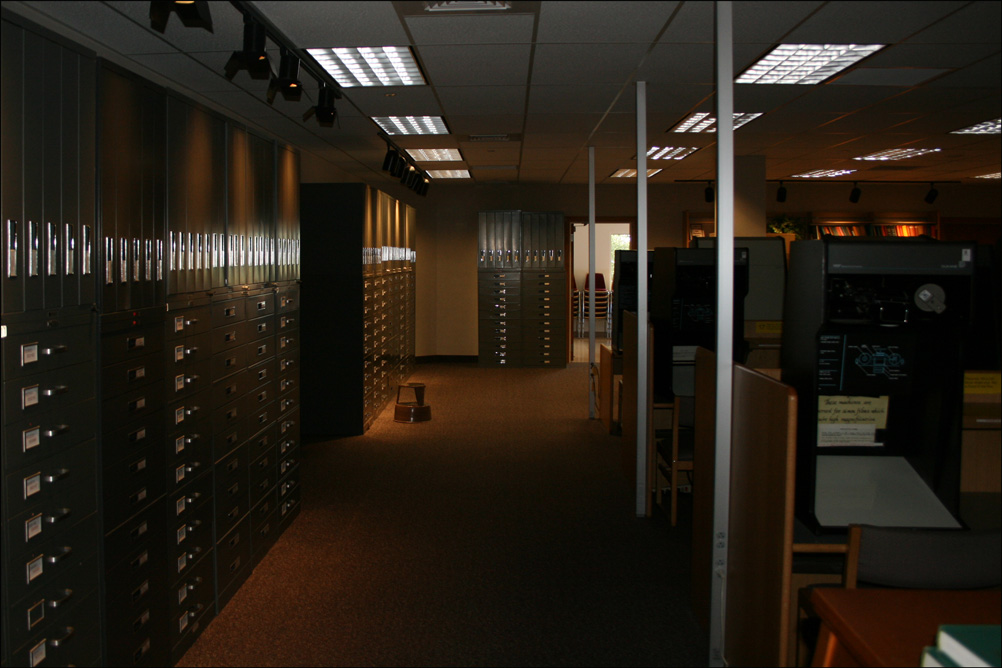
The Stacks at the Oakland FHC

The Stacks at the Oakland FHC

SOURCE: The Stacks at the Oakland FHC (Oakland, Alameda Co., California). Photographed by Stephen J. Danko on 08 Mar 2008.

Microfilm Cabinets and Readers at the Oakland FHC

Microfilm Cabinets and Readers at the Oakland FHC

SOURCE: Microfilm Cabinets and Readers at the Oakland FHC (Oakland, Alameda Co., California). Photographed by Stephen J. Danko on 08 Mar 2008.

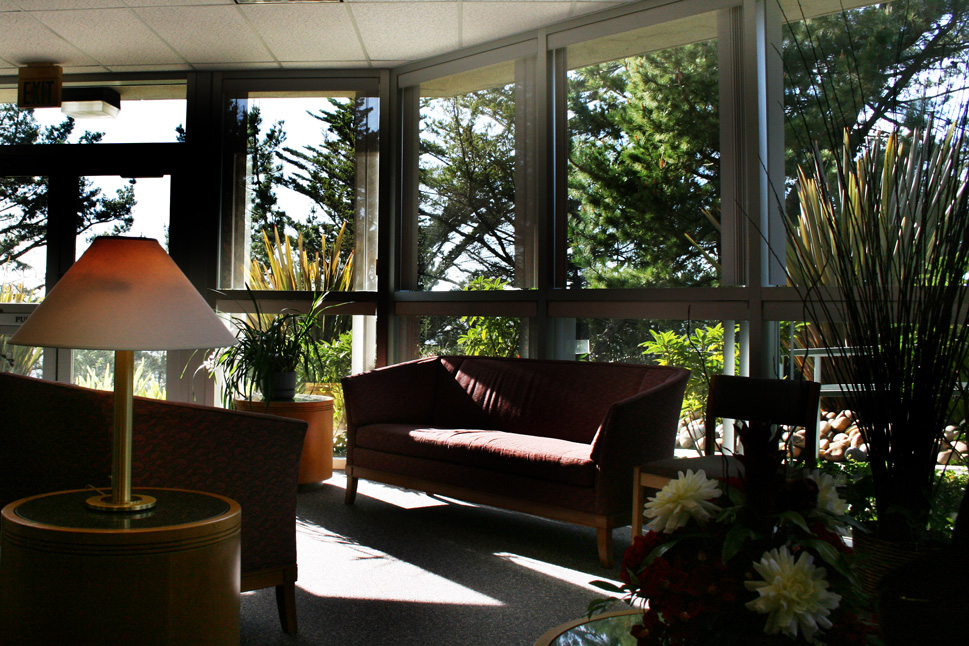
A place to relax at the Oakland FHC

A Place to Relax at the Oakland FHC

SOURCE: A Place to Relax at the Oakland FHC (Oakland, Alameda Co., California). Photographed by Stephen J. Danko on 08 Mar 2008.


Posted in Daily Journal | Comments Off on Inside the Oakland Regional Family History Center

California Genealogical Society Meeting at the Oakland Family History Center

Saturday’s meeting of the membership of the California Genealogical Society was held at the Oakland Family History Center (FHC). The meeting was extremely well attended.

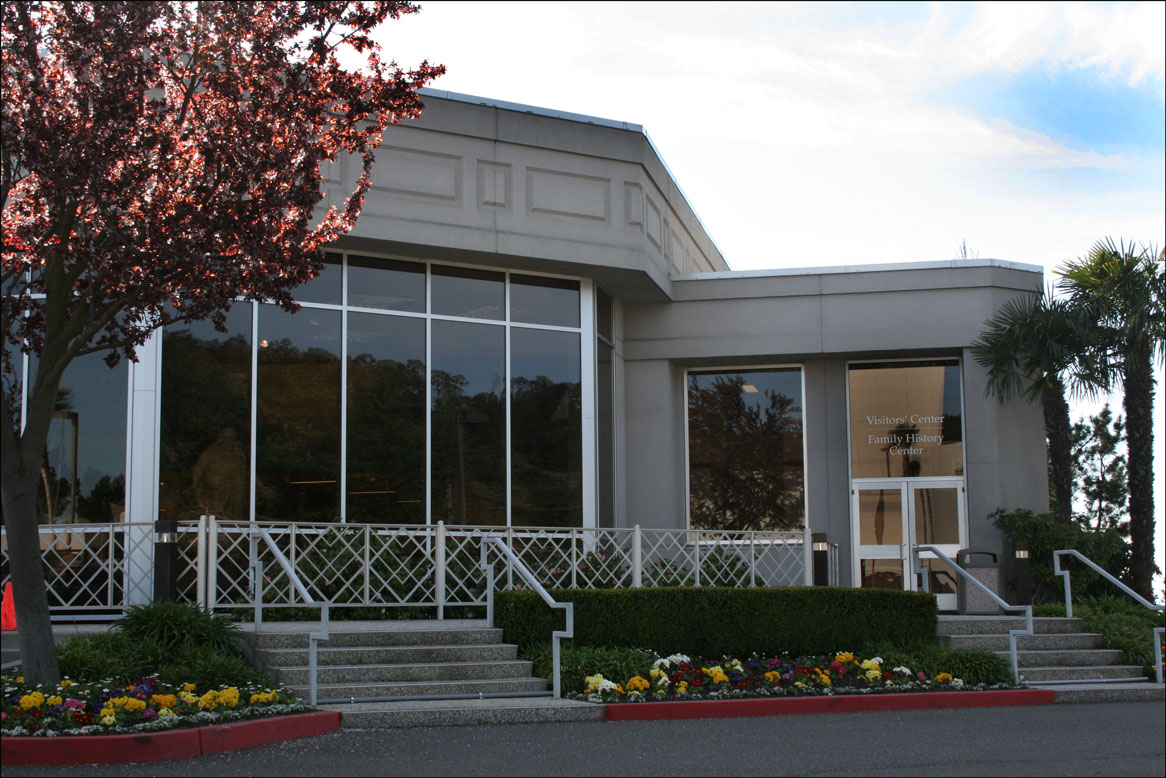
Oakland Regional Family History Center

Oakland Regional Family History Center

Source: Oakland Regional Family History Center (Oakland, Alameda Co., California). Photographed by Stephen J. Danko on 08 Mar 2008.

The venue for the meeting was apt, because the featured presentation was “Amazing New Offerings at the Family History Library” by Margery Bell, Assistant Director of the Oakland Regional Family History Center.

The FHC Portal

Margery explained that, since the Oakland FHC is a regional center, patrons of the facility have free access to a number of databases not available at other FHCs. The FHC Portal provides access to Ancestry.com, Footnote.com, Genline, the Godfrey Memorial Library, Heritage Quest Online, and World Vital Records.

In particular, Margery noted the offerings of Footnote.com and explained that the FHC has a special relationship with Footnote.com since Footnote.com is using technology developed by the Family History Library to scan microfilms. She demonstrated how to use the website and showed how to find Revolutionary War service records and pension records on the site. Patrons can search Footnote.com at home and, once they find images of interest to them, they can access the images for free at any regional FHC.

Margery also highlighted Genline, a database of images of Swedish records available for free at regional FHCs through the FHC Portal.

FamilySearch Labs

Of particular interest to participants was the indexed records search facility at FamilySearch Labs. Registration is required to access the collection. Margery explained that the indexes are 98% accurate. The records are indexed by two indexers familiar with the language. Disagreements are resolved by arbiters.

After searching for records, researchers can browse the records by scrolling from one record to the next record in the collection. Researchers can also choose to browse through just the hits in their search by clicking on a single button.

In addition to indexed collections, researchers can browse the images in collections that have been digitized but not yet indexed, similar to the way researchers would browse through the images on microfilms. Eventually, all 2.8 million rolls of microfilm will be digitized and available either at home through FamilySearch Labs or at an FHC.

Since the rights to some microfilms are owned by organizations other than the Family History Library, not all images will be available for home access. Researchers will be able to search the indexes to these films at home, but must view them either at an FHC or through the contractor’s own website.

Two years ago, the Family History Library announced that the project of scanning all films would be completed within ten years.

FamilySearch Wiki

Another development of interest is the FamilySearch Wiki where users can contribute genealogical content. In particular, the FamilySearch Wiki will provide research guidance for genealogists researching in countries the world over.

New FamilySearch 

A third development of FamilySearch is the New FamilySearch. Currently, this facility is only available to members of the Church of Jesus Christ of Latter Day Saints whose temples are also using it. In a year, all temples will be using the New FamilySearch, and the site may be expanded in the future to allow anyone to participate if resources allow.

The basis of the New FamilySearch is an interactive Web 2.0 application wherein all Ancestral File, IGI, Pedigree Resource Files, and Church membership records will be integrated into family trees that will merge duplicated records in those resources and enable researchers to examine conflicting records for the same individual and select preferred records to show up in their view of the New FamilySearch. Corrections can be added, but incorrect information already in the system can only be changed by the person who initially contributed it. If the original contributor is deceased, a closely related researcher can claim the records.

The New FamilySearch will also allow users to sign in to help other researchers long-distance in real time, online.

In the future, we may be able to add timelines of the lives of individuals in the database and add scans of the original documents.

California Genealogical Society Update

Jane Lindsey of the California Genealogical Society and Library provided information about the databases available online at the CGS Library, including WorldVitalRecords.com, Footnote.com, NewEnglandAncestors.com, and Ancestry Library Edition . She also updated members about upcoming society events, including the upcoming Member Coffee on April 2 in San Francisco, the Central and Eastern European Genealogy Workshop on April 12, and the society’s Research Trip to Salt Lake City from April 13-20. Kathryn Doyle provided a tour of the society blog.

Copyright © 2008 by Stephen J. Danko
Posted in Daily Journal | Tagged | 1 Comment

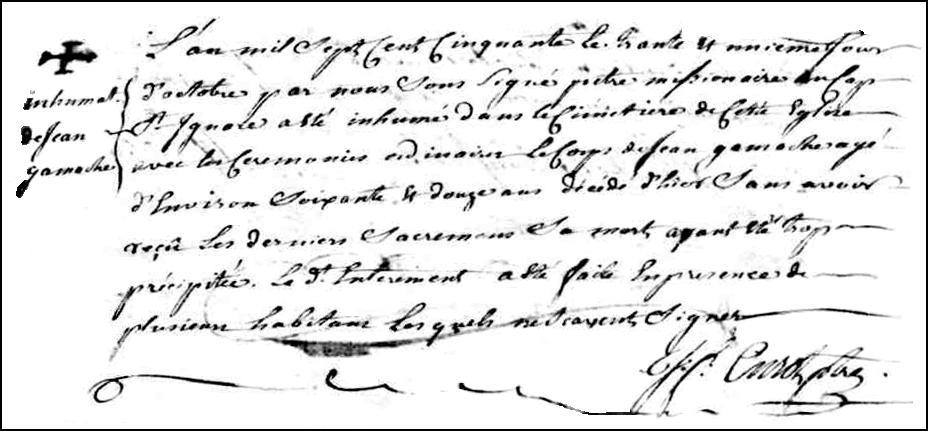
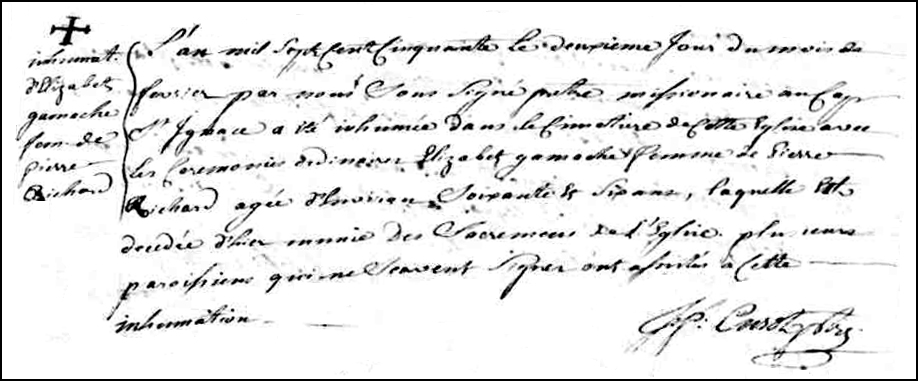
The Death and Burial of Jean Baptiste Gamache – 1750

On 30 Oct 1750, Jean Gamache, son of Nicolas Gamache and í‰lisabeth Ursule Cloutier, died. He was buried in the parish of Cap St. Ignace, New France on 31 Oct 1750.

The Death and Burial Record of Jean Gamache -1750

The Death and Burial Record of Jean Gamache – 1750

SOURCE: Gabriel Drouin, comp. Drouin Collection. Montréal, Québec, Canada: Institut Généalogique Drouin. Parish of Cap St. Ignace, New France, 1750. Death and Burial Record of Jean Gamache, Front of Folio 22.

Click on the image above to enlarge it. Click on the link for a PDF copy of the Death and Burial Record of Jean Gamache – 1750. Translated from the French the record reads:

Bur[ial] of Jean Gamache

In the year one thousand seven hundred fifty, on the thirty first day
of October, by us, the undersigned missionary priest of Cap
St. Ignace, was buried in the cemetery of this Church
with the usual ceremonies, the body of Jean Gamache, age
about seventy two years, who died yesterday without having
received last rights. The death was too rapid.
The burial was made in the presence of
several residents who do not know how to write.
                           [signed] J[ean] F[raní§ois] Curot, priest

This record can be found as image 27/33 in the Québec Vital Records (Drouin Collection), 1621-1967 on Ancestry.com in the records for Cap St. Ignace 1747-1751. The record appears on the front of folio 22.

While searching for this record, I discovered that there were quite a number of deaths reported in Cap St. Ignace in October and November 1750. This observation suggests there may have been an epidemic of some sort in Cap St. Ignace at that time . 

There were a few words I didn’t understand in this record. I’ll have to find someone more familiar with the French language who may be able to help.

UPDATE 08 Mar 2008: Gilles, The Nomadic Researcher, really helped me out with this record. I had problems reading the original French in two places, both of which Gilles provided for me.

The first was the phrase “avec les cérémonies ordinaires” which Gilles translated as “with the usual ceremonies”.

The second was the phrase “Sa mort ayant été trop précipitée” which Gilles translated as “The death was too rapid”.

Thanks, thanks, and more thanks, Gilles!

Copyright © 2008 by Stephen J. Danko
Posted in Daily Journal, Gamache | 1 Comment

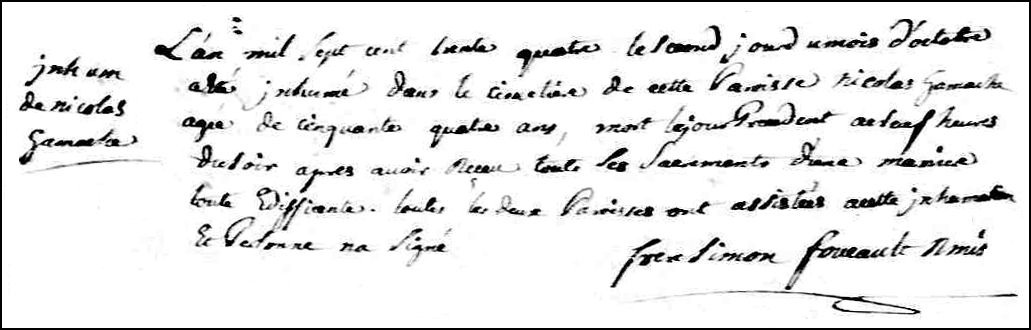
The Death and Burial of Nicolas Gamache – 1734

On 01 Oct 1734, Nicolas Gamache, son of Nicolas Gamache and í‰lisabeth Ursule Gamache, died. He was buried in the parish of Notre-Dame-de-Bonsecours-de-l’Islet (L’Islet-sur-Mer), New France on 02 Oct 1734.

The Death and Burial Record of Nicolas Gamache - 1734

The Death and Burial Record of Nicolas Gamache – 1734

SOURCE: Gabriel Drouin, comp. Drouin Collection. Montréal, Québec, Canada: Institut Généalogique Drouin. Parish of L’Islet-sur-Mer, New France, 1734. Death and Burial Record of Nicolas Gamache, Back of Folio 7.

Click on the image above to enlarge it. Click on the link for a PDF copy of the Death and Burial Record of Nicolas Gamache – 1734. Translated from the French the record reads:

Bur[ial] of Nicolas Gamache

In the year one thousand seven hundred thirty four, on the second day of the month of October, Nicolas Gamache was buried in the cemetery of this parish, age fifty four years, died on the previous day at nine o’clock in the evening after having received all the sacraments in an edifying manner, both of the two parishes assisted with this burial and no one signed.
                       [signed] Brother Simon Foucault, RMis

This record can be found as image 75/312 in the Québec Vital Records (Drouin Collection), 1621-1967 on Ancestry.com in the records for L’Islet 1679-1779. The record appears on the back of folio 7.

I don’t quite understand the translation after “having received all the sacraments” except for the fact that no one signed the record.

UPDATE 08 Mar 2008: Once again Gilles, The Nomadic Researcher has come to my rescue. Gilles wrote that the phrase with which I was struggling states (in French) “d’une manií¨re toute édifiante” which means “with an edifying manner”. Thanks, Gilles!

Copyright © 2008 by Stephen J. Danko
Posted in Daily Journal, Gamache | Comments Off on The Death and Burial of Nicolas Gamache – 1734

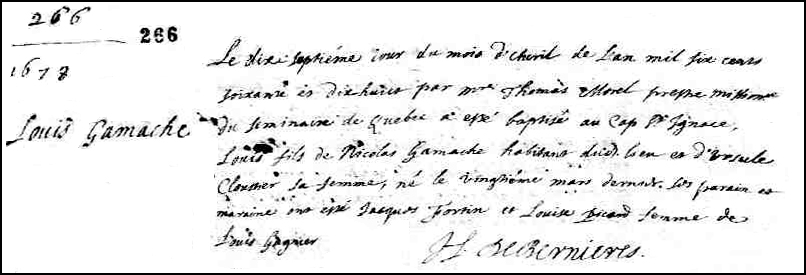
The Birth and Baptism of Louis Gamache – 1678

On 20 Mar 1678, Louis Gamache, son of Nicolas Gamache and í‰lisabeth Ursule Gamache, was born. He was baptized in the Parish of Cap St. Ignace, New France on 17 Apr 1678.

The Birth and Baptismal Record of Louis Gamache - 1678

The Birth and Baptismal Record of Louis Gamache – 1678

SOURCE: Gabriel Drouin, comp. Drouin Collection. Montréal, Québec, Canada: Institut Généalogique Drouin. Parish of St. Ignace, New France, (recorded in the records of Québec – Notre Dame) 1678. Birth and Baptismal Record of Louis Gamache, Page 266.

Click on the image above to enlarge it. Click on the link for a PDF copy of the Birth and Baptismal Record of Louis Gamache – 1678. Translated from the French the record reads:

266 266 1678 Louis Gamache

On the seventeenth day of the month of April in the year one thousand six hundred
seventy eight, by Mister Thomas Morel, missionary priest
from the Seminary of Québec, was baptized in Cap St. Ignace
Louis, son of Nicolas Gamache, habitant of this place, and Ursule
Cloutier his wife, born on the twentieth of March last. The Godfather and
Godmother were Jacques Fortin and Louise Picard wife of
Louis Gagnier.
                                    H[enri] Debernieres

This record can be found as image 135/150 in the Québec Vital Records (Drouin Collection), 1621-1967 on Ancestry.com in the records for Québec (Notre Dame). The record appears on page 266.

This is the same Louis Gamache whose death and burial record I showed yesterday.

Copyright © 2008 by Stephen J. Danko
Posted in Daily Journal, Gamache | Comments Off on The Birth and Baptism of Louis Gamache – 1678

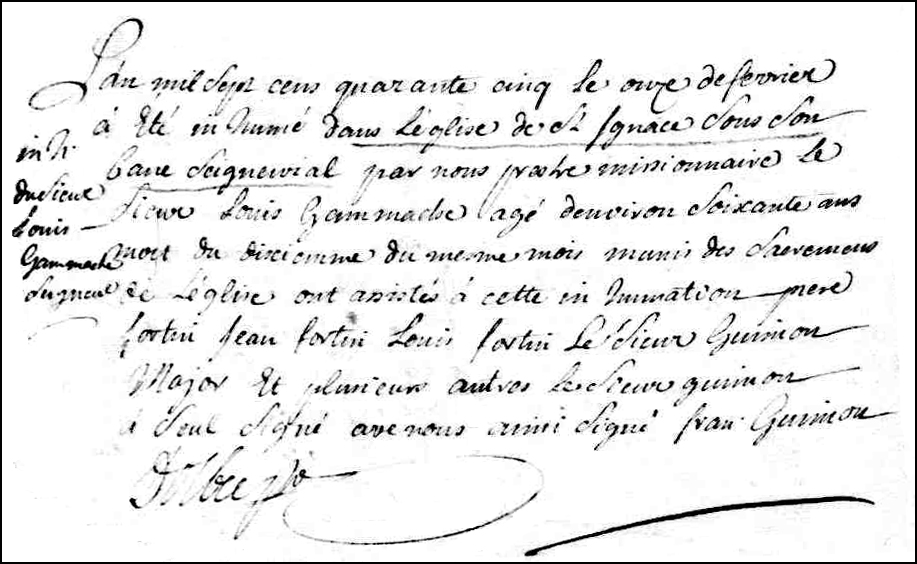
The Death and Burial of Louis Gamache – 1745

On 10 Feb 1745, Louis Gamache, son of Nicolas Gamache and í‰lisabeth Ursule Gamache, died. He was buried in the Church of St. Ignace, New France under his Seigneurial territory on 11 Feb 1745.

The Death and Burial Record of Louis Gamache - 1745

The Death and Burial Record of Louis Gamache – 1745

SOURCE: Gabriel Drouin, comp. Drouin Collection. Montréal, Québec, Canada: Institut Généalogique Drouin. Parish of St. Ignace, New France, 1745. Death and Burial Record of Louis Gamache, Back of Folio 16.

Click on the image above to enlarge it. Click on the link for a PDF copy of the Death and Burial Record of Louis Gamache – 1745. Translated from the French the record reads:

Burial of Mister Louis Gamache, Seigneur

In the year one thousand forty five on the eleventh of February
was buried in the church of St. Ignace under his
seigneurial bench by us the missionary priest of
this place, Louis Gamache, age about sixty years,
died on the tenth of this same month, armed with the Sacraments
of the Church. Pierre Fortin, Jean Fortin, Louis Fortin, Mister
Guimon, Major, and many others assisted in this burial.
Mister Guimon has signed below with us. signed Fran[í§ois] Guimon
Dolbec, priest

This record can be found as image 181/948 in the Québec Vital Records (Drouin Collection), 1621-1967 on Ancestry.com in the records for Cap St. Ignace 1679-1808. The record appears on the back of folio 16.

Louis Gamache is described in this record as a seigneur and a reference is made that he was buried under his seigneurial territory.

Many of the parish records from New France describe the subjects of the records as habitants. This record, however, describes the subject as a seigneur.

Cardinal Richelieu established the seigneurial system in new France in 1627. Seigneuries were narrow strips of land along the Saint Lawrence River which were officially the property of the King of France.

Seigneurs managed the seigneuries for the king. Habitants were free men who worked for themselves but paid taxes to the seigneur. Habitants often worked for the seigneur three days each year in such tasks as building roads.

UPDATE 08 Mar 2008: Gilles, The Nomadic Researcher, wrote to say that I had mistranslated a phrase in this record. The record provides the location of the burial of Louis Gamache. Gilles wrote that the phrase, in French, is “sous son ban seigneurial”, translated into English as “under his seigneurial bench”. Gilles also provided additional information about this phrase:

“In New France and old Québec, benches in a church were sold to the parishioners; in some churches, the seigneur had his special bench which was located in the front and sometimes with doors…”

Thanks, Gilles!

Copyright © 2008 by Stephen J. Danko
Posted in Daily Journal, Gamache | Comments Off on The Death and Burial of Louis Gamache – 1745

The Birth and Baptism of Nicolas Gamache – 1680

On 21 May 1680, Nicolas Gamache, son of Nicolas Gamache and í‰lisabeth Ursule Gamache, was born. He was baptized in the Parish of Neuville, New France on 09 Jun 1680.

The Birth and Baptismal Record of Nicolas Gamache - 1680

The Birth and Baptismal Record of Nicolas Gamache – 1680

SOURCE: Gabriel Drouin, comp. Drouin Collection. Montréal, Québec, Canada: Institut Généalogique Drouin. Parish of Neuville, New France, 1680. Birth and Baptismal Record of Nicolas Gamache, Front of Folio 2.

Click on the image above to enlarge it. Click on the link for a PDF copy of the Birth and Baptismal Record of Nicolas Gamache – 1680. Translated from the French the record reads:

Nicolas Gamache

On the ninth day of the month of June in the year [two words?]
by me the undersigned missionary priest, was baptized in Cap de
Vincelotte, Nicolas Gamache, born on the twenty first of [two words?]
son of Nicolas Gamache and Ursule Cloutier, his wife. The
Godfather was Eustache Fortin, cousin of the child. The
Godmother was Marie LeRoy, wife of Jean Gotreau [one word?]
residing in this place. The said father Gamache and Godfather
Fortin signed and the others have declared that they are not able
to write or sign as required…

This record can be found as image 6/324 in the Québec Vital Records (Drouin Collection), 1621-1967 on Ancestry.com in the records for Neuville 1679-1724. The record appears on the front of folio 2.

Over two weeks passed between the time Nicolas Gamache was born and the time he was baptized. In 1680, the priests in New France apparently served several communities and were only available for baptisms and marriages in a given community for a short period of time every few weeks.

This record is one of the most difficult records I’ve ever tried to read. The writing is faint and the document itself is damaged. Fortunately, the record was extracted by Le Programme de recherche en démographie historique
(The Research Program in Historical Demography) or PRDH at the University of Montreal, allowing me to decipher the original record using the information in the PRDH extraction as a guide.

Copyright © 2008 by Stephen J. Danko
Posted in Daily Journal, Gamache | Comments Off on The Birth and Baptism of Nicolas Gamache – 1680