The Słownik Geograficzny Królestwa Polskiego i Innych Krajów Słowiańskich (Geographical Dictionary of the Kingdom of Poland and other Slavonic Countries) includes one entry for the Polish village of Szwelice currently in Maków Powiat. Szwelice was the local parish and, at the time the Słownik Geograficzny was written, was an ecclesiastical village owned by the local bishop.
In the map below, the village of Szwelice is indicated by a red box. Villages belonging to the local bishop and part of the parish of Szwelice are indicated by black boxes. Villages owned by the lesser nobility and part of the parish of Szwelice are indicated by blue boxes.
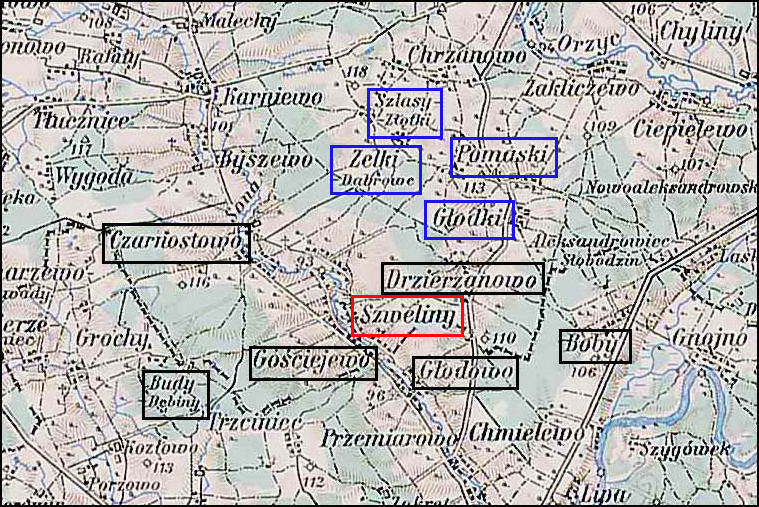
Szwelice and Surrounding Area – 1910
Third Military Mapping Survey of Austria-Hungary (ELTE Faculty of Informatics,
Institute of Cartography and Geoinformatics); digital images, Lazarus ELTE
(http://lazarus.elte.hu/hun/digkonyv/topo/200e/39-53.jpg: accessed 20 December 2025)
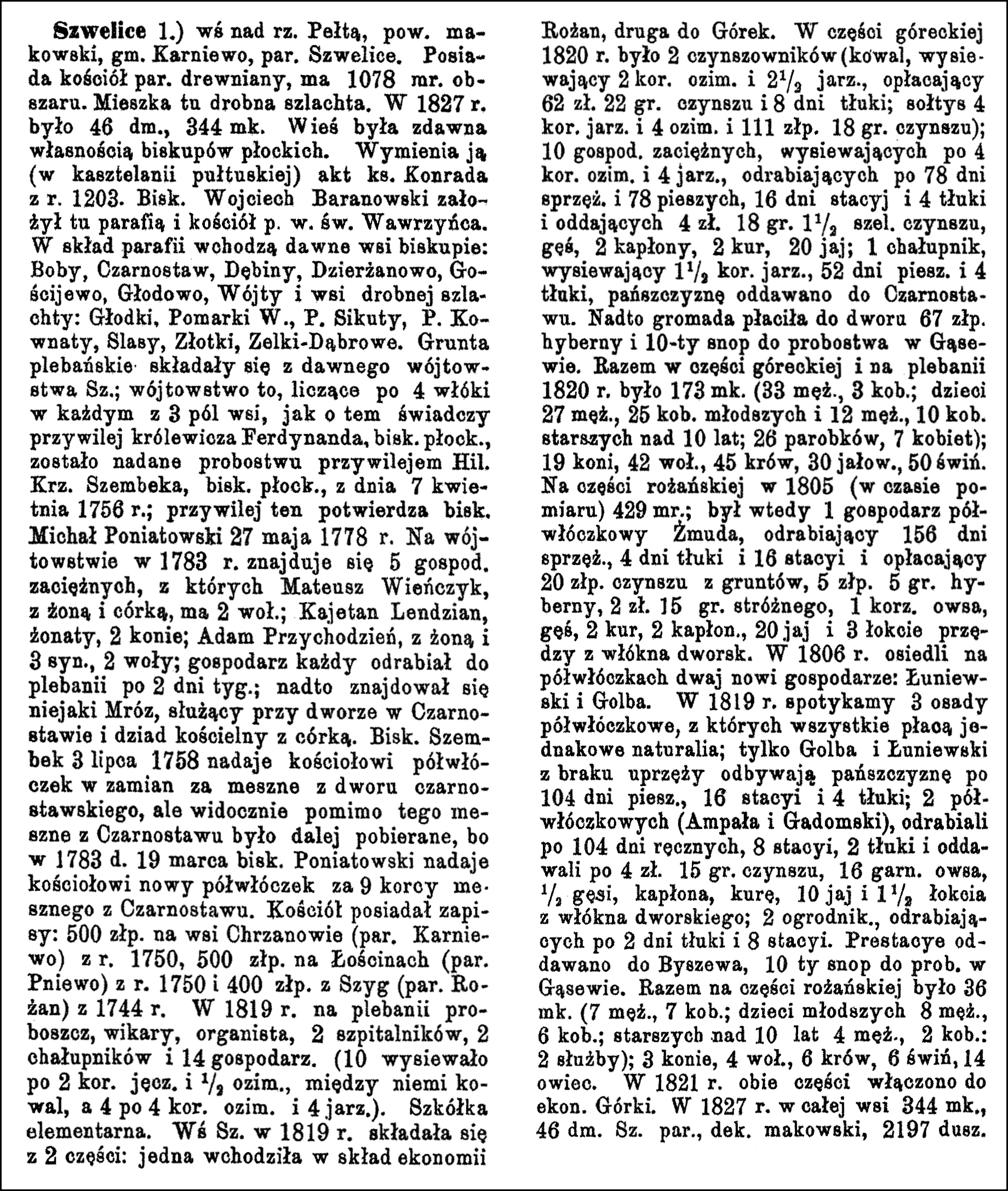
Source: Chlebowski, Bronisław, ed., Słownik Geograficzny Królestwa Polskiego i Innych Krajów Słowiańskich (Geographical Dictionary of the Kingdom of Poland and other Slavonic Countries) – Warsaw 1892, Volume XII, pages 89-90.
Click on the link for a PDF copy of the the Słownik Geograficzny entries for Szwelice. Translated from the Polish, the entry for Szwelice reads:
Szwelice 1.) a village on the Pełta River, Maków powiat, Karniewo gmina, Szwelice parish. It has a wooden parish church and covers an area of 1078 mórgs [Gerald Ortell’s book on Polish Parish Records states that in the Russian partition 1 mórg = 1.388 acres]. It is inhabited by minor nobility. In 1827, there were 46 houses and 344 inhabitants. The village was historically owned by the bishops of Płock. It is mentioned (in the Pułtusk castellany) in a document of Duke Konrad from 1203. Bishop Wojciech Baranowski founded the parish and the church of Św. Wawrzyniec [St. Lawrence] here. The parish includes villages formerly governed by the local bishop: Boby, Czarnostaw, Dębiny, Dzierżanowo, Dościjewo, Głodowo, Wójty, and villages of minor nobility: Głodki, Pomarki Wielkie., Pomaski Sikuty, Pomaski Kownaty, Slasy, Złotki, and Zelki-Dąbrowe. The parish lands consisted of the former Szwelice jurisdiction; this jurisdiction, comprising 4 włóki [1 włóka = 30 mórgs] in each of the 3 fields of the village, as evidenced by the privilege of Prince Ferdinand, Bishop of Płock, was granted to the parish by a privilege of Hilary Krzysztof Szembek, Bishop of Płock, dated April 7, 1756; this privilege was confirmed by Bishop Michał Poniatowski on May 27, 1778. In 1783, the jurisdiction had 5 tenant farmers, of whom Mateusz Wieńczyk with his wife and daughter, had 2 oxen; Kajetan Lendzian, married, 2 horses; Adam Przychodzień with his wife and 3 sons, 2 oxen; each farmer worked 2 days a week for the rectory; Furthermore, there was a certain Mróz, a servant at the manor in Czarostaw, and a church sexton with his daughter. Bishop Szembek, on July 3, 1758, granted the church ½ włóka of land in exchange for tithes from the Czarostaw manor, but apparently, despite this, tithes from Czarostaw continued to be collected, because on March 19, 1783, Bishop Poniatowski granted the church another ½ włóka of land for 9 bushels of tithes from Czarnostaw [now called Czarnostów]. The church possessed endowments: 500 Polish zlotys in the village of Chrzanowo (Karniewo parish) from the year 1750, 500 Polish zlotys in Łościn (Pniewo parish) from 1750, and 400 Polish zlotys from Szygi (Rożan parish) from 1744. In 1819, the rectory housed the parish priest, vicar, organist, 2 hospital attendants, 2 cottagers, and 14 farmers. (10 sowed 2 bushels of barley and ½ bushel of winter grain each, including the blacksmith, and 4 sowed 4 bushels of winter grain and 4 bushels of spring grain each). There was an elementary school. In 1819, he village of Szwelice consisted of 2 parts: one was part of the Rożan estate, the other belonged to Górki. In the Górki part in 1820 there were 2 tenants (a blacksmith, sowing 2 bushels of winter grain and 2 1/3 bushels of spring grain, paying 62 złoty and 22 groszy in rent and 8 days of labor; the village headman sowing 4 bushels of spring grain and 4 bushels of winter grain and 111 złoty and 18 groszy in rent); 10 hired farmers, sowing 4 bushels of winter grain each, and 4 cottagers, working 78 days with a team of horses and 78 days on foot, 16 days of station work and 4 days of threshing, and paying 4 zloty 18 groszy 1½ shillings in rent, a goose, 2 capons, 2 chickens, 20 eggs; 1 cottager, sowing 1½ korzec [bushel] of grain, 52 days on foot and 4 days of threshing, the serfs were sent to Czarnostaw [Czarnostaw is now Czarnostowo] to perform forced labor. In addition, the community paid 67 Polish złoty in winter tax to the manor and 1/10 sheaf to the rectory in Gąsewo. In total, in the Górecki part and at the rectory in 1820 there were 173 inhabitants (33 men, 3 women; 27 boys, 25 girls younger than 10 years old; and 12 boys, 10 girls older than 10 years old; 26 farmhands, 7 women); 19 horses, 42 oxen, 45 cows, 30 heifers, 50 pigs. In the Rożański part in 1805 (at the time of the survey) there were 429 mórgs; at that time there was one ½ włóka farmer, Żmuda, working 156 days with a team of horses, 4 days of threshing and 16 days of station work and paying 20 Polish złoty in rent for the land, 5 Polish złoty 5 groszy in winter tax, 2 złoty 15 groszy in watchman’s fee, 1 korzec of oats, a goose, 2 chickens, 2 capons, 20 eggs and 3 cubits of yarn from the manor’s fiber.In 1806, two new farmers settled on the ½ włóka plots: Łuniewski and Golba. In 1819, we find three ½ włóka settlements, all of which pay the same in kind; only Golba and Łuniewski, due to a lack of harnesses, performed serf labor for 104 days on foot, covering 16 stages and 4 threshing sessions; two ½ włóka tenants (Ampała and Gadomski) worked 104 days of manual labor, 8 stages, 2 threshing sessions, and paid 4 złoty and 15 groszy in rent, 16 measures of oats, ½ goose, a capon, a hen, 10 eggs, and 1 ½ cubits of flax from the manor; two gardeners worked 2 days of threshing and 8 stages. Services were rendered to Byszewo, and 10 sheaves were given to the parish priest in Gąsewo. In total, the Rożan part of the village had 36 inhabitants (7 men, 7 women; 8 younger children, 6 older children over 10 years old; 2 servants); 3 horses, 4 oxen, 6 cows, 6 pigs, 14 sheep. In 1821, both parts were incorporated into the Górki estate. In 1827, the entire village had 344 inhabitants and 46 houses. Parish of Szwelice, Maków deanery, 2197 souls.
Copyright © 2026 by Stephen J. Danko