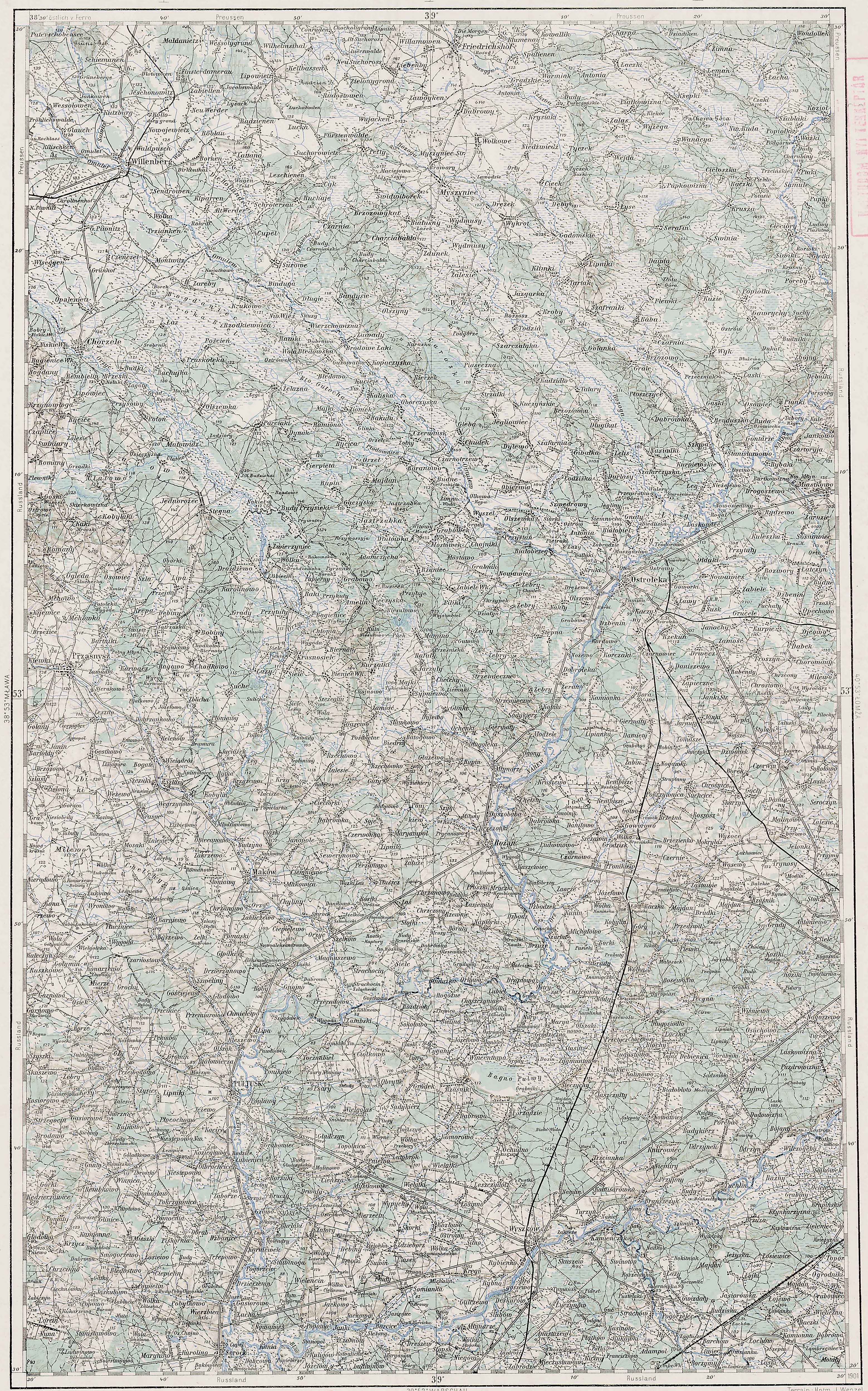
The Słownik Geograficzny Królestwa Polskiego i Innych Krajów Słowiańskich (Geographical Dictionary of the Kingdom of Poland and other Slavonic Countries) includes two entries for Polish villages called Smrock, both of them for the same village belonging to the parish of Szelków.
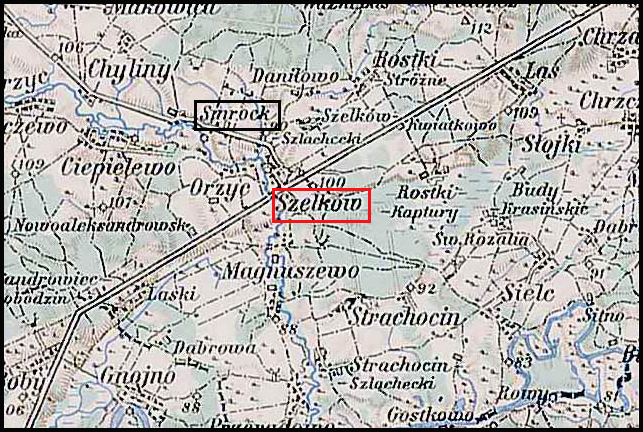
Smrock and Surrounding Area – 1910
Third Military Mapping Survey of Austria-Hungary (ELTE Faculty of Informatics,
Institute of Cartography and Geoinformatics); digital images, Lazarus ELTE
(http://lazarus.elte.hu/hun/digkonyv/topo/200e/39-53.jpg: accessed 20 December 2025)
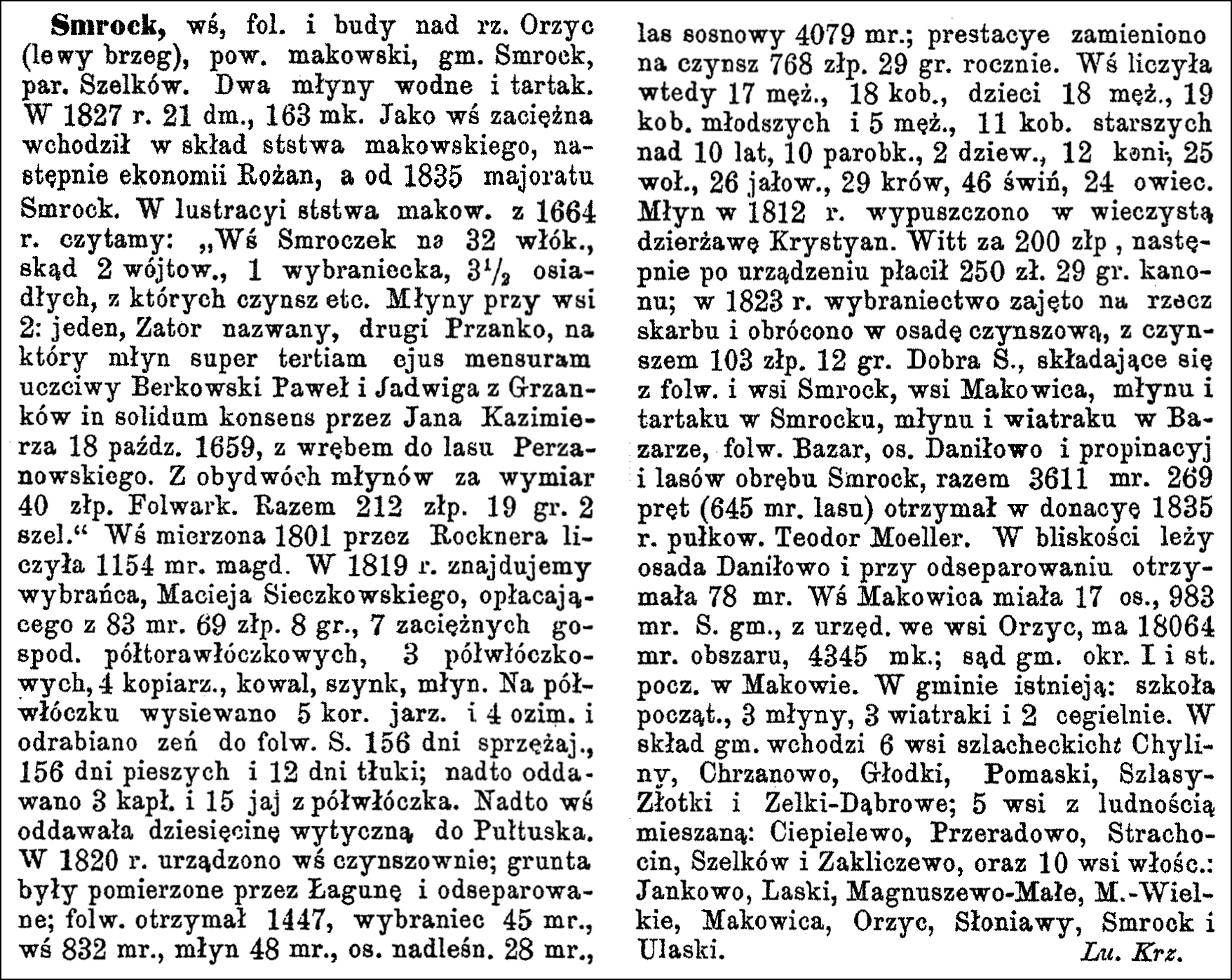
Source: Chlebowski, Bronisław and Władysław Walewski, eds., Słownik Geograficzny Królestwa Polskiego i Innych Krajów Słowiańskich (Geographical Dictionary of the Kingdom of Poland and other Slavonic Countries) – Warsaw 1889, Volume X, page 923
Click on the link for a PDF copy of the the Słownik Geograficzny entry for Smrock. Translated from the Polish, the first entry reads:
Smrock, a village, manor, and hamlet on the Orzyc River (left bank), Maków powiat, Smrock gmina, Szelków parish. Two watermills and a sawmill. In 1827, it had 21 houses and 163 inhabitants. As a leased village, it was part of the Maków starosty, then the Rożan estate, and from 1835 the Smrock majorate. In the 1664 inspection of the Maków starosty, we read: “The village of Smroczek has 32 włóki [1 włóka = 30 mórgs; Gerald Ortell’s book on Polish Parish Records states that in the Russian partition 1 mórg = 1.388 acres], from which 2 belong to the village headmen, 1 to a chosen representative, and 3½ are permanently resident, from which rent, etc. Two mills near the village: one called Zator, the other Przanko, for which mill, according to its third measurement, the honorable Paweł Berkowski and Jadwiga née Grzanka received a joint consent from John Casimir on October 18, 1659, with the right to timber from the Perzanowski forest. From both mills, the rent is 40 Polish złotys. Manor house. Total 212 Polish złotys 19 groszy, 2 shelags [a shelag is an old Polish coin.]” The village, measured in 1801 by Rockner, comprised 1154 Magdeburg mórgs. In 1819, we find the chosen representative, Maciej Sieczkowski, paying 69 złotys and 8 groszy for 83 mórgs for 7 hired farmhands working 1 ½ włóka each, 3 hired farmhands working ½ włóka each, 4 copyists, a blacksmith, a tavern, and a mill. On a ½ włóka field, 5 bushels of spring grain and 4 bushels of winter grain were sown, and 156 days of teamwork, 156 days of manual labor, and 12 days of threshing were performed for the manor. In addition, 3 capons and 15 eggs were given from each ½ włóka. Furthermore, the village paid a tithe to Pułtusk. In 1820, the village was reorganized into a rent-paying system; the lands were measured by Łaguna and separated; the manor received 1447 mórgs, the representative 45 mórgs, the village 832 mórgs, the mill 48 mórgs, the forester’s settlement 28 mórgs, and the pine forest 4079 mórgs; the services were converted into an annual rent of 768 złotys and 29 groszy. At that time, the village had 17 men, 18 women, 18 boys and 19 girls under 10 years old, 5 men and 11 women over 10 years old, 10 farmhands, 2 maids, 12 horses, 25 oxen, 26 heifers, 29 cows, 46 pigs, and 24 sheep. The mill was leased in perpetuity in 1812 to Krystyan Witt for 200 złotys, and after the reorganization, he paid 250 złotys and 29 groszy in rent; in 1823 the chosen estate was confiscated by the treasury and converted into a leasehold settlement, with a rent of 103 Polish złotys and 12 groszy. The Smrock estate, consisting of the Smrock manor and village, the village of Makowica, a mill and sawmill in Smrock, a mill and windmill in Bazar, the Bazar manor, the Daniłowo settlement, and the Smrock forest district, totaling 3611 mórgs and 269 rods (645 mórgs of forest), was granted in 1835 to Colonel Teodor Moeller. The Daniłowo settlement is located nearby and, upon separation, received 78 mórgs. The village of Makowica had 17 inhabitants and 983 mórgs. The Smrock gmina, with its office in the village of Orzyc, has an area of 18064 mórgs and 4345 inhabitants; the district court and post office are in Maków. The gmina includes: a primary school, 3 mills, 3 windmills, and 2 brickyards. The gmina comprises 6 noble villages: Chyliny, Chrzanowo, Głodki, Pomaski, Szlasy Złotki, and Zelki-Dąbrowo; 5 villages with mixed population: Ciepielewo, Przeradowo, Strachocin, Szelków, and Zakliczewo, and 10 peasant villages: Jankowo, Laski, Magnuszewo-Małe, Magnuszew.-Wielkie, Makowica, Orzyc, Słoniawy, Smrock, and Ulaski. Lu. Krz.
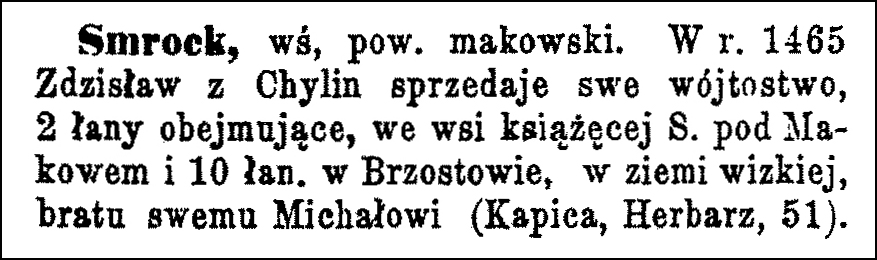
Source: Chlebowski, Bronisław, ed., Słownik Geograficzny Królestwa Polskiego i Innych Krajów Słowiańskich (Geographical Dictionary of the Kingdom of Poland and other Slavonic Countries) – Warsaw 1902, Volume XV Part II, Page 600
Translated from the Polish, the second entry reads:
Smrock, a village in the Maków powiat. In 1465, Zdzisław of Chylin sold his Vogtship, comprising 2 lans [1 lan = 30 mórgs; Gerald Ortell’s book on Polish Parish Records states that in the Russian partition 1 mórg = 1.388 acres] in the ducal village of Smrock near Maków and 10 lans in Brzostów in the Wizna region to his brother Michał (Kapica, Herbarz, 51).
Copyright © 2026 by Stephen J. Danko