
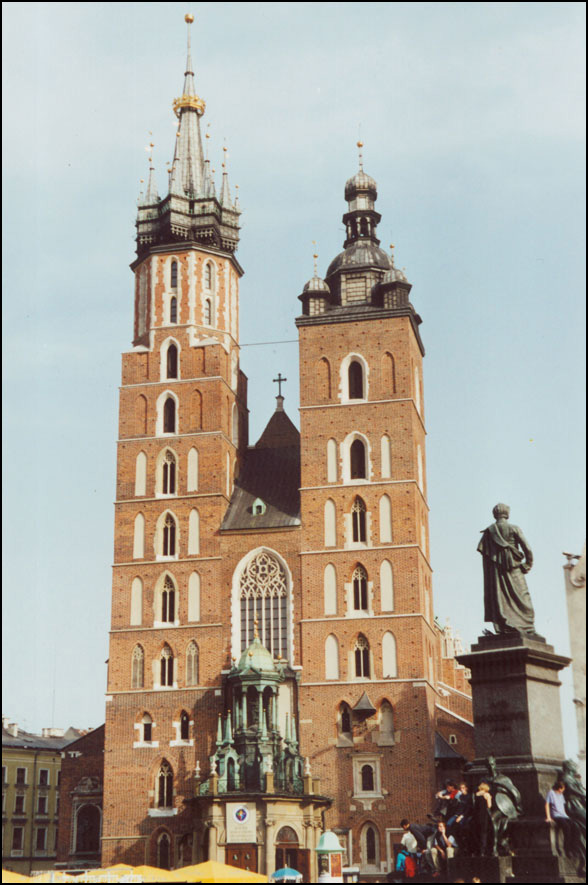
Just about everyone who visits Kraków stops at the Mariacki Church near Cloth Hall . Every hour, in tribute to a trumpeter who was sounding the Hejnal from one of the church towers warning of the invading Tatars, the Hejnal is played from the taller of the two towers of the church . According to legend, the trumpeter’s warning call was cut short when he was struck in the throat by a Tatar arrow . Today, the Hejnal is played on the hour four times, once from each side of the tower, and ends abruptly on the same note the legendary trumpeter’s call . The story is fictionalized in Eric P. Kelly’s children book The Trumpeter of Krakow, a book that won the Newbery Medal in 1929.
During much of the time of the partitions of Poland, Kraków existed as the Free City of Kraków, separate from the occupying powers of Russia, Prussia, and Austria . After an uprising in Kraków in 1846, the Free City was annexed by Austria and closely associated with the Austrian partition, known as Galicia . Records of births/baptisms, marriages, and deaths in Galicia were kept by the Roman Catholic Church, and people of all faiths were required to register births, marriages, and deaths with the local parish . For that reason, all Catholic Church records indicated whether the subject of the record was “Catholic” or “Other”.
The marriage record for my great great grandparents, Pawel Dańko and Zofia Szymańska, is typical of marriage records in this part of Poland . The record was recorded by the parish priest in a pre-printed record book in which the information was recorded in columns . Most of the record was recorded in Latin, although annotations were often made in Polish.
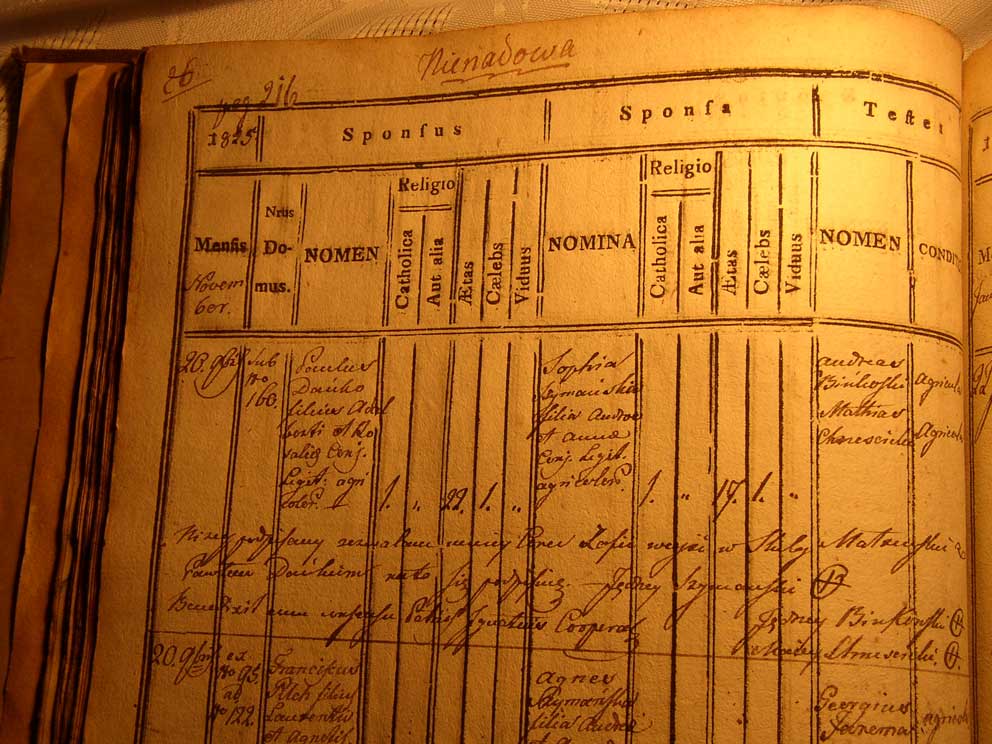
The column headings were:
- Mensis – Month
- Nrus Domus -House Number
- Sponsus – Groom
- Sponsa – Bride
- Testes – Witnesses
- Nomen, Nomina – Name (masculine or feminine)
- Religio (Catholica, Aut alia) – Religion (Catholic, Other)
- AEtas – Age
- Caelebs – Unmarried
- Viduus – Widowed
- Sponsa – Bride
- Conditio – Status
The Marriage Record for Pawel Dańko and Zofia Szymańska indicates that:
- The couple was from Nienadowa
- The couple was married on November 20, 1825
- The groom was Pawel Dańko
- Pawel was the son of Adalbert and Rozalia, a lawfully married couple, farmers
- Pawel lived under house number 160
- Pawel was unmarried, 22 years old, and Catholic
- The bride was Zofia Szymańska
- Zofia was the daughter of Andrzej and Anna, a lawfully married couple, farmers
- Zofia was unmarried, 17 years old, and Catholic
- The witnesses were Andrzej Bińlioski, farmer, and Maciej Charescicki, farmer
- Because Zofia was only 17, her father had to sign the record, indicating he had given his permission
- The marriage was blessed by Father Ignatius, who also signed the document
- Zofia’s father and the witnesses signed the document with an X inside a circle
If you look carefully at the first column where the day is written, you’ll notice that the entry reads “20. 9bris” indicating the 20th of November . The period after the twenty changes the cardinal number twenty to the ordinal number twentieth . The notation 9bris refers to the ancient Roman calendar, which originally had ten months, not twelve . In ancient times September was the seventh month, October was the eighth, November was the ninth, and December was the tenth month, so 9bris means “of the ninth month” or “of November” . This notation was redundant, since the priest wrote “November” in the heading under Mensis.
Genealogical Trivia
On this day in history:
- May 18, 1631 – John Winthrop took the oath of office as the first governor of Massachusetts
- May 18, 1804 – Napoleon Bonaparte became the Emperor of France
- May 18, 1976 – Wyatt Earp was appointed assistant city marshal in Dodge City, Kansas
- May 18, 1897 – Bram Stoker published his novel Dracula
- May 18, 1910 – The earth passed through the tail of Halley’s Comet
- May 18, 1920 – Pope John Paul II born
- May 18, 1933 – Franklin Delano Roosevelt signed legislation to form The Tennessee Valley Authority
- May 18, 1944 – The Soviet Union deported the Crimean Tatars
- May 18, 1969 – Apollo 10 launched
- May 18, 1974 – India detonated its first nuclear weapon
- May 18, 1980 – Mount St. Helens erupted in Washington
- May 18, 1995 – Alexander Godunov, Russian ballet dancer, died
Copyright © 2006 by Stephen J. Danko


Pingback: Steve’s Genealogy Blog » The Birth and Baptism of Piotr DaÅ„ko
I am looking for Peter Bawol’s birth certificate and marriage license. Peter Bawol married Catherine Rys. Both of them were born in Galicia Austria, year unknown. Peter Bawol and Catherine Rys had a child named Wojciech Bawol who was born on Jan 21,1894 and died on Feb 17, 1971 in Detroit (he is my grandfather). I need a birth certificate for Wojciech Bawol, alias Albert. Wojciech Bawol married Zofia Policht April 26, 1915 in Detroit, Michigan. Zofia Policht’s father name was Casper and her mom was Mary Mijka Policht. They were born in Syscyrown Austria, but I can’t find anything about Zofia Policht (my grandmother). I cant even find Syczyrown Austria on the map. I am lost and confused. Can you please help me?
Patty Perry USA
We are searching for the name of the wife of Stephen Fedycki. We estimate they married in 1911 then emigrated to the USA in 1912. We have divulged that Stephen was from Galicia and was 22 when he married. We particularly are interested in his wife who we know to be Mary Mochan but we are not turning up anything on Mary at all. She was our maternal grandmother who passed away in her early 30’s here in the USA. Any help or direction will be greatly appreciated.
Thank you,
Diane Weaver